An international team of scientists announced Thursday they’ve successfully drilled one of the oldest ice cores yet, penetrating nearly 2 miles (2.8 kilometers) to Antarctic bedrock to reach ice they say is at least 1.2 million years old.
Analysis of the ancient ice is expected to show how Earth's atmosphere and climate have evolved. That should provide insight into how Ice Age cycles have changed, and may help in understanding how atmospheric carbon changed climate, they said.
“Thanks to the ice core we will understand what has changed in terms of greenhouse gases, chemicals and dusts in the atmosphere,” said Carlo Barbante, an Italian glaciologist and coordinator of Beyond EPICA, the project to obtain the core. Barbante also directs the Polar Science Institute at Italy's National Research Council.
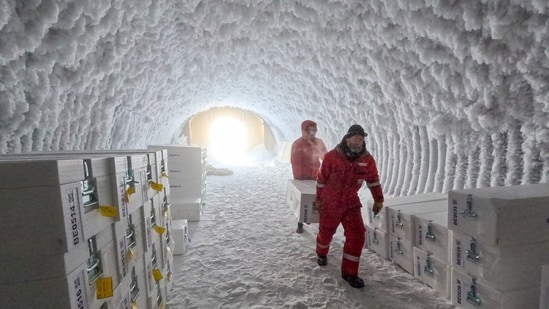
The same team previously drilled a core about 800,000 years old. The latest drilling went 2.8 kilometers (about 1.7 miles) deep, with a team of 16 scientists and support personnel drilling each summer over four years in average temperatures of about minus-35 Celsius (minus-25.6 Fahrenheit).
Italian researcher Federico Scoto was among the glaciologists and technicians who completed the drilling at the beginning of January at a location called Little Dome C, near Concordia Research Station.
{{/usCountry}}Italian researcher Federico Scoto was among the glaciologists and technicians who completed the drilling at the beginning of January at a location called Little Dome C, near Concordia Research Station.
{{/usCountry}}“It was a great moment for us when we reached the bedrock,” Scoto said. Isotope analysis gave the ice's age as at least 1.2 million years old, he said.
Both Barbante and Scoto said that thanks to the analysis of the ice core of the previous Epica campaign they have assessed that concentrations of greenhouse gases, such as carbon dioxide and methane, even during the warmest periods of the last 800,000 years, have never exceeded the levels seen since the Industrial Revolution began.
“Today we are seeing carbon dioxide levels that are 50% above the highest levels we’ve had over the last 800,000 years," Barbante said.
The European Union funded Beyond EPICA (European Project for Ice Coring in Antarctica) with support from nations across the continent. Italy is coordinating the project.
The announcement was exciting to Richard Alley, a climate scientist at Penn State who was not involved with the project and who was recently awarded the National Medal of Science for his career studying ice sheets.
Alley said advancements in studying ice cores are important because they help scientists better understand the climate conditions of the past and inform their understanding of humans’ contributions to climate change in the present. He added that reaching the bedrock holds added promise because scientists may learn more about Earth’s history not directly related to the ice record itself.
“This is truly, truly, amazingly fantastic,” Alley said. “They will learn wonderful things.”