The findings present what is the first significant global projection, taking into account population demography, social contact patterns and health care infrastructure as well as the infection and mortality rates seen in the Covid-19 pandemic till now.
Nearly 90% of the world’s population could become a Covid-19 patient this year and at least 40 million of them could die if there are no interventions to stop the pandemic, a projection released by the Imperial College of London showed on Thursday, underscoring the need to take strong steps against a pathogen that has already brought much of the world to a standstill.
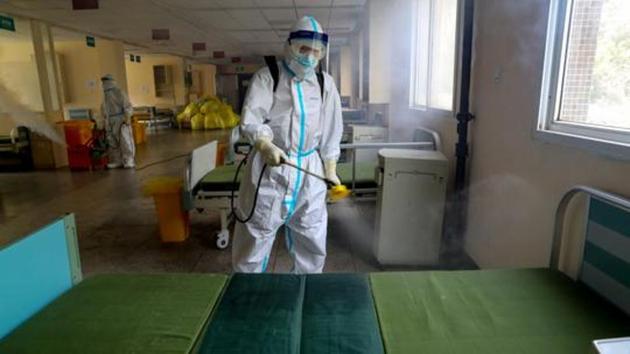
The virus, Sars-Cov-2, has infected close to 500,000 people and caused at least 22,000 fatalities till Thursday. (Reuters file photo)
{{^htLoading}} {{/htLoading}}
The findings present what is the first significant global projection, taking into account population demography, social contact patterns and health care infrastructure as well as the infection and mortality rates seen in the Covid-19 pandemic till now.
“The world faces a severe and acute public health emergency due to the ongoing Covid-19 global pandemic. How individual countries respond in the coming weeks will be critical in influencing the trajectory of national epidemics,” said the report by the Imperial College Covid-19 Response Team.
According to the report, in the absence of interventions – such as social distancing and shutting down of cities – the pandemic “would have resulted in 7.0 billion infections and 40 million deaths globally this year”.
The virus, Sars-Cov-2, has infected close to 500,000 people and caused at least 22,000 fatalities till Thursday.
{{^htLoading}} {{/htLoading}}
{{^usCountry}}
According to estimates, the current global population is 7.8 billion. The most severe pandemic in history was the 1918 H1N1 outbreak -- commonly known as the Spanish Flu -- which is estimated to have infected close to a third of the population at the time.
{{/usCountry}}
{{#usCountry}}
According to estimates, the current global population is 7.8 billion. The most severe pandemic in history was the 1918 H1N1 outbreak -- commonly known as the Spanish Flu -- which is estimated to have infected close to a third of the population at the time.
Binayak Dasgupta is a senior editor at Hindustan Times, New Delhi, where he has worked since 2013. He heads the paper's Page 1 team and is part of the editorial leadership overseeing daily news operations. He has previously led the national news desk. His work sits at the intersection of specialist depth and emerging public consequence — stories where complexity and nuance are in themselves the journalistic challenge. He shapes Hindustan Times's coverage and editorial positions on technology and artificial intelligence, information security, environment, health and science — steering these subjects from the commissioning of reporting to editing and the framing of the paper’s institutional view. His work spans analysis, commentary and reportage and in the past has led the paper's coverage of Covid-19 pandemic science. His interviews and hosted sessions include Nobel laureates, technology leaders, economists and climate justice scholars. In recent months, Binayak has overseen the coverage of the Air India Flight 171 crash and its investigation, India's energy exposure during the West Asia conflict, the trade dispute with the US, Delhi's air quality emergency and the evolving conversations around AI, including the IndiaAI Summit.
Get the latest World News, breaking headlines and global updates from the US, UK, Pakistan, Bangladesh, Russia and other countries. Follow major international events on Hindustan Times.
Get the latest World News, breaking headlines and global updates from the US, UK, Pakistan, Bangladesh, Russia and other countries. Follow major international events on Hindustan Times.