
DUBAI—After sitting out months of the Iran war, Yemen’s Tehran-backed Houthi rebels seized a crucial maritime chokepoint in a lightning offensive over the weekend that further imperiled global energy supplies and injected the group into any effort to resolve the conflict.
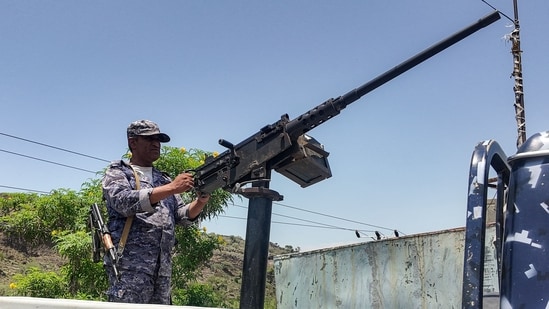
It’s an unusually prominent position for the group’s warlord leader, Abdulmalik Al-Houthi, who claims descent from the Prophet Muhammad and rules his impoverished territory through fear and religious fervor. But it’s one that reflects both the growing ambition of
DUBAI—After sitting out months of the Iran war, Yemen’s Tehran-backed Houthi rebels seized a crucial maritime chokepoint in a lightning offensive over the weekend that further imperiled global energy supplies and injected the group into any effort to resolve the conflict.
It’s an unusually prominent position for the group’s warlord leader, Abdulmalik Al-Houthi, who claims descent from the Prophet Muhammad and rules his impoverished territory through fear and religious fervor. But it’s one that reflects both the growing ambition of his 350,000-strong militant army and its prowess with military tactics, missiles and drones.
Last year, the Houthis survived an intense American bombing campaign with fierce tactics that exhausted the Navy on a long deployment that presaged the current difficulty suppressing Iran. This summer, they exploited divisions among their internal opponents and their Arab sponsors amid the distraction of the wider war to expand their domain. On Friday they took Perim Island, which sits in the middle of the strategic Bab al-Mandeb Strait, an 18-mile-wide chokepoint that is to the Red Sea what the Strait of Hormuz is to the Persian Gulf.
They had been preparing for the assault for months. In mid-August, they moved weapons and thousands of troops to positions around the port city of Mokha, threatening their opponents’ supply lines. They used their control of Yemeni telecoms systems to listen in on their enemies’ calls and to sow confusion and intimidate their rivals into giving up.
The world paid little attention to the group even after it captured the Yemeni capital, San’a, in 2014. Now, it holds one of the world’s most important energy corridors and has to be reckoned with.
“They feel they’ve won the civil war,” said Elisabeth Kendall of Cambridge University’s Girton College, who has long studied Yemen. “They aren’t afraid of the United States, and most importantly they’re pretty adaptive.”
The Houthis first emerged in the 1990s as significant players in Yemen, a country of about 40 million people on the Arabian Peninsula’s southern tip. They later leaned on their religious pedigree, a history ruling northern Yemen and harsh repression to expand their territory in the wake of the Arab Spring.
They fought off intervention by Saudi Arabia and the United Arab Emirates during Yemen’s civil war—using cheap drone and missile technology with funding and support from Iran—and consolidated their control over about a third of the country.
After mobilizing in recent weeks, the Houthis seized Mokha on Thursday. The next day they took the strategically located Perim Island.
Disrupting the flow of oil out the waterway would cripple Saudi oil exports already bottled up in Hormuz, and risk spiking global oil prices.
For years, forces allied to the U.A.E. had operated on Perim Island and the surrounding area. But a dispute in December between Saudi Arabia and the U.A.E. over their positions in Yemen frayed the anti-Houthi alliance. The kingdom bombed a weapons shipment from the U.A.E. after it arrived in Yemen for some of the Houthis’ rivals, and the U.A.E. withdrew from the war.
Mohammed al-Basha, a Yemen expert who runs the Basha Report risk advisory firm, said the anti-Houthi coalition—which includes fighters who want to see a separate nation in southern Yemen, as well as others aligned with the Muslim Brotherhood and former government forces—is up against a tough, unified opponent.
“The Houthis have one leader, one ideology and a clear vision,” Basha said. “The anti-Houthi forces have eight armies and multiple commands.”
Amr al-Bidh, an official with Yemen’s Southern Transitional Council, which had been backed by the U.A.E. and supports south Yemen becoming its own nation, accused Saudi Arabia of mishandling the campaign.
A de facto ceasefire in the war had existed for years, with Saudi Arabia providing funding for Yemeni state employees. Saudi energy officials told The Wall Street Journal in April the kingdom had secured commitments from the Houthis not to attack the kingdom or its ships.
When that understanding broke down, Saudi Arabia, focused on Iran, hesitated. The kingdom’s leaders worried about getting enmeshed again in Yemen after thousands of bombing runs during the civil war failed to dislodge the group and led to attacks on its own energy infrastructure.
Anti-Houthi Yemeni officials said Saudi Arabia failed to answer their pleas for airstrikes to support their defense, allowing the Houthis to win.
The pressure has grown on the Saudis. Last week, a drone attack that Saudi Arabia believes came from Iraq struck the kingdom’s crucial East-West pipeline. With the Strait of Hormuz under attack by Iran and the Houthis in control of the Bab al-Mandeb, Saudi Arabia’s enemies are increasing.
“It’s one thing to fight the Houthis, and it’s one thing to fight on three front lines,” said Farea Al-Muslimi, a research fellow at Chatham House.
Untangling the Houthis’ control of Perim Island at the mouth of the Red Sea again may force international powers into Yemen’s long war.
So far, the U.S. doesn’t appear eager to intervene after bombing the Houthis for more than 50 days during Operation Rough Rider in 2025. President Trump said Saturday that the Houthis had asked Washington not to intervene and that the situation would be worked out.
Even if the Houthis are pushed off the island or further away from the Red Sea, they maintain an arsenal of drones and missiles capable of holding the waterway at risk. That mirrors the Iranian strategy in the current stalemate in the Strait of Hormuz.
“They are always going to be able to hold bits of the Red Sea to ransom,” Kendall said. “The world only pays attention when it affects their wallets.”
Write to Summer Said at summer.said@wsj.com and Saleh al-Batati at reports@wsj.com
One Subscription.
Get 360° coverage—from daily headlines
to 100 year archives.
Archives
HT App & Website