
A Russian barrage of missiles and drones hit a children’s hospital, a school, apartments and warehouses around Kyiv last week, killing at least 16 people. Ukraine, lacking Patriot interceptors, didn’t shoot down any of Russia’s ballistic missiles.
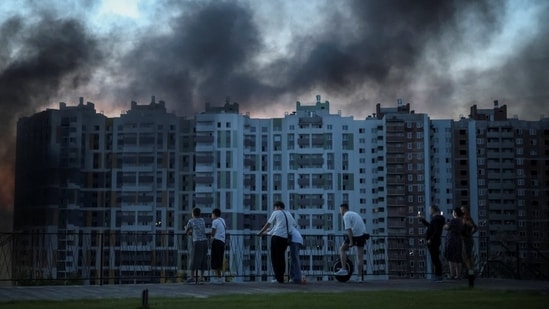
Ukraine’s response this week included a drone strike that caused a massive fire at one of Russia’s largest oil refineries, near Nizhny Novgorod, on Wednesday. Meanwhile, in the central Russian region of Tambov, a warehouse belonging to e-commerce giant Wildberries burned.
The air
A Russian barrage of missiles and drones hit a children’s hospital, a school, apartments and warehouses around Kyiv last week, killing at least 16 people. Ukraine, lacking Patriot interceptors, didn’t shoot down any of Russia’s ballistic missiles.
Ukraine’s response this week included a drone strike that caused a massive fire at one of Russia’s largest oil refineries, near Nizhny Novgorod, on Wednesday. Meanwhile, in the central Russian region of Tambov, a warehouse belonging to e-commerce giant Wildberries burned.
The air war between Russia and Ukraine has entered a new phase. With expanded aerial arsenals and inadequate air defenses, both sides are bludgeoning each other in a bare-knuckle fight that is causing a widening swath of destruction and a rising civilian toll.
Moscow is betting that it can crush the will of Ukraine’s civilian population, giving it the breakthrough that has eluded its army in eastern Ukraine. Kyiv is trying to make Russia’s invasion unsustainable by crippling the industries that underpin its economy.
Yet neither side appears to be close to breaking. The war is getting more ruthless and destructive—but no closer to ending.
Russian President Vladimir Putin threatened to expand the range of targets in Ukraine in response to Kyiv’s strikes on its oil industry. “The Kyiv regime set out to damage our economy. What did it do? It opened this Pandora’s box itself,” he said last week.
Russia’s strategy of pain
Russia’s and Ukraine’s long-range air campaigns both use drones and missiles, but their strategies are different.
Russia began a systematic campaign against Ukraine’s energy infrastructure in the fall of 2022, when its invasion had stalled and its army had suffered a series of setbacks. Moscow pivoted to plunging Ukrainian cities into cold and darkness as winter approached.
For four winters in succession, it hasn’t worked. Ukrainians have managed to defend, repair or replace enough of their heating and electricity supply to keep their cities going. But each year, the cumulative damage to Ukraine’s energy grid has grown.
The lack of Patriot interceptors—in short supply globally since the U.S.-Iran war—is darkening the mood in Kyiv. Russia’s long-range strikes have killed hundreds of Ukrainian civilians this summer, with Iskander-M ballistic missiles doing much of the killing.
Many residents of Kyiv fear Russia will try to destroy the city’s water and sewage systems, as Moscow looks for new ways to create a humanitarian crisis. Some in Kyiv are discussing whether to move temporarily to the countryside if conditions in the capital get too bad this winter. Few believe Russia will achieve victory this way.
“The theory is that pain plus exhaustion produces political capitulation,” said Franz-Stefan Gady, a Vienna-based military analyst and head of Gady Consulting. But experience since 2022, “and a century of strategic bombing before that, say sustained air attack hardens societies rather than breaking them, and there is nothing in the Ukrainian data suggesting otherwise,” he said.
Surveys suggest the Ukrainian public has become more opposed in recent months to making territorial concessions to Moscow.
Hunting missile launchers
Russia’s strikes have failed to stop the rapid growth of Ukraine’s defense-technology sector, which is now churning out millions of drones a year in decentralized and well-hidden facilities.
With only a trickle of Patriot interceptors arriving from Western allies, Ukraine is working on other ways to disrupt Russia’s missile salvos.
Ukrainian drones have been destroying air defenses in neighboring regions of southern Russia, potentially paving the way for a larger-scale effort to hunt down Russian missile launchers—including for the relatively short-range Iskander-Ms.
“If the airspace is cluttered with drones, it could force missile launchers to hide, or push them further back,” said Rob Lee, a Kyiv-based military analyst and a senior fellow at the Foreign Policy Research Institute in Philadelphia. “It’s not a 100% solution, but it could make things more difficult for Russia.”
Ballistic missiles aren’t the only threat, Lee noted. Russia is building up its arsenal of jet-powered drones such as the Geran-5, based on the Iranian Shahed, and the relatively low-cost Banderol cruise missile. Both are cheaper than regular missiles, allowing for large-scale production, and could further stretch Ukraine’s air defenses, he said.
The czar unmoved
Ukraine’s long-range capabilities have risen dramatically over the past year. Its deep-strike campaign has widened from oil refineries, energy-export infrastructure and missile-component factories to Black Sea shipping and the warehouses of Russia’s biggest e-commerce chains, Wildberries and Ozon. The strikes are killing civilians, although not on the same scale as Russia’s.
Kyiv’s declared aims are to hit military supply chains, cut off the export revenues that fund Moscow’s war machine, and cause widening economic disruption that makes the war visible to Russia’s population.
Yet most observers of Russia doubt that discontent among the country’s population or its business elite will move Putin to accept a ceasefire. He is betting he can suppress dissent, and that the economy can absorb the pain for longer than Ukraine can.
“The effects of the long-range strike campaign on Russian society and the Russian economy would have to get a lot worse for it to be anywhere close to changing Putin’s calculus,” said Hanna Notte, a Russia expert at the James Martin Center for Nonproliferation Studies in Monterey, Calif.
Although a few Russian analysts have said recently that Moscow can’t achieve its war aims in Ukraine, “they were less driven by the effects of the long-range strike campaign, and more worried about the lack of movement at the front,” said Notte.
The decisive variable in the war remains military manpower, said Gady, including whether Putin will launch a large-scale mobilization in the coming months to redouble his ground campaign.
“Long-range strike is what both sides do because it is the one domain where they can still act when the ground war is stalemated,” he said. “It will get steadily more destructive without being decisive.”
Write to Marcus Walker at Marcus.Walker@wsj.com
One Subscription.
Get 360° coverage—from daily headlines
to 100 year archives.
Archives
HT App & Website