
SEOUL—President Trump returned to an old playbook this weekend to break a yearslong stalemate with North Korea, ordering cuts to annual military exercises with South Korea that began Monday.
But things have changed for Kim Jong Un—and for the U.S. military.
Trump, touting his personal relationship with the North Korean leader, ordered reductions to the drills on Sunday, as he did during his first term to advance nuclear talks with Kim.
The move is riskier now. North Korea’s military is
SEOUL—President Trump returned to an old playbook this weekend to break a yearslong stalemate with North Korea, ordering cuts to annual military exercises with South Korea that began Monday.
But things have changed for Kim Jong Un—and for the U.S. military.
Trump, touting his personal relationship with the North Korean leader, ordered reductions to the drills on Sunday, as he did during his first term to advance nuclear talks with Kim.
The move is riskier now. North Korea’s military is a significantly more powerful threat to the U.S. and its allies than it was when Trump suspended the drills in 2018.
Since then, North Korea has expanded its nuclear arsenal, increased missile production, and acquired battlefield experience and technology after sending troops to assist Russia in its war against Ukraine. With help from Russia and China, North Korea’s economy has experienced growth despite global sanctions.
With these gains under his belt, Kim has so far spurned all of Trump’s diplomatic overtures since the president returned to the White House.
At the same time, the demands of the U.S. war with Iran have raised concerns among some in Asia that U.S. security forces are overstretched, impairing their ability to deter China and North Korea.
Soon after the war began, the U.S. shifted dozens of missile interceptors and other assets from South Korea to the Middle East, The Wall Street Journal reported.
Most recently, the war is pulling away a key American warship, as the Pacific-based aircraft carrier USS George Washington heads toward the Middle East to replace the USS Abraham Lincoln. Whether the U.S. has adequate munitions to escalate the conflict in Iran remains a topic of debate in Washington, although the White House has maintained that the U.S. has enough for any operation.
U.S. allies in Asia are already under pressure from the Trump administration to shoulder a greater share of the security burden.
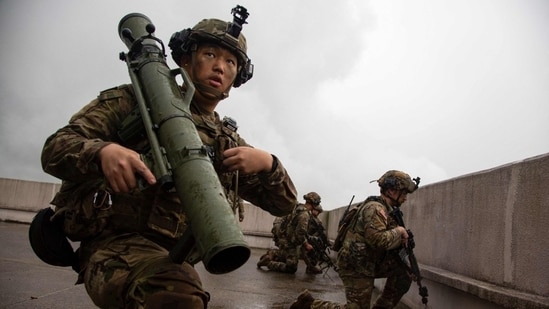
The annual joint exercises with South Korea, a display of Washington and Seoul’s military alliance, began without signs of any immediate cutbacks. The South Korean government said it was cooperating with the U.S. on the drills and hoped that the “friendly relationship” between Trump and Kim would lead to meaningful dialogue.
Since last year, South Korean President Lee Jae Myung has suggested scaling back the joint exercises to improve the chances for engagement with North Korea. Kim says the U.S. must accept North Korea as a nuclear state before any dialogue begins.
But Trump’s order on the eve of the 11 days of exercises has raised concerns among military officials and advisers about undermining military readiness.
A reduction in joint drills would lower Washington’s ability to deter China and North Korea while failing to assure allies that the U.S. is a credible partner, said Mark Montgomery, a retired U.S. Navy rear admiral.
“This was a mistake in 2018 and it’s a bigger mistake in 2026,” said Montgomery, who is now a senior fellow at the Foundation for Defense of Democracies think tank. “Kim Jong Un is more powerful now because of the technology and equipment he’s gotten from Russia.”
In 2018, Trump suspended the joint drills with South Korea during a summit with Kim as a concession to move forward in denuclearization talks. He scaled down other exercises the following year.
On Saturday, Trump posted on social media a photo of Kim and himself during a 2019 meeting at the inter-Korean borde. “Despite the unfriendly look on this particular picture, there are many where we’re smiling, Kim Jong Un and I get along GREAT!” he wrote.
That was their last meeting before talks fell through.
Trump said in a separate post on Sunday that the joint drills with South Korea were costly and provocative—another repetition from his first term. He said that North Korea had been “unthreatening and respectful” and that South Korea failed to help the U.S. in its fight with Iran. South Korea said Monday that it was in discussions with the U.S. about contributing in Iran.
North Korea has consistently referred to the U.S.-South Korea drills as hostile. On Thursday a spokesperson for North Korea’s foreign ministry called the exercises a “rehearsal for an aggressive war” that posed a grave threat to Pyongyang’s security.
This year’s joint drills already feature fewer battalion-level field-training exercises than last year. It wasn’t immediately clear where the Pentagon would reduce the drills now that they have begun.
Despite concerns, military cooperation between the U.S. and its partners in Asia has remained robust. At the recent biennial “Rim of the Pacific” exercise, U.S. allies turned out in record numbers.
Trump’s last-minute announcement raises questions about whether major alliance decisions are coordinated, said Chun In-bum, a retired lieutenant general and former special-forces commander of the South Korean army.
“Trump’s statement raises concerns among U.S. allies in Asia about the predictability of American security commitments,” Chun said.
Ahead of the joint exercises, U.S. and South Korean officials said they would incorporate responses to lessons drawn from North Korea’s troop deployment to Russia, including drone tactics that Pyongyang has acquired on the battlefield.
The United Nations Command has sent around 70 personnel from 12 member states to support the drills. At a briefing last week, UNC’s deputy commander Lt. Gen. Scott Winter said this year’s drills would be “bigger and better than ever.”
Write to Dasl Yoon at dasl.yoon@wsj.com
One Subscription.
Get 360° coverage—from daily headlines
to 100 year archives.
Archives
HT App & Website