...
...
Next Story

US moves authorizing force resolution in UNSC to counter Russia

The US, France and UK expect that all the members of UNSC except Russia support the chapter 7 tough resolution and will get it passed later in General Assembly.

Published on: Feb 25, 2022, 10:26:14 IST
Advertisement

US-led west has moved a tough “chapter 7” resolution in the UNSC which authorizes the use of force to NATO to counter the Russian invasion of Ukraine. The resolution, which will be put to vote around 1500 hours Eastern time, will be vetoed by Russia, which apart from being a permanent member, is the President of UNSC this month.
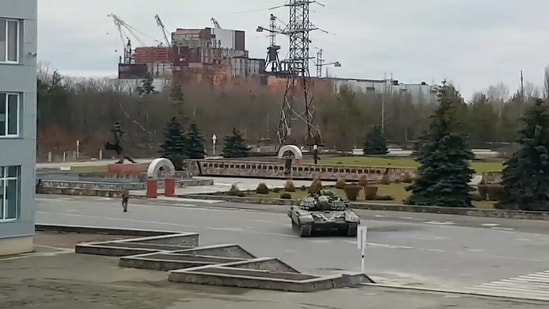
Russian T-72 tank outside devastated Chernobyl nuclear plant in Ukraine on Thursday. (Getty Images)

According to diplomats based in New York, the US-led West has moved a very tough resolution under chapter seven that authorizes force rather than chapter six resolution that aims for a peaceful settlement. The US supported by UK and France are doing heavy diplomatic lifting within the 15-member UNSC to ensure that all members except for Russia vote for the resolution. With China likely to abstain from voting and India still undecided on its vote, US Secretary of State Antony Blinken is pressing hard on both countries to vote in favour of the resolution and isolate Russia.

It is understood that after the Russian veto, the US has plans to get the resolution passed through the General Assembly, where no veto can be exercised. It is quite evident that the tough resolution will pass muster of the General Assembly as Russia, despite the complexity of the crisis and its historic legacy, has violated international norms of sovereignty and territorial integrity apart from rule of law and UN charter.

While Prime Minister Narendra Modi has appealed for an immediate cessation of violence and concerted effort to return to the diplomatic table in his telephonic conversation with Russian President Vladimir Putin on Thursday evening, there is no let-up in Russian military operations in Ukraine. India on its part is still debating on the draft resolution but is very clear on the issue of sovereignty and territorial integrity apart and is opposed to might is right doctrine. The Modi government is all for rules-based international order despite the fact that Ukraine has been an arms and tank supplier to both Pakistan and China. President Putin’s invite to Pakistan PM Imran Khan at the height of the Ukraine crisis and the developing defence relationship between the two has been noted by New Delhi. Ukraine had criticised India after the Pokharan II Shakti series tests in 1998.

Russian ambivalence in the UNSC after Pakistan through China tried to force a resolution against India post abrogation of Article 370 in August 2019 is also not so distant development.

Although the jury is out on what stand India takes on the UNSC resolution, it is quite clear that India will side with protecting the sovereignty and territorial integrity of Ukraine in the explanation of the vote.

 
ABOUT THE AUTHOR
Shishir Gupta

Shishir Gupta is Executive Editor at Hindustan Times and one of India's top journalists covering national security, strategic affairs, foreign policy and geopolitics. Over the past three decades, he has extensively reported on India's military, diplomatic and security landscape, covering every major conflict and national security challenge, from the 1999 Kargil War and the 2020 East Ladakh standoff to Operation Sindoor in 2025. He has also covered major terror attacks, including the IC-814 hijacking, the 26/11 Mumbai attacks and the 2025 Pahalgam terror strike, along with numerous Pakistan-backed terrorist incidents in the Kashmir Valley and across India. He has reported on national and state elections for more than three decades. A recognised authority on strategic affairs, Gupta has covered India's nuclear programme since the Pokhran-II (Shakti series) tests in May 1998 and has written extensively on global nuclear issues, Indian diplomacy and the country's expanding global outreach. He has also reported widely on international conflicts and terrorism, with a special focus on the Indian subcontinent. Gupta has interviewed Prime Minister Narendra Modi more than four times, including Modi's first interview with the print media after becoming Prime Minister in May 2014. His other interviews include three with the Dalai Lama, as well as conversations with Benjamin Netanyahu, Amit Shah, Yogi Adityanath, S. Jaishankar, Nirmala Sitharaman and Piyush Goyal. He is the author of Indian Mujahideen: The Enemy Within (Hachette, 2011) and Himalayan Face-off: Chinese Assertion and Indian Riposte (Hachette, 2014). He was awarded the Chevening-Wolfson Joint Scholarship at Wolfson College, University of Cambridge, UK, in 1998 and participated in the International Visitor Leadership Program (IVLP) of the US State Department in 2006. He received the Ben Gurion Prize from Israel in 2011 and the K. Subrahmanyam Prize for Strategic Studies in 2015 from the Manohar Parrikar Institute for Defence Studies and Analyses (MP-IDSA). Since 2024, he has hosted Point Blank, Hindustan Times' weekly YouTube show on global geopolitics.

Get the latest World News, breaking headlines and global updates from the US, UK, Pakistan, Bangladesh, Russia and other countries. Follow major international events on Hindustan Times.
SHARE THIS ARTICLE ON
Hindustantimes wants to start sending you push notifications. Click allow to subscribe