
Lip-Bu Tan was anxiously preparing for the biggest meeting of his life.
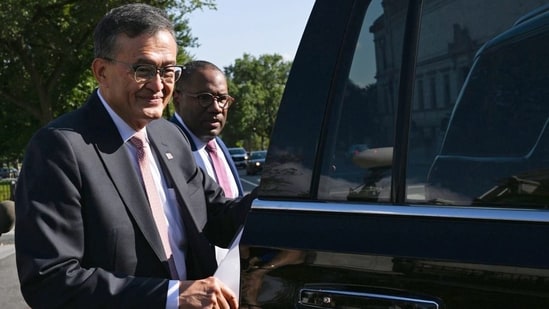
Just five months into his tenure as chief executive of Intel, Tan was already fighting for his job. A few days earlier, Donald Trump had demanded he step down over his past ties to the Chinese military.
The demand sent Intel’s leadership into a panic. They immediately contacted the White House for a meeting, and Tan flew to Washington, huddling with his advisers for hours on Sunday, Aug.
Lip-Bu Tan was anxiously preparing for the biggest meeting of his life.
Just five months into his tenure as chief executive of Intel, Tan was already fighting for his job. A few days earlier, Donald Trump had demanded he step down over his past ties to the Chinese military.
The demand sent Intel’s leadership into a panic. They immediately contacted the White House for a meeting, and Tan flew to Washington, huddling with his advisers for hours on Sunday, Aug. 10. His team reassured him that the president would hear him out because “Trump loves meetings with CEOs,” even those whom he has attacked publicly, according to people with knowledge of the conversations.
The next day, Tan met with Trump, Commerce Secretary Howard Lutnick and Treasury Secretary Scott Bessent in the Oval Office. He sought to convince the president that he wasn’t a Chinese spy and that the U.S. government has a long-term interest in bolstering Intel, one of the only homegrown manufacturers of the computer chips that power the modern economy.
The CEO’s argument proved persuasive. The president also took a liking to Tan, a Malaysia-born, Singapore-raised U.S. citizen who once considered a career as a professional basketball player, and backed off his demand for the CEO’s ouster.
But the truce came with a cost: In return for Trump’s support, the administration proposed taking an equity stake in the company. It decided to convert nearly $9 billion in grants—promised to Intel as part of the 2022 Chips Act—into a 10% equity stake in the company, an unusual arrangement that makes the government Intel’s biggest shareholder.
The meeting was the pivot point in a frenzied period for Intel, once one of America’s most venerated technology companies, now stuck in a yearslong downward spiral. The company’s scramble to control the fallout from the president’s demand that Tan step down—triggered by a Fox Business Network segment—underscores the unpredictable environment major corporations face under Trump.
By the end of the two-week roller-coaster ride, Tan’s job appeared to be secure and the company’s situation more stable. Japan’s SoftBank Group agreed to invest $2 billion, seeking to curry favor with Trump. On Friday, Intel and the White House officially revealed the terms of the deal.
“He came in, he saw me, we talked for a while. I liked him a lot, I thought he was very good,” Trump said of Tan from the Oval Office. “I said, ‘You know what? I think the United States should be given 10% of Intel.’ And he said, ‘I would consider that.’”
Yet a host of questions remain.
Tan must resolve core business challenges to get his company on track. Some analysts say Intel isn’t in a much better position. Without new commitments from customers, converting government grants to stock will only leave the company in a worse financial shape by diluting shareholders. Trump will likely need to find more ways to support Intel, not wanting it to fail on his watch.
“Intel needs a lot of help, and the U.S. needs Intel,” said Jimmy Goodrich, a senior adviser to the think tank Rand who focuses on tech issues. “Hopefully something good is going to come out of this.”
This account is based on interviews with current and former Intel and industry executives, administration officials, lobbyists and company advisers.
‘Left behind’
Intel was founded in 1968 by semiconductor pioneers Robert Noyce, who co-created the modern computer chip, and Gordon Moore, originator of Moore’s Law—the idea that computing power and chip efficiency would likely double every year or two, a guiding principle in the tech revolution. By the 1990s, Intel dominated the market for processors used in personal computers. Its Pentium line and “Intel Inside” marketing campaign, with dancers in multicolored clean-room suits, made the company a household name.
Then came a series of strategic missteps. The company largely missed out on the mobile-phone and artificial-intelligence booms by overemphasizing short-term financial targets, analysts say. Rivals in chip design like Nvidia and manufacturers such as Taiwan Semiconductor Manufacturing surged ahead.
The company is still seen as key to reviving U.S. manufacturing. In his first term, Trump touted Intel’s plans for a $7 billion manufacturing plant in Arizona. Trump advisers began discussing what became the Chips Act, wanting to attract companies such as TSMC to the U.S.
As discussions on the Chips Act crescendoed during the Biden administration, Intel CEO Pat Gelsinger lobbied aggressively, hoping for some of the law’s tens of billions of dollars in subsidies. In 2022, he sat in the first lady’s box for the State of the Union speech, during which President Biden touted Intel’s investment plans.
While the bill was being negotiated, senators including Bernie Sanders (I., Vt.) and Elizabeth Warren (D., Mass.) pushed unsuccessfully for a version that would see the government receiving equity in companies it backed.
Intel became the law’s biggest beneficiary, qualifying for roughly $11 billion in grants and about $11 billion in loans for a plant in Ohio, an expansion in Arizona and other projects.
It seemed like a boon at the time, but the law’s slow rollout and Intel’s core business challenges led to repeated delays. Late last year, Tan, who had been an Intel director since 2022, left the board in protest of Gelsinger’s strategy. The board also soured on Gelsinger and pushed him out.
Trump’s 2024 victory presented another curveball. He had bashed Biden’s implementation of the Chips Act, fueling worries that he could try to change deals or cancel them altogether. Intel’s financial condition worsened, and the incoming administration worried the company might fail.
Even with the recent share-price rebound in August following reports of the deal with Trump, the company is now valued at about $110 billion, a fraction of its dot-com bubble peak. The stock is down roughly 50% since the start of last year.
“Intel has been left behind,” Trump said Friday.
‘No more blank checks’
Around Trump’s inauguration in January, Lutnick and administration officials began evaluating Chips Act recipients and which tech companies generally could increase their U.S. investments in line with the president’s goals. They asked semiconductor companies receiving Chips Act awards to increase their total U.S. investment but knew they might need to revamp Intel’s deal or help the company in other ways.
The administration began early conversations with Intel’s board about taking an equity stake. The talks didn’t move forward in part because the board, which has often been mired in disagreement, wanted more than the administration was willing to give.
A former banker, Lutnick has in recent months asked other tech executives what can be done to help Intel, even asking other chip companies like TSMC, Advanced Micro Devices and Micron whether they would consider potential deals involving the company.
In March, Intel’s board named Tan, 65, as CEO. One of the biggest decisions he faces is whether to keep the company as one of the few chip firms that does both design and manufacturing. Some analysts say Intel should consider splitting the businesses or doing other types of deals to cut costs.
Tan has so far shied away from spinning off the manufacturing segment, which lost $3.2 billion in the second quarter. He has told confidants he “inherited a very bad hand.”
In July, Intel said it would lay off 15% of its workforce by year-end, cancel billions in planned investments and further delay work on the sprawling Ohio plant. The new rules of the road were “no more blank checks,” Tan wrote in a memo to employees.
Making a deal
Tan’s early decisions at Intel were aimed at getting the company on more stable ground. But the CEO’s past work at chip-design software company Cadence Design Systems thrust the company into the spotlight.
In late July, Cadence agreed to pay $140 million for violating U.S. export restrictions by selling banned technology to a Chinese national defense university. The sales happened while Tan was CEO. A week later, Sen. Tom Cotton (R., Ark.) sent a letter to Intel’s board raising concerns about Tan’s ties to China.
Trump was watching Fox Business Network on Aug. 7 when host Maria Bartiromo highlighted Cotton’s criticism at 7:34 a.m. ET. Five minutes later, Trump fired off a message on his Truth Social platform: “The CEO of INTEL is highly CONFLICTED and must resign, immediately.”
It was one of the first times in modern history that the president publicly called for the leader of a major company to step down. Trump’s demand was seen by some on both sides as an “opening bid” in negotiations with the CEO.
The president had already grown intrigued by the idea of government stakes in key industrial companies during his May trip to the Middle East, a senior White House official said. Though the official added that wasn’t what sparked Trump’s post, the president wants to see more such deals in the future.
In the Oval Office, Tan told the president his ties to Chinese businesses were years in the past and he was loyal to the U.S. He presented ideas for turning Intel around and investing more in the U.S.
Lutnick told Tan he thought it was dangerous to have so much of the global chip-making capacity controlled by foreign companies. Tan agreed, and reiterated that he was dedicated to Trump’s “America First” manufacturing agenda.
By the end of the hourlong discussion, the president was convinced—and agreed to lay off the criticism.
Tan and Lutnick then moved quickly to hammer out a deal for the government to take a minority stake in Intel. It was a complicated negotiation because it is unusual to convert government grants that have already been awarded into equity.
While they were in talks, SoftBank, led by storied tech investor Masayoshi Son, suddenly agreed to put $2 billion into the company, part of its campaign to bet on U.S. firms and appeal to Trump. SoftBank had already pledged to spend at least $100 billion in the U.S. on AI and other tech investments, a move announced by Son at Trump’s Mar-a-Lago club last December. SoftBank had also earlier this year discussed a potential deal to acquire Intel’s chip-manufacturing business.
Intel and the U.S. soon agreed the government would use $8.9 billion in grants that had been committed but not paid to take a nearly 10% equity stake at a slight discount. The U.S. won’t have a say in governance. It already gave Intel $2.2 billion in Chips Act grants.
David Shapiro, a former partner at the Wall Street law firm Wachtell, Lipton, Rosen & Katz, drew up the terms, including a provision that the government could acquire another 5% of Intel at a discount if the company sells the majority of its manufacturing business.
The administration insisted on the provision as a type of “poison pill” meant to dissuade the company from fully exiting the manufacturing segment. If Intel were to give the government another 5%, it would further dilute shareholders and complicate the company’s finances.
Finding customers
Despite the initial optimism, many analysts say the agreement will only be a boon for Intel if Trump can also help find customers and attract more investment for the company.
SoftBank’s $2 billion and the $8.9 billion government funding that had already been promised aren’t game-changing in the chip-manufacturing business. “In the grand scheme of things, it’s not that much money,” Bernstein Research analyst Stacy Rasgon said.
The agreement is fueling speculation that the president could lean on other tech companies to work with Intel. Tan has met with potential customers including Apple CEO Tim Cook, trying to win support for Intel’s next-generation manufacturing process. Trump recently praised Cook and Nvidia CEO Jensen Huang for investing in their U.S. operations.
The administration’s priority is helping the company start manufacturing the most advanced chips in the U.S. as soon as possible. That will likely include outreach to major customers. Tan has said Intel can’t invest in its most sophisticated chipmaking technologies until it has secured major commitments from customers. Doing so could prove difficult.
Many executives say they would need big incentives to use Intel for manufacturing given how badly it trails industry leaders like TSMC. It is difficult to switch semiconductor manufacturers because the processes are specialized and have to be planned out years in advance.
The government’s stake in Intel is the latest in a series of extraordinary interventions in the private sector launched by the administration.
The president won a “golden share” of control over Japan’s Nippon Steel in return for allowing it to take over U.S. Steel. And last month, Trump struck a deal with Nvidia and Advanced Micro Devices for the federal government to take 15% of their chip sales to China in return for allowing the exports.
In early July, the Defense Department took a minority stake in MP Materials, a maker of rare-earth magnets. Days later, Apple, which the Trump administration had long pressured to expand its U.S. supply chain, announced a $500 million deal to buy MP’s products.
But the Intel stake is among the most notable given Trump called for Tan to resign, then quickly brought him to the negotiating table.
“There’s this Darth Vader aspect of the whole thing,” said Gautam Mukunda, a lecturer at the Yale University School of Management who studies innovation and leadership, referring to the “Star Wars” villain who started as good, became evil, then redeemed himself.
“If your situation with the administration can swing so radically in such a short span of time based on nothing more than a meeting, then it can always swing back,” he said.
On Friday, as Tan posed smiling for a photo with Lutnick at the Commerce Department, the CEO “had a real pep in his step,” according to someone who saw him that day.
As the pair gathered in the Oval Office in front of the president to sign the documents formalizing the government’s stake, Trump proposed signing them as well, an unusual suggestion. The two men agreed, and the president added his autograph in large script, saying he hoped he could help “make Intel great” again.
Write to Robbie Whelan at robbie.whelan@wsj.com, Amrith Ramkumar at amrith.ramkumar@wsj.com, Lauren Thomas at lauren.thomas@wsj.com and Josh Dawsey at Joshua.Dawsey@WSJ.com
One Subscription.
Get 360° coverage—from daily headlines
to 100 year archives.
Archives
HT App & Website