E-Paper


Oil Tycoons Bet Big on Trump. It’s Paying Off.
The Trump administration has opened land to drilling and is moving to roll back environmental restrictions and hobble renewable energy.


Oil billionaire Harold Hamm high-fived Donald Trump on election night as results trickled in at the Mar-a-Lago watch party.
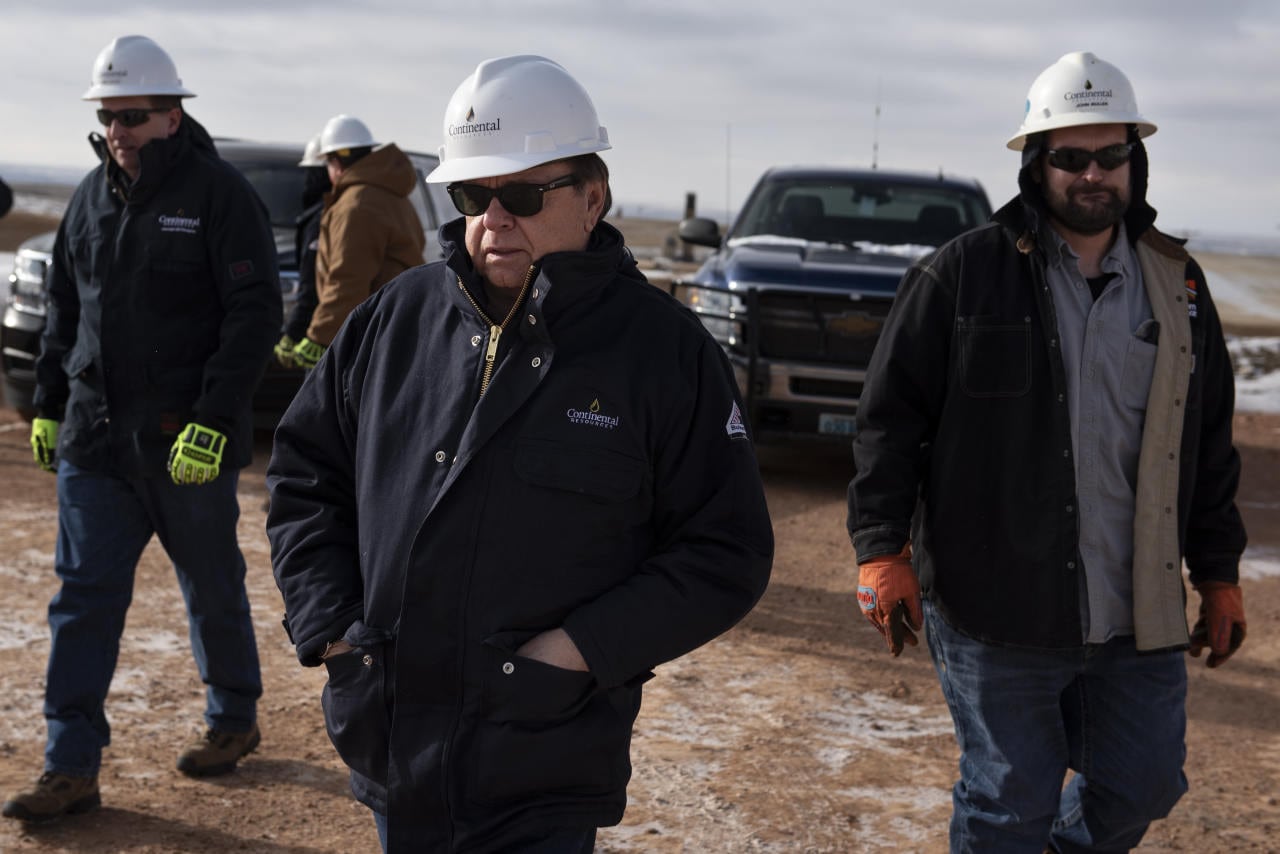
Hamm, founder of family-owned oil-and-gas company Continental Resources, had good reason to celebrate. He and other oilmen had donated tens of millions of dollars to help re-elect Trump, betting that his pro-fossil-fuel agenda would stave off a long-term shift away from fossil fuels and keep the country hooked on gasoline.
That wager is paying off. The Trump administration is opening swaths of wilderness land and federal waters to drilling, approving new terminals to export natural gas and proposing to ax environmental regulations, including an Obama-era rule used to curb emissions from power plants, tailpipes and oil-and-gas production. His One Big Beautiful Bill is expected to hobble renewable-energy projects and stunt the adoption of electric vehicles.
Oil executives now enjoy extraordinary access to the White House. Trump has taken to phoning oil bosses whose TV appearances he enjoys, such as Chevron CEO Mike Wirth, according to White House and industry officials.
“No doubt, this administration understands how important energy is,” said Toby Rice, CEO of natural-gas producer EQT. Rice and Exxon Mobil CEO Darren Woods sat at Trump’s table during a July energy summit in Pittsburgh.
So far, however, the industry’s policy wins haven’t flowed through to the companies’ bottom lines. Trump’s shifting positions on trade, coupled with an increase in crude supplies globally, have depressed oil prices, cost energy firms billions of dollars in stock-market value and contributed to layoffs across the industry. And new tariffs on steel and aluminum are making drilling more expensive.
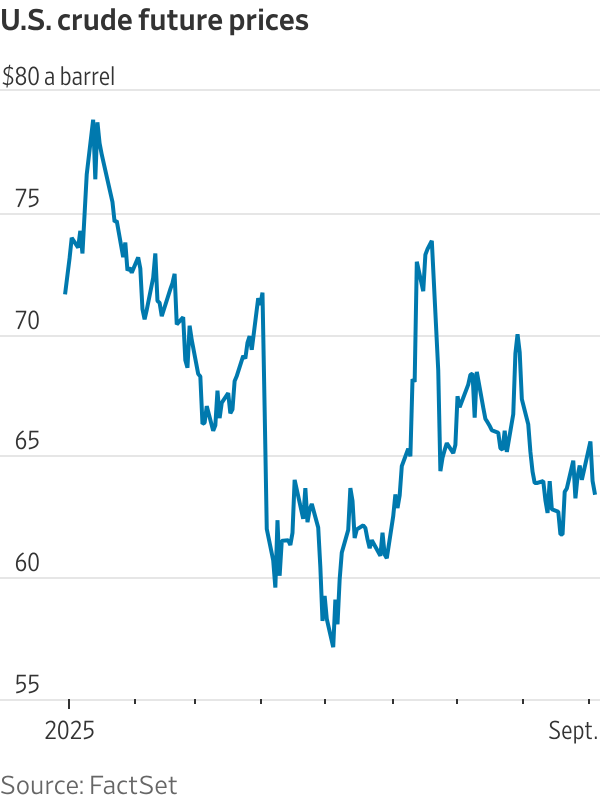
U.S. oil prices are hovering near $62 a barrel—below the break-even point for many of the industry’s smaller players—down from about $76 the week Trump took office. Yet some oil bosses see the turbulence as a price worth paying to see the president implement their agenda.
White House spokeswoman Karoline Leavitt said the oil-and-gas industry is the backbone of the American economy and the source of “millions of good-paying jobs,” and that the president is delivering on his promise to “make America energy dominant again.”
Trump’s unabashed support for the industry has left environmentalists aghast. They contend the administration’s moves will translate into higher energy prices for consumers, fuel climate change and make the U.S. less competitive with other nations that are embracing renewable energy.
Big asks
Hamm, Energy Transfer Executive Chairman Kelcy Warren and Liberty Energy’s then-CEO Chris Wright—now Trump’s energy secretary—were some of the top oil executives who hosted fundraisers for Trump during the campaign. Among other things, they wanted the next president to open up new markets by supporting new pipelines and terminals, to end subsidies for electric vehicles and to kill tailpipe emissions regulations.
Before the election, Warren told investors he was banking on finally completing Lake Charles LNG, a Gulf Coast terminal his company had sought to build for more than a decade. Warren donated more than $13 million to Trump’s bid.
After Trump became president, he lifted a pause former President Joe Biden had imposed on new LNG exports, and the Energy Department last month granted the project a permit extension that the previous administration had denied. Warren and his company each gave $12.5 million after the election to the Trump-aligned MAGA Inc. super political-action committee.
Trump’s tax-and-spending legislation will end subsidies of up to $7,500 for purchasing or leasing an EV. It also brings a windfall to oil-and-gas and other companies in the form of expanded tax breaks.
ConocoPhillips, EOG Resources, Occidental Petroleum and Devon Energy recently told investors that because of new tax provisions in Trump’s One Big Beautiful Bill, they collectively expect to save more than $1.2 billion in tax payments in 2025—and likely billions more in the coming years. British giant BP, which operates in the U.S., said the tax savings would likely offset any pressure from tariffs.
Although large producers such as Exxon and Occidental Petroleum have acknowledged that climate change is a major global problem, administration officials have said global warming isn’t a serious threat.
In July, the Environmental Protection Agency said it aims to rescind a 2009 climate rule that states that greenhouse gases threaten public health and welfare by raising global temperatures. The agency has used the finding to regulate releases from power plants, motor vehicles, aircraft, landfills and oil-and-gas activities.
The Domestic Energy Producers Alliance, an industry lobbying group co-founded by Hamm, praised the EPA’s proposed revision of the rule, which the lobbying group called the foundation for nearly all environmental challenges facing U.S. oil and gas. Environmental groups have vowed to fight the move in court.
Open doors
Hamm and other top oil executives gathered on Inauguration Day for brunch and mimosas on the roof of the Hay–Adams Hotel overlooking the White House. As they watched the president deliver his speech, one of them called out: “He just said drill baby drill!” Others clapped and cheered.
The industry had had rockier relations with the Biden White House. That administration had urged the industry to reduce emissions and embrace low-carbon technologies, and Biden had accused oil companies of war profiteering after Russia’s invasion of Ukraine sent oil prices and corporate profits soaring. The joke among some oil CEOs back then was that their only way into the White House was through the basement.
The American Petroleum Institute, the industry’s biggest oil lobby, couldn’t get a meeting with Biden. When Biden Energy Secretary Jennifer Granholm appeared at an API meeting via video, recalled one attendee, “She told us we had to change or we’d be like Kodak,” referring to the photography company upended by the advent of digital cameras. “It has become a legendary story in the industry. The Kodak story.”
Trump first met with API and oil-and-gas executives in March at the White House. He told them it was his favorite industry, and that there would be no tariffs on energy, according to people who attended. Two weeks later, when Trump announced global tariffs on Liberation Day, oil and gas products were exempt.
Since then, API has met with Treasury Secretary Scott Bessent, Commerce Secretary Howard Lutnick, Interior Secretary Doug Burgum, Energy Secretary Wright, U.S. Trade Representative Jamieson Greer and other administration officials. At least a dozen oil executives—including Hamm, Exxon’s Woods and former Hess CEO John Hess—have spoken to Trump by phone since the election, according to people in the industry. Many CEOs have Wright’s phone numbers, according to industry lobbyists.
“It has been a complete turnaround from our interactions with the Biden administration,” said Mike Sommers, who leads API. “We outlined a clear policy road map well before the last election, and they’ve advanced those issues at every turn.”
Most of the oil companies and executives named in this article didn’t respond to requests for comment.
Early last year, Hamm brought Wright, then still head of oil-field-services company Liberty Energy, to an energy roundtable at Mar-a-Lago. Then candidate Trump went around the room asking questions. Hamm later recalled at an energy conference that Trump was so impressed by Wright’s answers that he asked Wright to “head out to DOE,” referring to the Energy Department. Trump later attended a fundraiser at Wright’s house in Montana, telling aides it was among the nicest he had ever seen.
In April, after Wright became energy secretary, he attended a gathering in Oklahoma City arranged by Hamm to discuss the need for more energy to support the rise of artificial intelligence. So too did Burgum, EPA Administrator Lee Zeldin and Secretary of Agriculture Brooke Rollins. Attendees joked at how many officials from the administration showed up separately.
Burgum, Wright and Zeldin have been zipping around the country to visit fossil-fuel-producing regions, talking up energy projects in Alaska, Louisiana and Pennsylvania.
At least a dozen former oil executives and lobbyists have joined the administration and are helping to oversee the nation’s public lands and mineral resources. The National Energy Dominance Council, a body Trump set up to produce more American energy, is partly staffed and advised by former employees of oil-and-gas companies.
A spokesman for the Energy Department said it is working to “restore American energy dominance, lower costs and expand consumer freedom,” and that the “only special interest” the president cares about is the American people.
New territory
ConocoPhillips has lobbied for years to be allowed to drill on new parcels of federal land in Alaska, where it is the largest oil producer. Biden approved Willow, the company’s massive drilling project on the state’s North Slope, but moved to restrict access to millions of acres of Arctic wilderness, to the delight of environmentalists.
On Inauguration Day, Trump signed an executive order to boost production in Alaska. At the White House meeting in March with oil-and-gas executives, ConocoPhillips CEO Ryan Lance discussed with the president drilling opportunities in the state, according to people familiar with the matter.
In June, the Interior Department proposed rescinding Biden restrictions in an area in Alaska known as the National Petroleum Reserve. ConocoPhillips has since applied for federal permits to explore in the reserve, which is also where Willow is located.
The announcements have been met with despair by environmentalists, who for years have fought to shut down fossil-fuels exploration and production in the Arctic.
A spokesman for ConocoPhillips said the company has been safely and reliably developing Alaska’s energy resources for years, including in the National Petroleum Reserve, and that it appreciates the Trump administration’s rule changes.
While boosting prospects for the oil industry, the Trump administration also has taken steps to pause or halt wind and solar projects. The tax-and-spending bill ended tax credits, and the Interior Department issued an order last month that will likely make it more difficult to build solar and wind projects on federal land.
Clean-energy companies complain that the U.S. risks slowing the delivery of new power needed for the global AI race ceding to China advances in solar panels, batteries and electric vehicles.
“I think it’s sad and bad for the U.S. economy, bad for competitiveness, and bad for the environment to be trying desperately to shore up the role of fossil fuels,” said John Holdren, a former director of the White House Office of Science and Technology Policy in the Obama administration and now a Harvard University professor.
Trade-offs
During a fundraiser last fall in Midland, Texas, Trump repeated his campaign vow to “drill, baby, drill,” according to Curtis Leonard, one of the oil executives who attended. Someone in the crowd shot back that oil-and-gas producers decide whether or not to drill, not the government, Leonard recalled.
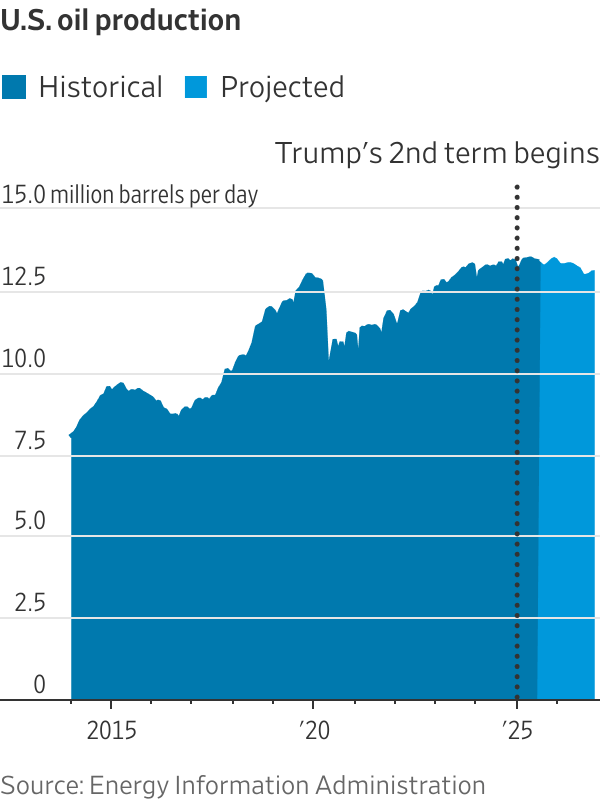
For years, U.S. shale-oil companies burned cash to fuel growth but returned little or no profits. Investors compelled them to rein in spending, and the publicly traded ones are wary of ramping up development, even when oil and gas prices jump. Their inventories of premium wells have been shrinking.
Trump has kept pushing for lower crude prices to help tame inflation and achieve his geopolitical goals. He has repeatedly told oil executives he wants oil under $40 a barrel, and executives have taken turns lobbying him against lower prices. “He thinks lower oil prices solve every problem—it’s a magic elixir,” one oil executive said. “A lot of executives have told him it will actually lead to bankruptcies in the industry and lower production over time.”
The recent tumble in crude prices has prompted producers to shed drilling rigs and crews that frack wells, and added pressure on companies to do more with less. ConocoPhillips last week said it would cut up to a quarter of its workforce. Some of those layoffs were expected after it acquired rival Marathon Oil last year. Chevron announced earlier this year that it would shrink its workforce by up to 20%.
The number of oil-and-gas extraction jobs declined by more than 3% between January and August to its lowest level in two years, according to preliminary data by the Bureau of Labor Statistics.
In their March meeting with Trump, oil-and-gas executives lobbied for a carve-out for oil-field products from his 25% tariffs on steel and aluminum, but that didn’t happen.
Permian Basin driller Diamondback Energy reported last month that it expected some well construction costs to increase nearly 25% this year because of the tariffs, which Trump doubled in June. It said the duties would raise the break-even cost of nearly every well drilled in the U.S. this year.
Still, many in the industry say Trump is bestowing so many gifts that a period of lower profits is probably worth the cost.
“We all voted for this,” said Taylor Sell, chief executive of Texas driller Element Petroleum.
Write to Benoît Morenne at benoit.morenne@wsj.com and Josh Dawsey at Joshua.Dawsey@WSJ.com