In a seven-hour long meeting that American officials have described, among other things, as candid, substantial and important, US National Security Advisor Jake Sullivan conveyed, on Monday, Washington’s “deep concerns about China’s alignment with Russia” to top Chinese official Yang Jiechi, warning him that should Beijing offer support to Moscow, there would be “significant consequences” for China.
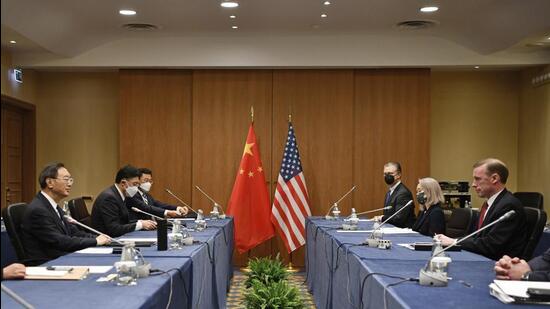
The meeting, which took place in Rome on Monday, came after reports from the Financial Times saying US believed China had shown a willingness to offer specific military support asked for by Russia. US officials have refused to officially comment on the reports and maintained that they will engage with “privately and directly” with China. The White House, in a brief readout, described the discussions on Russia’s invasion of Ukraine as “substantial”, with both sides agreeing to maintain open lines of communication.
Also Read | Ukraine war: Russia slaps sanctions on US President Joe Biden, top officials
“What we have conveyed and what was conveyed by our National Security Advisor in this meeting is that should they (China) provide military or other assistance that, of course, violates sanctions or supports the war effort, that there will be significant consequences,” White House spokesperson Jen Psaki said, refusing to elaborate on what form those consequences could take.
State department spokesperson Ned Price was far more direct, and said that the NSA had “raised directly and very clearly” US’s concerns about China’s support to Russia in the wake of the invasion, and the implications of any such support, not just for China’s relationship with the US, “but for its relationships around the world”.
{{/usCountry}}State department spokesperson Ned Price was far more direct, and said that the NSA had “raised directly and very clearly” US’s concerns about China’s support to Russia in the wake of the invasion, and the implications of any such support, not just for China’s relationship with the US, “but for its relationships around the world”.
{{/usCountry}}“That includes our allies and partners in Europe and in the Indo-Pacific,” he said.
A senior administration official said, separately, that Sullivan had described to Yang the unprecedented US cooperation and coordination with allies and partners in Europe and Asia to inflict costs on Russia over the invasion.
When asked if the US believed that China was already offering support to Russia, Price said, “We are watching very closely the extent to which the PRC, or any other country for that matter, provides any form of support, whether that’s material support, whether that’s economic support, whether that’s financial support, to Russia. Any such support from anywhere in the world would be of great concern to us.”
He added that it would of the “greatest concern” if China, “a country that has tremendous leverage with Russia, has a relationship with Russia that is distinct from the relationship that we or just about any other country on the planet has with Russia”, was doing that. “And with that in mind, (China) could do more than probably many other countries to bring an end to this senseless violence, to this brutality, to (Vladimir) Putin’s premeditated war of choice.”
Price said that the US had communicated “very clearly” to Beijing that it won’t stand by and allow any country to “compensate Russia for its losses”.
Also Read | Ukraine war: Russia withdraws from Council of Europe
Responding to a question on whether the US was disappointed with China’s response to the outreach, the state department spokesperson said that it was “incumbent on every country” in the world to speak out, and have no ambiguity”, and said that China’s statements had “somewhat of an ambivalent message, calling for a diplomatic solution”.
Referring to a statement by a Chinese official calling the situation “complicated”, Price said, “There is nothing complicated about this. This is a naked aggression; a war of choice”. He added that as a country that had benefited from the “rules-based order”, and as a country that “touted and brandished the concept of sovereignty”, the US expected China to speak up clearly.
When asked if the US had noted a shift in China’s posture – from a more ambivalent stance in the initial days of the war to a more supportive stance towards Russia in recent days – Price said that he would not speak for China, but that China had a lot to explain for both its words and its actions.
He referred to the deepening partnership between China and Russia in recent years, including the Putin-Xi Jinping joint statement from February, and said, “What does seem to unite them is a vision of the world that is in stark contrast to the vision that the US and our allies and partners have not only built and promoted and defended, but the system that itself has advantaged countries such as PRC and Russia.”
On the partnership between the two, he added that it was clearly a case of “two autocracies” with a desire to see a world that was “more closed, less open, less free” coming together.