
Last year, Energy Secretary Chris Wright complained that the GOP-led Congress wouldn’t give the Trump administration the billions of dollars needed to fill up the U.S.’s oil reserves. President Trump is trying to find a way around reluctant lawmakers.
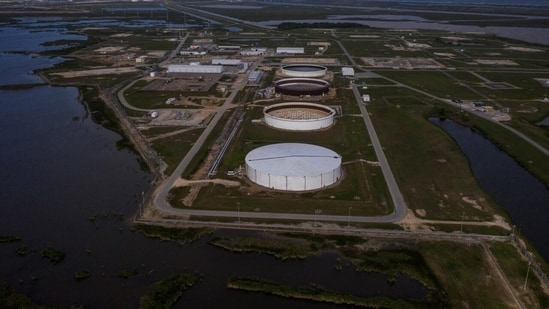
Trump said Sunday that he plans to use Venezuelan oil that the U.S. will control through a deal with a private company to refill the Strategic Petroleum Reserve. The agreement would give Washington access to oil fields said to contain one-fifth
Last year, Energy Secretary Chris Wright complained that the GOP-led Congress wouldn’t give the Trump administration the billions of dollars needed to fill up the U.S.’s oil reserves. President Trump is trying to find a way around reluctant lawmakers.
Trump said Sunday that he plans to use Venezuelan oil that the U.S. will control through a deal with a private company to refill the Strategic Petroleum Reserve. The agreement would give Washington access to oil fields said to contain one-fifth of the country’s crude reserves.
The federal oil stocks are in dire need of new supplies. The Trump administration has repeatedly blamed former President Joe Biden for draining the reserves, but it has depleted the stocks further despite Trump’s pledge that he would replenish them “right to the top.”
But Trump’s plan comes with a number of uncertainties—and it’s unclear it would provide relief to Americans pinched by high gasoline prices in the near term. It could take months before the deal yields new barrels, and the administration hasn’t explained exactly how the procurement would work. Plus, future elections in both countries could jeopardize the enterprise, analysts say.
The U.S. has released more than 128 million barrels from strategic salt caverns on the Gulf Coast in a bid to mitigate the impact of the monthslong closure of the Strait of Hormuz. Oil levels at the sites have fallen to their lowest since the autumn of 1982—and Trump has a narrowing set of options to bring gasoline prices below $4 a gallon.
“I think they probably see this as a plausible mechanism for both stimulating the Venezuelan industry and bringing [oil] into the country,” Joseph Majkut, an energy expert at the Center for Strategic and International Studies, said of the recently announced deal.
The Trump administration said the deal “secures our energy dominance for the next century—all at zero cost to the United States.” It said it would ensure a stable supply of low-cost oil that can facilitate refilling the federal stockpile.
The maneuver would be unprecedented for the U.S.: It would directly tap in to foreign oil reserves to buttress its own—and seemingly relegate Congress to a secondary role.
A White House official said that oil would be flowing to the market by the end of the year to help bring down gasoline prices for Americans. The official said that if the company the U.S. entered a deal with scales as planned, the country could be adding 50 million barrels to strategic oil reserves every year.
The Energy Department in the past has used proceeds from crude sales to acquire new barrels, but before Trump’s re-election, that account was essentially depleted, analysts at energy analysis firm Rapidan Energy Group noted at the time. Congress last year appropriated a paltry $171 million to begin refilling the stockpile, compared with the $20 billion that Wright said at the time was needed.
In January, a few days after the Trump administration seized Venezuelan strongman Nicolás Maduro, Wright said he was looking at “creative ways in which we do deals with private businesses that we can generate oil without any government cash and put it in the Reserve.”
Wright offered more details on Wednesday about the unorthodox deal. He said on CNBC that American refineries are set up to transform heavy Venezuelan crude into fuel and would benefit from an influx of new barrels. The administration could swap that heavy oil for light or medium crude from the U.S., which it would then pump into the national stockpile.
“Our refineries could buy Venezuelan oil and then offer the U.S. government higher-quality oil,” said Clayton Seigle, a managing director at advisory firm Beacon Global Strategies. “Think of it like trading in an older car and putting its value toward a new vehicle purchase.”
Analysts said the trade would likely be necessary because the salt caverns are set up to contain mostly light to medium types of crude. But they noted that it would have the added benefit of letting American oil producers participate in the plan, which could help address their concerns about U.S.-sponsored competition from Venezuela. The government has reserved recent solicitations for crude to recharge the strategic stocks to domestic producers.
The plan faces several challenges. For instance, analysts say, it is unclear how exactly the U.S. would procure the crude. The White House said North American Blue Energy Partners, the privately held oil company with which it signed a deal, granted the State Department the right to purchase a guaranteed 20% of oil from current and future fields, at production cost. But it isn’t clear what funding the department might use, said analysts at energy-research firm ClearView Energy Partners.
The Trump administration is betting future leaders in Washington and Venezuela will regard the deal as important for economic stability in Venezuela and energy security in the U.S., said Kevin Book, who heads research at ClearView.
But if Democrats retake the White House in 2028, they might withdraw support for the deal. In Venezuela, a future government could reject previous agreements with the U.S. Either scenario would likely imperil the administration’s plan to use the oil bounty to reload the strategic stocks.
The White House official said the deal was with a private company and reached under the existing legal framework.
Even if the plan is successfully implemented, it would take years to restore the reserve—currently sitting at about 286 million barrels—to its authorized capacity of 714 million barrels. Frequent drawdowns, wear-and-tear and a lack of investment have strained the reserve. The 60 Gulf Coast salt caverns that make up the stocks can’t be drawn from or refilled at the rate at which they were designed, federal researchers have found.
“The emergency releases of the last five years, the two energy crises, have brought us not to tank bottom, but quite low,” Majkut said.
Write to Benoît Morenne at benoit.morenne@wsj.com
One Subscription.
Get 360° coverage—from daily headlines
to 100 year archives.
Archives
HT App & Website