India on Tuesday pulled out close to 600 of its nationals from the besieged Ukrainian city of Sumy through what is the first significant humanitarian corridor established by Ukrainian and Russian authorities in the war-torn country as hostilities escalated.
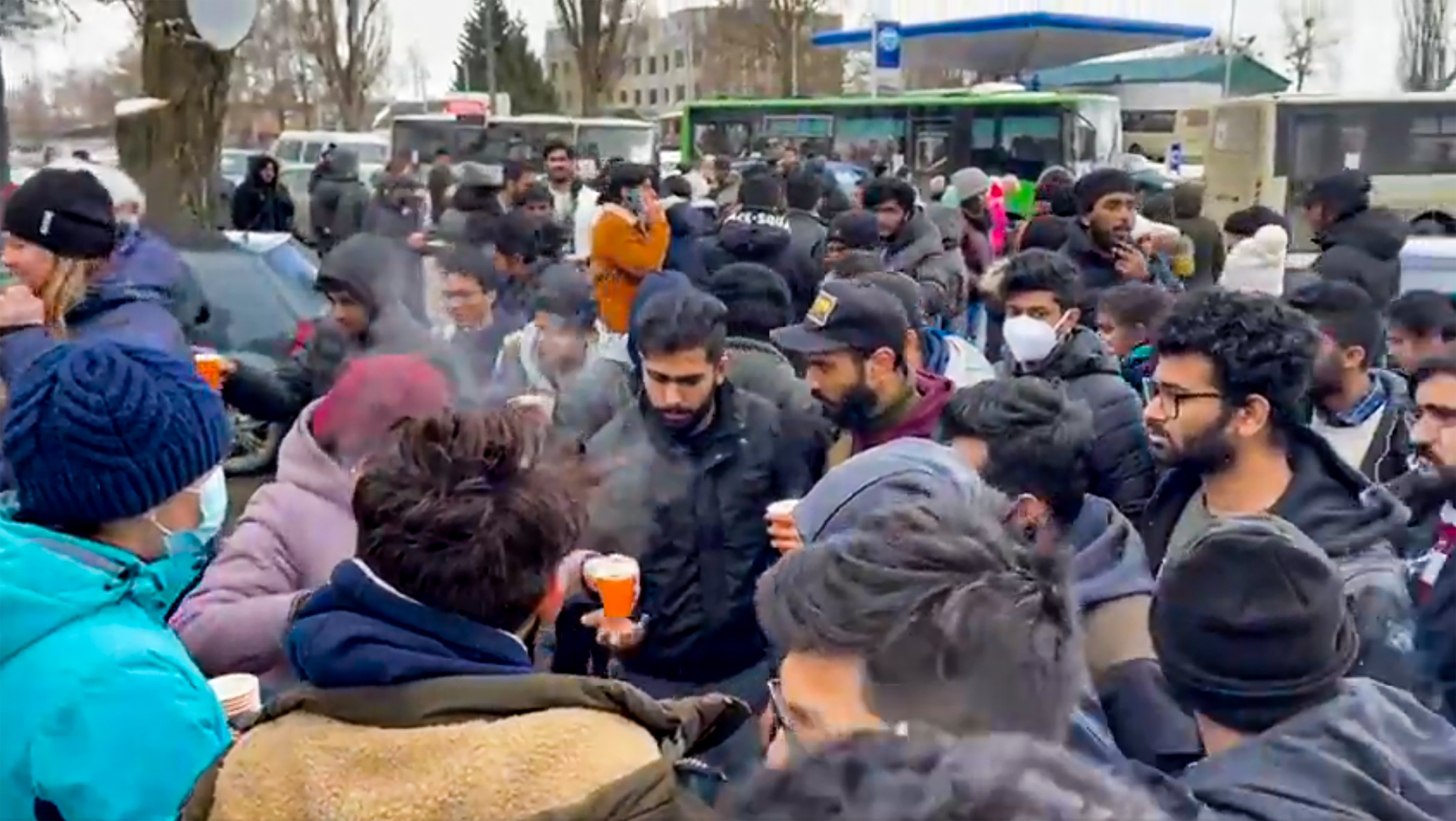
The operation to move out the Indians, mostly students, from the eastern city of Sumy was kept tightly under wraps a day after a similar attempt fell through when ceasefire plans fell apart.
Also Read| Anxiety grips parents of students still in Ukraine
The final go-ahead from authorities in Kyiv for the evacuation came at about midnight Ukrainian time (3.30am IST) and Indian officials were in place within hours at Sumy and several staging posts to facilitate the exit of the Indians, people familiar with the matter said.
The official confirmation about the completion of the successful operation came at 6.28pm, when external affairs ministry spokesperson Arindam Bagchi tweeted: “Happy to inform that we have been able to move out all Indian students from Sumy.”
The Indian nationals were taken from Sumy in a convoy of about 12 buses escorted by the International Committee of the Red Cross, Ukrainian authorities and Indian embassy officials to Poltava city, where Indian officials had been stationed for the past few days to coordinate their safe passage out of the conflict zone.
{{/usCountry}}The Indian nationals were taken from Sumy in a convoy of about 12 buses escorted by the International Committee of the Red Cross, Ukrainian authorities and Indian embassy officials to Poltava city, where Indian officials had been stationed for the past few days to coordinate their safe passage out of the conflict zone.
{{/usCountry}}At Poltava, the Indians were set to board trains heading towards Ukraine’s western borders. After crossing the frontier, they will be flown out on evacuation flights from neighbouring countries.
Also Read| Nearly 18,000 Indians brought back from Ukraine by special flights, says Centre
Bagchi did not give further details, including the number of Indians brought out of Sumy. People familiar with the matter said about 600 Indian nationals had been moved out of the city, most of them students of Sumy State University. The group included a handful of Indian workers and about a dozen nationals of Bangladesh, Nepal, Pakistan and other countries.
Union minister Hardeep Singh Puri had earlier pegged the number at close to 700. “Last night, I checked with the control room, 694 Indian students were remaining in Sumy. Today, they have all left in buses for Poltava,” Puri told reporters in Delhi.
Russia’s state-run RIA Novosti news agency quoted the defence ministry as saying that 723 people, including 576 Indian nationals, were evacuated through the Sumy-Poltava corridor.
Several Indian students said they were relieved and hoped that they would be in a safe zone soon.
“The evacuation from Sumy has started. There was finally some good news on Tuesday. All Indian students will be evacuated from Sumy on Tuesday itself. They will be taken to a safe location from where they will be brought to India,” said Anshad Ali, a student coordinator, news agency PTI reported.
A medical student at the Sumy university, who did not wish to be identified, confirmed that buses have arrived and students have started boarding the buses. “We have been told that we will go to Poltava. I am praying that we reach a safe zone and this misery is over,” he told PTI from Sumy.
Also Read| ‘Grateful to…’ Ukrainian president tweets after speaking to PM Modi
“We stood in a queue for three hours in freezing cold on Monday, waiting to board the buses and then, we were told that we cannot go. Thankfully, we left Sumi on Tuesday. I am hoping that we will be in a safe zone soon,” Aashiq Hussain Sarkar, another medical student, told PTI.
As the convoy rolled out of Sumy, the Indian students were barred from sharing videos and photos of their journey on social media or with their contacts. A similar move by some students during an abortive attempt to leave Sumy on Monday had triggered concerns that the security of the convoy had been compromised. The journey on Monday was subsequently abandoned after intense preparations.
The first videos and images emerged on Tuesday only after the convoy had covered a considerable distance from Sumy. A Red Cross vehicle led the convoy and all the buses had Indian flags pasted on the windows. They also had signs that said “Indian students on board” in English and Russian.
“Both the Russian and Ukrainian sides had to agree to a ceasefire, and that wasn’t happening. Prime Minister Narendra Modi’s phone calls with Russian President Vladimir Putin and Ukrainian President Volodymyr Zelensky on Monday were effective and set the stage for the evacuation,” one of the people cited above said.
At the same time, external affairs minister S Jaishankar worked the phones with his Russian and Ukrainian counterparts, while foreign secretary Harsh Shringla called in the envoys of both countries to coordinate the evacuation. Shringla was also in touch with his Ukrainian counterpart to ensure things went smoothly, the person said.
“There were also contacts with the defence ministries of the two countries and the Red Cross and Ukrainian authorities were roped in to escort the convoy. At the suggestion of the Ukrainian side, the convoy was expanded to include the nationals of several other countries so that everyone could be evacuated at the same time,” the person added.
Indian teams were positioned both north and south of Sumy but Ukrainian authorities ruled out the option of allowing the Indians to be driven to the Russian city of Belgorod, a distance of about 150km. The Indian side then arranged buses from various sources for the journey to Poltava and positioned officials at several staging posts.
Ukrainian deputy Prime Minister Iryna Vereshchuk said on Tuesday that Russian proposals to evacuate civilians to Russia and Belarus were unacceptable.
Russia’s defence ministry, which on Tuesday confirmed the ceasefire in a letter to the International Red Cross, had proposed a second evacuation route to Belgorod in Russia. News agency Interfax reported that Moscow was opening corridors from Ukrainian cities of Cherhihiv, Kharkiv, Mariupol, the capital Kyiv, and Sumy but reports throughout the day suggested successful evacuations only took place via Sumy and Irpin, a town on the outskirts of Kyiv.
The Ukrainian side has said repeated attempts to evacuate some 300,000 civilians from Mariupol have been disrupted by Russian attacks.
Sumy had been the main focus of India’s evacuation efforts in Ukraine as most Indian nationals have already been evacuated from other conflict zones in the eastern part of the country such as Kharkiv. Sumy had the largest concentration of stranded Indians over the past few days, and students had posted several videos on social media that detailed how they were spending most of their time in bunkers while food and water supplies ran low.
An advisory from the Indian embassy in Kyiv on Tuesday said all stranded Indians should use humanitarian corridors established in various parts of Ukraine and “evacuate using trains/vehicles or any other available means of transport” while ensuring their safety. “Considering the security situation, establishment of the next humanitarian corridor is uncertain,” the advisory said.
Indian ambassador Partha Satpathy met the mayor of Lviv city, Andriy Sadovyi, on Tuesday and discussed the evacuation of Indians. Satpathy thanked the mayor for the support for India’s evacuation efforts.
In a separate development, the Indian embassy evacuated 57 sailors – including 52 Indians, three Syrians and two Lebanese – who were stranded in Mykolaiv port on Monday. The embassy said in a tweet that another 23 Indian sailors could not be evacuated because of “route constraints” and arrangements were being made to pull them out on Tuesday.
Some 22,000 Indians have exited Ukraine since January, including those who left well before the Russian invasion began on February 24.
(With agency inputs)