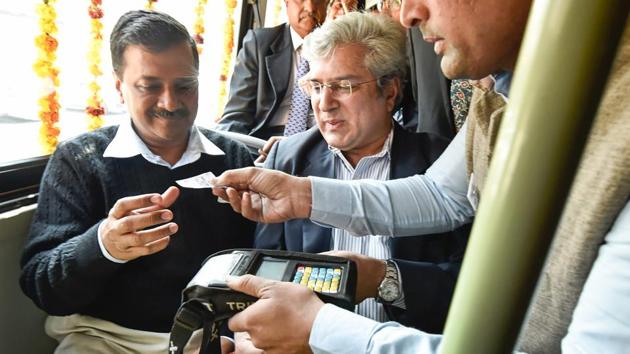
Transportation lies at the heart of the unwieldy beast that is the modern city and public transportation, particularly in populous cities such as Delhi and Mumbai with millions of users of these networks. In a bid to simplify the lives of daily commuters, the Delhi Government recently launched a ‘Common Mobility Card’. The card is a prepaid mechanism allowing users to move seamlessly between the Delhi Metro and the city bus networks and it has a deep, direct utility for users. Its real power, however, lies in its potential to create a unique product for the city: real-time big data on transportation usage.
Data is a critical component of transportation planning. The last comprehensive citywide report on transportation in Delhi was the Travel Demand Forecast Study conducted in 2007-08 by RITES; it demonstrated that 30% of the population utilised public transportation to get around (27% used buses, and 3% the metro). Given that the city had a population of under 17 million according to the 2011 census data, the numbers are striking and would likely be higher today. Beyond the quantum of numbers, these numbers are also no longer accurate. Since the report was published in 2010, the general population has increased substantially and the extent of the Delhi metro has increased as well. Therein lies the primary problem in transport planning in Delhi -- the lack of holistic up-to-date data on transportation choices that are essential for planners to create systems that are responsive to the needs of the people. The data collected through the card will help inform decision-makers in three critical areas: 1) the user mode choice (bus and/or metro), 2) the segmentation (bus-metro-bus, bus-bus…etc.) and, 3) the density of population using particular routes.
A similar card that was launched in 2011, however did not go far beyond a trial period. It stands to reason that this card could succeed where the last one failed because the concepts of big data and planning have come a long way since 2011 and other missions like the Smart City Mission and Digital India could support the processes of the IT-based technology. The data collected through the cards is anonymised and could be kept open to allow for the public and specialists outside the government to analyse and give solutions as is common practice across the globe. The Netherlands is known for its focus on creating better bicycle paths using data from existing cyclists. Singapore is tracking movement within the city and using that data to improve efficiency by reducing crowding and waiting times. Such technology is sorely needed to deal with and complexities of Indian cities. The only aspect better than the actual ability to collect the data, is that it is available in real-time. This is a gold mine for being responsive to the needs of the city and opens possibilities for transit authorities to deploy increased frequencies, alternative routing or dynamic pricing to deal with exigencies.
{{/usCountry}}A similar card that was launched in 2011, however did not go far beyond a trial period. It stands to reason that this card could succeed where the last one failed because the concepts of big data and planning have come a long way since 2011 and other missions like the Smart City Mission and Digital India could support the processes of the IT-based technology. The data collected through the cards is anonymised and could be kept open to allow for the public and specialists outside the government to analyse and give solutions as is common practice across the globe. The Netherlands is known for its focus on creating better bicycle paths using data from existing cyclists. Singapore is tracking movement within the city and using that data to improve efficiency by reducing crowding and waiting times. Such technology is sorely needed to deal with and complexities of Indian cities. The only aspect better than the actual ability to collect the data, is that it is available in real-time. This is a gold mine for being responsive to the needs of the city and opens possibilities for transit authorities to deploy increased frequencies, alternative routing or dynamic pricing to deal with exigencies.
{{/usCountry}}Finally, the card is advertised as enabling seamless travel. Its full potential will only be realised, however, with fare integration of the various modes where chaining multiple modes for a single journey would be possible with lower user charges. Today, while switching from one Metro line to another, one is charged for the total distance travelled, the per kilometre rate of which reduces telescopically in a longer journey. Similarly, the future of this technology could enable such single-charge trips even with modal interchanges, thereby reducing the cost of such segmental trips. In such a system, transit operators would be able to provide complementary, rather than competitive services. If transport can be thought of in such an integrated manner, it would be a game changer for commuting in the city.
Public transportation is an economic enabler and, if kept affordable, allows for greater equity and access. While the importance of infrastructure cannot be overemphasised, there is often one gaping hole while planning it for cities – data. Planners are routinely provided patchy and unreliable data to extrapolate from, and plan for millions of users. Furthermore, as cities grow and change, transport routes and needs also alter. One of the most robust measures of any planning mechanism is its flexibility in dealing with change. The Common Mobility Card will allow people to use one instrument as they travel between modes, and analysts can utilse this data towards creating systems that are accurate and curated to the needs and economics of the city.
Persis Taraporevala is a PhD candidate at King’s College London, and has worked on intermediate public transportation in Kolkata with the Centre for Policy Research, New Delhi.
Ryan Christopher Sequeira is an architect-urbanist and is currently Deputy Manager of Transport Planning at DIMTS Ltd
The views and opinions expressed in this article are those of the authors and do not necessarily reflect the institutions they are affiliated to