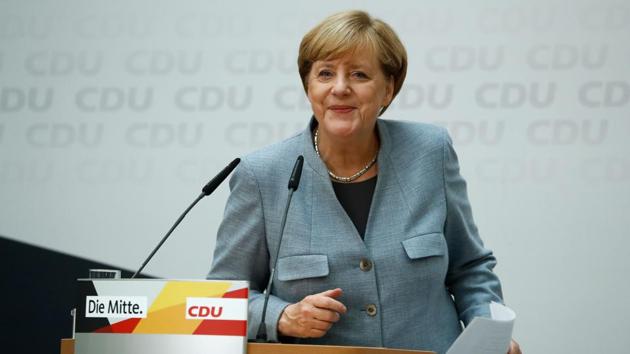
Chancellor Angela Merkel is poised for an unprecedented fourth term as Chancellor in Germany with her party, the Christian Democrats (CDU/CSU) winning 33% of the vote and emerging as the largest party in parliament with 246 seats. The vote reflects a comfort level with Merkel’s non-flashy and pragmatic leadership which has steered Germany and Europe through the difficult currents of the global financial crisis, the debt crisis in Southern Europe and now the challenge to European integration posed by the decision of the UK to leave the European Union. The German economy, the largest in Europe, is performing relatively well largely on the back of reforms undertaken by Merkel’s predecessor, Gerhard Schroeder, while Germany’s consensual style of politics has brought both political and social stability.
At the same time, the vote is a signal of the looming challenges ahead. For the first time since the Second World War a far right nationalist party – the Alternative for Germany (AfD) – has won around 13% of the vote and has entered the German parliament with 94 seats. The AfD had campaigned on an anti-refugee, anti-Islam platform, tapping into the fears of a section of Germans against Merkel’s decision to allow over one million refugees into the country. This is part of a larger wave sweeping Europe and America and reflected in the rise of right wing parties across several European countries, in the UK’s Brexit decision and in the election of an inward-looking Donald Trump in America.
Echoing Trump’s slogan of ‘take our country back’, the AfD talks of ‘taking our land back’. In a direct attack on the refugee policy of Angela Merkel, the AfD has threatened to launch an investigation into the ‘crimes’ she has committed against the country. The AfD support has come largely from East Germany, where it was expected to get 21% of the vote. The Eastern part of Germany continues to struggle with unemployment and a subdued economy, post-reunification, providing fertile ground for xenophobic ideas. Surprisingly AfD is also poised to do well in the traditionally conservative states of southern Germany – Baden-Wurttemberg and Bavaria – where it has gained at the cost of Merkel’s partner, the CSU. Overall the AfD is gaining around 8% of vote share at the cost of the CDU/CSU combine whose vote share has come down by 8.6%.
{{/usCountry}}Echoing Trump’s slogan of ‘take our country back’, the AfD talks of ‘taking our land back’. In a direct attack on the refugee policy of Angela Merkel, the AfD has threatened to launch an investigation into the ‘crimes’ she has committed against the country. The AfD support has come largely from East Germany, where it was expected to get 21% of the vote. The Eastern part of Germany continues to struggle with unemployment and a subdued economy, post-reunification, providing fertile ground for xenophobic ideas. Surprisingly AfD is also poised to do well in the traditionally conservative states of southern Germany – Baden-Wurttemberg and Bavaria – where it has gained at the cost of Merkel’s partner, the CSU. Overall the AfD is gaining around 8% of vote share at the cost of the CDU/CSU combine whose vote share has come down by 8.6%.
{{/usCountry}}The Free Democrats (FDP) will be the other major gainer in this election with over 10% of vote share. Traditionally the FDP has been a coalition partner in many governments in post-war Germany and has been described as the tail which wagged the dog. However, in the last election they had failed to cross the minimum 5% vote threshold and were unrepresented in parliament. They are opposed to some of the European reform proposals of President Macron of France.
The other major party, the Social Democratic Party (SPD), which is currently a partner in the Grand Coalition Government led by Chancellor Merkel, is likely to lose 5% voting share and obtain around 20.5% of the vote. While this is less than the 8.6% decline in the CDU/CSU voting share, what should be of concern to the SPD is that over the last 20 years, its vote share has declined by nearly 20%. Martin Schulz, the SPD’s candidate for Chancellor, has announced that the SPD will not join a grand coalition to form the government. They will then be the largest opposition party, a space which would have otherwise been occupied by the far right AfD.
Chancellor Merkel is now likely to explore a coalition with the FDP and the Greens. This is not going to be easy but Merkel has, in the past, pragmatically appropriated parts of the platform of the Greens, such as closing down all nuclear power plants, and is known as a skilled coalition builder.
Steering a four party coalition with partners with widely divergent political outlooks will be more complex and challenging and will test Merkel’s skills.
Germany faces a more uncertain international environment as the traditional pillars of its post-war policies look increasingly shaky, including closer European integration, the alliance with the USA under Donald Trump, relations with Putin’s Russia and robust economic growth. The overhang of the debt crisis in Europe continues while the new wave of digitisation and artificial intelligence sweeping the world could disrupt the traditional manufacturing sector, which has been Germany’s mainstay. The emergence of the AfD and its sharp rhetoric presages a more polarised polity and a shift in the post war style of German politics characterised by compromise and consensus. Angela Merkel’s leadership is reaffirmed but there are signals of the uncertainties and challenges ahead.
For India, Angela Merkel and Germany have been reliable partners in Europe and her re-election points to the relationship remaining on course. The challenge will be to impart more substance by building greater economic and strategic synergies.
Meera Shankar is a former Indian ambassador to Germany and USA
The views expressed are personal