New Delhi is well-known for the colonial bungalows designed by British architect, Edward Lutyens. But he also left his mark in Kathmandu, though he never visited Nepal. As the East India Company (EIC) expanded its hold on India in the 19th century, a clash with the Kingdom of Nepal, which had recently come into existence through the strong consolidation of power by the Gorkha king, Prithvi Narayan Shah, was inevitable.
The Anglo-Gorkha war and the 1801 Treaty of Friendship saw Willam Knox visited Kathmandu as the EIC’s representative. But, he was not welcome and left within a year, leading to further escalation of hostilities, culminating in the Treaty of Sugauli in 1816. Such was the EIC’s insistence on stationing its representative in Kathmandu that Edward Gardener, the appointed representative, presented his credentials to King Girvan Yuddha Bikram Shah at Nuwakot, where the king was holidaying.
The only other case of the credentials ceremony being held outside Kathmandu happened in 1990 when the ambassador of India, Lt Gen SK Sinha (retd), presented his papers to King Birendra in Pokhara. At that time, too, the king was on holiday.
The EIC was provided a plot “not too distant but outside” the old city of Kathmandu. The area later became known as “Lainchour” coming from the English word “lines”, the name given to British enclaves in India those days. A residency and an attached church were built in 1884. The residency was damaged in the earthquake that hit Kathmandu in 1934. It was repaired, but remained unsafe, and the structure was demolished in 1940. Nepal’s Prime Minister Juddha Shumsher Rana laid the foundation stone for the new building in May 1941, with the envoy shifting to the first secretary’s residence within the legation’s compound.
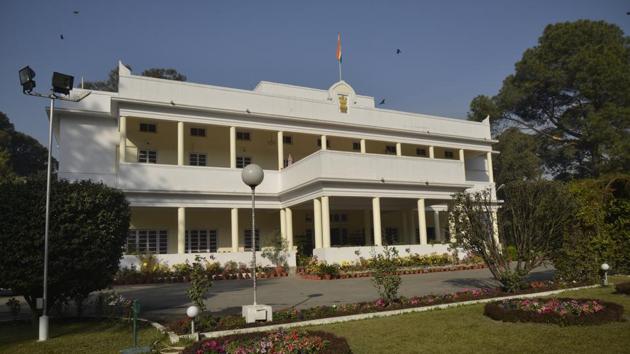
In June 1942, a new two-storied building was completed. It incorporated the most up-to-date earthquake-proof plan, and was fitted with electricity and modern sanitation. The construction was carried out by the Central Public Works Department of the Government of India (GoI). They modelled the new residence on the very few double storey houses in the Lutyens Zone of New Delhi. Ironically, an Indian official who visited the site in 1948 complained that it was “built in the New Delhi style which is unsuitable to the climatic and general conditions in Kathmandu”.
{{/usCountry}}In June 1942, a new two-storied building was completed. It incorporated the most up-to-date earthquake-proof plan, and was fitted with electricity and modern sanitation. The construction was carried out by the Central Public Works Department of the Government of India (GoI). They modelled the new residence on the very few double storey houses in the Lutyens Zone of New Delhi. Ironically, an Indian official who visited the site in 1948 complained that it was “built in the New Delhi style which is unsuitable to the climatic and general conditions in Kathmandu”.
{{/usCountry}}The British agreed to transfer the property occupied by their legation in Kathmandu to the GoI after Independence. However, negotiations over the transfer dragged on for several years. Andrew Hall, who later served as the UK’s ambassador to Nepal, notes that the British knew that they had to hand over the residence, but wanted to ensure that their new residence would “not look too modest in comparison with the Indian Embassy”. The Indian embassy started functioning in Kathmandu from June 1947, initially from a palace known as as Ranga Mahal, which no longer exists. It was later shifted to Shital Nivas, which now houses the residence of the President of Nepal.
It was only on March 25, 1954, that the British embassy handed over the residence to India, and it became India House, the residence of the Indian ambassador to Nepal. Ambassador BK Gokhale was India’s ambassador at that time. The British wrote to Nepal’s foreign minister Dilli Raman Regmi to place the transfer on record, and also told him that they were retaining two neighbouring plots for their embassy.
Interestingly, both the residence of the Indian ambassador to Nepal and the residence of the UK High Commissioner for India in New Delhi are Lutyens’ designs.