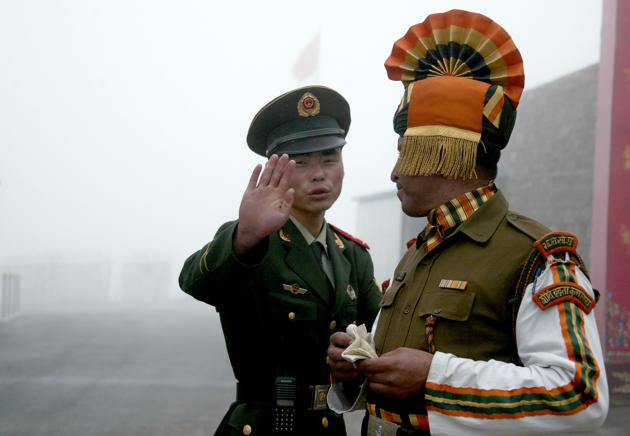
The Doklam stand-off, now into its eighth week, has been characterised by jingoistic war rhetoric from the Chinese official English media and patient-yet-firm Indian diplomacy. Many an armchair strategist has misconstrued India’s calm demeanour to convey that Narendra Modi is in a tight spot and trying to wriggle out from a perceived position of weakness. This perception is perhaps diametrically opposite from the situation on ground at the strategic Doklam plateau as well as the mood of the deep state in New Delhi.
The Modi government’s hand has also been significantly strengthened by political support across party lines as expressed during the short-duration discussion in the Rajya Sabha on August 3. What needs to be singled out from that debate is that Ghulam Nabi Azad, the Congress’s Leader in the Rajya Sabha, ticked off party MP Rajiv Shukla who wanted India to attend the One Belt One Road Forum, by dismissing it as Shukla’s personal view. The message from the Rajya Sabha that day was that India stands united on the Doklam stand-off and will not allow the Chinese People’s Liberation Army (PLA) to unilaterally change the border alignment at the India-China-Bhutan trijunction. This is in accordance with the latest 2012 agreement signed by the Special Representatives on boundary talks and firmly reiterated by Indian National Security Advisor Ajit Doval in his meeting with his Chinese counterpart State Councillor Yang Jiechi on the sidelines of the BRICS NSAs summit in Beijing last month.
The reason why India is not swayed by war rhetoric and is handling the situation quietly is due to its close diplomatic ties with Bhutan. The fact is that the Indian army and the Bhutanese army work in close operational coordination with a division-strength Indian Military Training Team (IMTRAT) sitting in Thimpu to train the troops of its closest ally. So while India has no intention of letting down its guard in the trijunction area and ending up exposing the vulnerable Silliguri corridor, the Chinese English media has been threatening military operations in two weeks time to evict Indian and Bhutanese troops from the so-called Chinese territory.
{{/usCountry}}The reason why India is not swayed by war rhetoric and is handling the situation quietly is due to its close diplomatic ties with Bhutan. The fact is that the Indian army and the Bhutanese army work in close operational coordination with a division-strength Indian Military Training Team (IMTRAT) sitting in Thimpu to train the troops of its closest ally. So while India has no intention of letting down its guard in the trijunction area and ending up exposing the vulnerable Silliguri corridor, the Chinese English media has been threatening military operations in two weeks time to evict Indian and Bhutanese troops from the so-called Chinese territory.
{{/usCountry}}This begets a simple question: If Doklam is Chinese territory then why has Beijing been negotiating with Bhutan on the same for the past decade? While New Delhi has gone on record stating that the issue needs to be resolved diplomatically, the verbal aggression from China could have a negative impact on the bilateral trade with the Indian public mood becoming increasingly resentful of the war rhetoric. Bilateral trade worth $ 71.482 billion is heavily skewed towards China with India’s trade deficit a touch more than $ 51 billion. Since Mao Zedong’s time, Beijing has advocated parallel diplomacy to encourage the China-India bilateral relationship. In his memoirs, former Chinese foreign minister Huang Hua wrote that Mao in the 1970s wanted bilateral trade and boundary resolution with India to go on separate tracks and not impinge on each other. The war rhetoric from Beijing will complicate this parallel diplomacy.
China watchers dismiss this verbal aggression as part of Chinese information warfare as it does not match with the passive military deployment on ground in Tibet. Even though border patrols on both sides are alert, there is nothing untoward happening at Doklam with troops from both sides at a safe distance. While hawks on the Chinese side favour escalation by the PLA, intruding into eight mutually identified disputed areas along the Line of Actual Control (LAC), such a move will further isolate Beijing globally after its aggressive behaviour in the South China Sea. This does not augur well for a country that aspires to be numero uno on the global front.
shishir.gupta@hindustantimes.com