The illegal practice of wealthy and influential individuals in Kerala allegedly purchasing captive elephants from northeastern states for financial gain, particularly during festivals like Thrissur Pooram, has once again come under national scrutiny. The Wildlife Crime Control Bureau (WCCB) has launched a thorough investigation, highlighting the urgent need for immediate action.
The WCCB, a statutory body under the Union ministry of environment, forests, and climate change, has taken decisive steps to dismantle the criminal networks involved in the interstate elephant
The illegal practice of wealthy and influential individuals in Kerala allegedly purchasing captive elephants from northeastern states for financial gain, particularly during festivals like Thrissur Pooram, has once again come under national scrutiny. The Wildlife Crime Control Bureau (WCCB) has launched a thorough investigation, highlighting the urgent need for immediate action.
The WCCB, a statutory body under the Union ministry of environment, forests, and climate change, has taken decisive steps to dismantle the criminal networks involved in the interstate elephant trade. It has directed its officials in the northeast, specifically in Arunachal Pradesh, to take strict action against Kerala’s procurement agents, corrupt local forest officials, and other groups overseeing the supply of these elephants.
The WCCB's order cites the 'clamour and demand' for elephants from Kerala, particularly in the districts of Namsai and Pasighat in Arunachal Pradesh. The order also details some notorious elephant traders from Kerala with a long history of wildlife crimes in Arunachal Pradesh, Assam, and Tripura.
According to a complaint received by the WCCB, a buyer from Kollam recently boasted on social media that he had already identified ten new elephants from the northeast to be used in Kerala’s festivals.
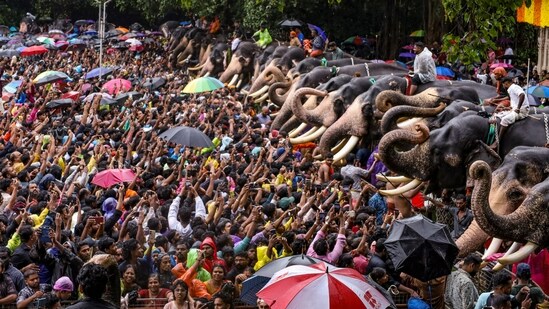
This development comes at a time when the organisers of the Thrissur Pooram, a traditional spectacle featuring caparisoned elephants adorned with vibrant parasols and synchronised with the rhythm of the panchavadyam ensemble, are concerned that the parade may lose its grandeur due to the dwindling availability of elephants.
The decline in Kerala's captive elephant population, from 900 in 2008 to just 407 this year, underscores the severity of the issue. The state is losing an average of 25 elephants annually, which calls for urgent corrective measures.
In Kerala, captive elephants are revered almost as deities, with some enjoying a popularity that rivals movie stars. In March this year, the Kerala Elephant Owners Federation approached environment minister Bhupendra Yadav, requesting amendments to the Wildlife Protection Act to relax regulations on the ownership and interstate transfer of elephants, citing the steep decline in the state's captive elephant population.
The delegation included Kerala’s transport minister, actor K B Ganesh Kumar, and actor-turned-BJP politician Suresh Gopi, who later became a Union minister. As a result, the ministry issued the Captive Elephants (Transfer or Transport) Rules, 2024, ostensibly to ease the transfer and movement of captive elephants.
Under the new rules, the chief wildlife warden (CWW) can authorise the transfer of elephants between states if the current owner cannot provide adequate care or if the animal would be better maintained under new circumstances. However, many key provisions ensuring only non-commercial transfers have been removed.
Animal conservationists have long argued that these relaxations encourage the illegal sale of elephants under the guise of moving them for better care. They see the WCCB’s investigation as a clear validation of their concerns.
Alok Hisarwala Gupta from the Centre for Research on Animal Rights in India contends that illegal traders from Kerala are driving a high demand for elephants in the northeast, compelling local players to exploit the system and mistreat the animals. This mistreatment includes separating young elephants from their mothers, subjecting them to harsh training methods, and keeping them in inadequate living conditions, all of which have severe physical and psychological effects on these intelligent and social animals.
According to Gupta, these groups exert financial pressure on traditional communities in the northeast to capture young elephants from the wild and keep them in captivity until a lucrative buyer emerges. They also misrepresent the commercial trade of elephants by falsifying documentation, turning an actual "sale" into a legal "gift" on paper, further highlighting the exploitation these elephants endure.
In response to the complaint, WCCB's Eastern Region division has directed the CWWs of Assam, Arunachal Pradesh, and Tripura to submit information on registered captive elephants, the number of transit permits issued for moving captive elephants within and between states, and details of cases related to illegal procurement and trade over the past three years.
V.K. Venkitachalam, secretary of the Thrissur-based Heritage Animal Task Force and a WCCB complainant, welcomed the investigation, stating it would expose the dubious intentions of Kerala’s elephant owners.
Congress Rajya Sabha MP Jairam Ramesh recently wrote to Bhupender Yadav, highlighting flaws in the amended rules. The senior leader pointed to recent instances of commercial elephant trade from Arunachal Pradesh to Kerala, Odisha, and Gujarat.
Thiruvananthapuram-based environmentalist Sreedhar Radhakrishnan argues that the modified rules now permit the transfer of elephants between individuals or states for "religious and other purposes," a practice previously prohibited.
Meanwhile, the ministry has acknowledged the negative effects of the recent relaxations and emphasised that transfers should only be permitted after recording the elephants' genetic profiles in the ministry’s electronic monitoring system. Genetic profiling involves collecting animal DNA samples, which are then analysed to create a unique genetic profile for each elephant.
After receiving numerous complaints about illegal activities involving the procurement, trading, and transfer of captive elephants, the ministry established a committee to investigate these activities. The committee’s scope includes registering captive elephants, issuing transportation permits, and following up on cases of illegal procurement and trade over the past three years.
A coalition of animal rights organisations, including People for the Ethical Treatment of Animals (PETA) India, Heritage Animal Task Force, Kaziranga Wildlife Society, the Federation of Indian Animal Protection Organisations (FIAPO), and the Centre for Research on Animal Rights (CRAR), is calling for immediate action to prevent the exploitation of relaxed regulations for illegal capture, exploitation, or commercial trading of captive elephants.
The organisations are urging the establishment of a national database for captive elephants, including ownership certificates, genetic mapping, owner information, and location, with public access to this database.
According to official data, the northeastern states have the highest number of captive elephants in India. Assam, Arunachal Pradesh, Tripura, Nagaland, and Meghalaya account for over 41% of the country’s captive elephants.
In 2016, the Supreme Court restrained the Kerala government from issuing ownership certificates to elephant owners and directed that those who possess elephants in the state not transfer the animals outside Kerala.
Official data shows that Kerala now has 518 captive elephants. Meanwhile, a Heritage Animal Task Force (HATF) survey revealed that 88 captive elephants died between 2008 and 2022, likely due to being paraded at temple festivals during the peak summer months, which take a toll on their health.
The festival season in Kerala coincides with the summer months when temperatures rise significantly. Due to the high demand for elephants at each festival, every elephant is forced to participate in at least fifty ceremonies during this period. Wildlife specialists claim that Kerala is notorious for mistreating captive elephants during these festivals.
During the festival season, the elephants must travel on roads coated with bitumen and remain in the same location for extended hours, enduring the scorching sun. Transportation poses an additional concern regarding the availability of essential resources such as water and feed.
One Subscription.
Get 360° coverage—from daily headlines
to 100 year archives.
Archives
HT App & Website