Prime Minister Narendra Modi's decision to hand over this year's duty of speaking before the United Nations General Assembly to Foreign Minister Sushma Swaraj is not unusual. The then foreign minister, S M Krishna, standing in for Manmohan Singh in 2010 is one among many such cases. Also, this year's Sustainable Development Goal session, which Modi will be addressing, will be centerstage.
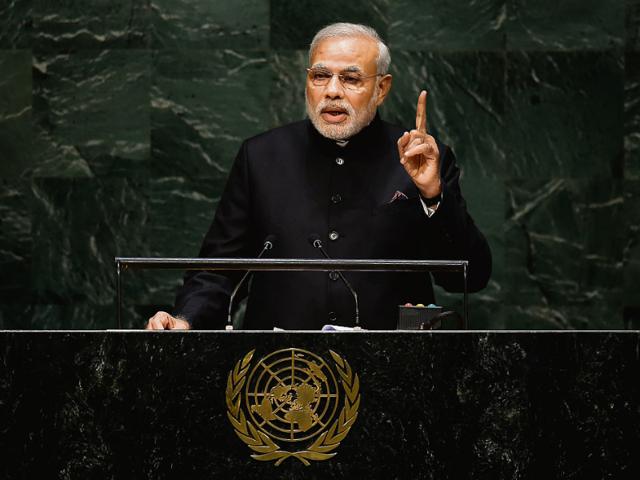
However, Modi's decision does underline his lack of enthusiasm for multilateral arenas. During his election campaign, his advisors spoke privately of the possibility of a Prime Minister Modi dropping symbolic summits like the BRICS and Non-Aligned Movement from his itinerary.
Once he took office such a drastic action proved impossible. But Modi privately complains about big international powwows: "Lots of small countries with their small problems." The United Nations is deliberately not under the direct charge of his foreign secretary, S. Jaishankar. It has been handed over to an additional secretary, a clear sign of the UN's demotion in India's priorities.
There are a number of reasons for this.
One, Modi is extremely focused on tangible foreign policy returns. Overseas relations that contribute to immediate economic and policy goals--foreign investment, renewable energy and so on--top his list. The UN, like most multilateral initiatives, tends to be strong on symbolism and weak on substance. Concrete results are visible, if at all, only after several years of diplomacy.
Two, Indian scholars have long argued the country has four schools of foreign policy. Of these the Hindutva worldview is the least interested in global togetherness. Explains Kanti Bajpai, professor at the Lee Kuan Yew School in Singapore, "The Hindutva school is not terribly interested in multilateral settings…You don't want to be in the company of the international minnows too long. Being one of the crowd is not Hindutva's idea of India. India is to be vishwa guru, a teacher and model that others look up to. Multilateralism requires you play by the rules and debate and compromise -- none of these are Hindutva traits."
{{/usCountry}}Two, Indian scholars have long argued the country has four schools of foreign policy. Of these the Hindutva worldview is the least interested in global togetherness. Explains Kanti Bajpai, professor at the Lee Kuan Yew School in Singapore, "The Hindutva school is not terribly interested in multilateral settings…You don't want to be in the company of the international minnows too long. Being one of the crowd is not Hindutva's idea of India. India is to be vishwa guru, a teacher and model that others look up to. Multilateralism requires you play by the rules and debate and compromise -- none of these are Hindutva traits."
{{/usCountry}}Three, the Indian prime minister is attuned to using foreign travel to appeal to his middle India base back home. This can be seen in his diaspora roadshow and constant references to his domestic policies even before foreign audiences. Most multilateral diplomatic efforts tend to be on issues - whether climate change, human rights, trade negotiations - that have little resonance with the larger Indian public. The UN initiative Modi is most associated with is International Yoga Day, something that earned him soft points at home.
Over the long term, this neglect of the larger big picture could prove damaging. New Delhi's protectionist stance in trade negotiations, for example, is undermining the "Make in India" strategy and hopes for strong bilateral relations with the US and Japan. New Delhi is doing many positive things in climate change but will receive no international recognition because of its unwillingness to put them in a global treaty.
Says Bajpai, "Modi wants the world to know him and quick -- multilateral settings were initially good for that because you quickly meet a lot of other leaders. But one year in, the world knows him and he doesn't need multilateralism very much."
Read: UNSC disagreement doesn't mean lack of support for India: US
PM Modi’s US visit to focus on start-up partnerships