There comes a time in the life of every nation when it has to revisit its roots to understand its nationhood and nationalism. There cannot be a more solemn occasion to do this than India’s 73rd Independence Day. In today’s India, the discourse on nationhood and nationalism are premised on three things. First, developing hatred against enemies, real or imagined, of India. For example, anyone who criticises or disagrees with the government or the popular mood is portrayed as an enemy. Second, adopting muscular or aggressive nationalism, in which one should be battle-ready to fight groups identified as enemies of the nation. Third, promoting cultural homogeneity — of language, religion or dietary habits — inspired from the parochial and ethnic nationalism of Western Europe in the first half of the 20th century.
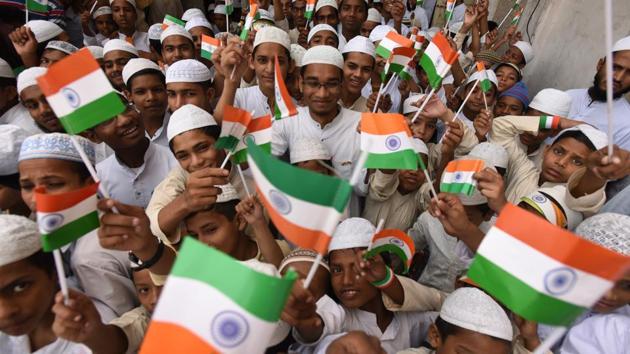
But this populist, narrow and parochial view of nationalism is not the one that our freedom fighters fought for. Mahatma Gandhi famously said, “I am a nationalist, but my nationalism is neither narrow nor aggressive”. Gandhi’s nationalism had no space for hatred for anyone because he believed that one should “hate the evil but not the evil-doer”. His political adversaries were not his enemies — a sentiment echoed by one of the Bharatiya Janata Party’s tallest leaders, LK Advani, at the time of 2019 general elections.
India’s greatest poet and Nobel laureate, Rabindranath Tagore, in his famous 1916 book, Nationalism, abhorred belligerent and sectarian nationalism that European countries at that time espoused. He offered an internationalist and a cosmopolitan vision to counter aggressive ethnic nationalism. Several decades later, another great son of India, Jayaprakash Narayan , quoting Tagore and Gandhi, also cautioned against aggressive nationalism and jingoism. While defining the concept of nationhood, he said: “In the long struggle for national freedom there emerged a clear enough concept of a single, composite, non-sectarian Indian nationhood. But the fact that there also emerged at the close of that struggle a rival concept based on [the] two-nation theory—a separate Hindu nation and a separate Muslim nation resulting in the division of the country and the establishment of an Islamic state—clouded the freedom movement’s concept”.
Embedded in this description are two competing “ideas of India”. One idea where India represents a civilisation of composite and syncretic culture. Thus, India is a sangam (fusion) of different cultures where none loses its unique characteristics and qualities, and yet forms a perfect union. This Ganga Jamuni tehzeeb , championed by freedom fighters like Sarojini Naidu, is the soul of Indian nationhood. As per this “idea of India”, all Indians irrespective of religion and caste are sons and daughters of the soil. The other “idea of India” is based on ethnicity/religion as being the unit of nationhood -- i.e. India should be a Hindu nation because majority of Indians are Hindus. This idea looks at Hindus as original inhabitants of India and Muslims and Christians as “aggressors” who should be relegated to second-class citizenship or even repatriated to some other country. JP, Gandhi, Subhas Chandra Bose, Sardar Patel, Jawaharlal Nehru, Maulana Abul Kalam Azad, Bhagat Singh, despite ideological differences, defended the former “idea of India”, and fought against the divisive communal “idea of India”.
{{/usCountry}}Embedded in this description are two competing “ideas of India”. One idea where India represents a civilisation of composite and syncretic culture. Thus, India is a sangam (fusion) of different cultures where none loses its unique characteristics and qualities, and yet forms a perfect union. This Ganga Jamuni tehzeeb , championed by freedom fighters like Sarojini Naidu, is the soul of Indian nationhood. As per this “idea of India”, all Indians irrespective of religion and caste are sons and daughters of the soil. The other “idea of India” is based on ethnicity/religion as being the unit of nationhood -- i.e. India should be a Hindu nation because majority of Indians are Hindus. This idea looks at Hindus as original inhabitants of India and Muslims and Christians as “aggressors” who should be relegated to second-class citizenship or even repatriated to some other country. JP, Gandhi, Subhas Chandra Bose, Sardar Patel, Jawaharlal Nehru, Maulana Abul Kalam Azad, Bhagat Singh, despite ideological differences, defended the former “idea of India”, and fought against the divisive communal “idea of India”.
{{/usCountry}}Indeed, unlike Pakistan, independent India rejected the two-nation theory and, thus, “cultural homogeneity”. Our Constitution’s makers defined nationhood as one that embodied a composite, non-sectarian culture. This “idea of India” was institutionalised in the Constitution by guaranteeing every Indian, irrespective of religion and creed, the fundamental right to freedom of speech, worship, and association. These fundamental rights act as bulwarks against majoritarianism. They ensure that rule of numbers never triumph the rule of law, and India remains a democracy and does not become a mobocracy. The Constitution balances national integration with distinct regional identities by adopting asymmetrical federalism. Article 370, now made redundant, that gave autonomy to Jammu and Kashmir, and Article 371 that contains special provisions for the North Eastern states of India, are examples of this asymmetrical federalism. In short, Indian nationhood embraces and celebrates multiplicity of religions, languages, sociocultural identities. Yet this rich diversity is tied together in the common thread of Indianness. This unique experiment of nation-building is also described as “unity in diversity”.
India’s freedom struggle and constitutionalism exemplify inclusive and constitutional nationalism, also known as civic nationalism, as against ethnic and belligerent nationalism that feeds on hatred and superiority of the religious majority. It is worthwhile to recall what Gandhi said: “It is not nationalism that is evil; it is the narrowness, selfishness, exclusiveness which is the bane of modern nations which is evil”. Therefore, this Independence Day, all Indians need to repledge their commitment to civic nationalism and reclaim the space lost to ethnic nationalists. Else, the beautiful and inclusive “idea of India”, for which our freedom fighters gave their life, blood and sweat, might be lost forever.
Prabhash Ranjan is a senior assistant professor, South Asian University’s faculty of legal studies
The views expressed are personal