When Soumitra Chatterjee passed away, actress Aparna Sen lamented that “Bengal’s cultural sky had lost its brightest star”. As actor, writer, poet, playwright, painter and elocutionist, Chatterjee was an artist extraordinaire. His readings and recitations brought Bengali literary accomplishments closer to the people while his films over the last six decades became the warp and weave of our lives. When he was taken to the hospital, Chatterjee was working in a film, ironically about his own life.
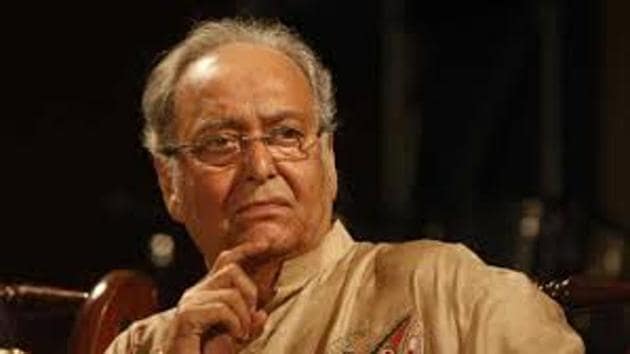
At 23, Chatterjee had made his debut in Satyajit Ray’s Apur Sansar (1959), the concluding film of the famous Apu Trilogy. He had been considered for Apu’s role in Aparajito (1954) but had looked older than the part. So Chatterjee joined the search for a younger Apu. He would later learn that Ray had already started planning the third film because he had found his adult Apu. Thus began the Ray-Chatterjee collaboration of world classics such as Teen Kanya (1961), Abhijan (1962), Charulata (1964), Aranyer Din Ratri (1970) Asani Sanket (1973) and Ghare Baire (1984).
The widely-divergent protagonists that Chatterjee played in these films were much acclaimed, but his most popular role was as Pheluda, Ray’s fictional detective, in Sonar Kella (1974) and Joi Baba Phelunath (1978). As we devoured the books as young adults, we wondered whether Ray would ever make a Pheluda film and if he did, who would play the sleuth? One day, Chatterjee walked into Ray’s house to find that the filmmaker was making an illustration of Pheluda. Curious to know who would play the part, and perhaps hoping against hope, Chatterjee remarked that Pheluda resembled Ray who replied, “Oh, I thought he looks like you.” Chatterjee maintained that Pheluda — quick, intelligent and encyclopedic in knowledge — was Ray’s secret self.
In the 1960s, when Chatterjee was acting in Ray films that were travelling to film festivals across the world, he was also Bengal’s rising popular star. Some of his best films during the decade included Tapan Sinha’s Khudita Pashan (1960) and Jhinder Bandi (1961), an adaptation of The Prisoner of Zenda; Ajoy Kar’s Saat Pake Bandha (1963), Barnali (1963) Kanch Kata Hire (1964), Parineeta (1969) and Mrinal Sen’s Akash Kusum (1965). With Tanuja as his heroine, he acted in Teen Bhubaner Pare (Ashutosh Bandhopadhyay, 1969) with its hit song “Jibone ki Pabona” (“Will I Never get in Life…”). That Chatterjee, in just one decade, should have acted in such a diversity of memorable films is enough for him to be conferred the title of “Mahanayak”, the great hero, along with Uttam Kumar.
{{/usCountry}}In the 1960s, when Chatterjee was acting in Ray films that were travelling to film festivals across the world, he was also Bengal’s rising popular star. Some of his best films during the decade included Tapan Sinha’s Khudita Pashan (1960) and Jhinder Bandi (1961), an adaptation of The Prisoner of Zenda; Ajoy Kar’s Saat Pake Bandha (1963), Barnali (1963) Kanch Kata Hire (1964), Parineeta (1969) and Mrinal Sen’s Akash Kusum (1965). With Tanuja as his heroine, he acted in Teen Bhubaner Pare (Ashutosh Bandhopadhyay, 1969) with its hit song “Jibone ki Pabona” (“Will I Never get in Life…”). That Chatterjee, in just one decade, should have acted in such a diversity of memorable films is enough for him to be conferred the title of “Mahanayak”, the great hero, along with Uttam Kumar.
{{/usCountry}}Influenced by Ray, Chatterjee introduced an understated style of acting in popular Bengali films. He made a break with the dramatic and stylised acting that Suchitra Sen had made her hallmark. Nor did he subscribe to Uttam Kumar and Suchitra Sen’s notion of stardom. With great affection, both stars would advise Chatterjee not to make himself so easily accessible as stars needed to cultivate a mystery around them. But Chatterjee’s stardom was extraordinary in that it was rooted in the ordinary. He played characters that lived close to our lives. Shyam Benegal had identified this as the actor’s special talent; his ability to become someone recognisable, thereby offering to the audience an extraordinarily intimate level of identification.
Chatterjee often reflected on the idea of death as the only inevitability of life. He spoke of the gradual debilitation of the body and the existential wonder that was death. Someone had asked him, what would you do in another life? His first instinct was to choose this life again. But then he decided that he would choose what he could not do in this life. During an interview, Chatterjee recounted this conversation and concluded: “I will be happy to just play with water, earth and air.” Those of us whose lives were enriched by living under the same sky as him, will no doubt feel the presence of Soumitra Chatterjee around us — in water, earth and air.
Shohini Ghosh is Sajjad Zaheer Professor, AJK Mass Communication Research Centre, Jamia Millia Islamia
The views expressed are personal