The great writer Saadat Hasan Manto’s story, Toba Tek Singh, underlined the senselessness of Partition and the enormity of human suffering thereafter. Manto would have seen the Citizenship (Amendment Bill), 2019, as a way of correcting a historical mistake. However, some vested interests are spreading misinformation, which has resulted in protests in some places. So, it becomes imperative for everyone to understand that the Act only extends citizenship, but doesn’t snatch anyone’s citizenship. The Act offers Indian citizenship to the Hindu, Sikh, Buddhists, Jain, Christians and Parsi migrants from Pakistan, Bangladesh and Afghanistan, who entered the country before December 31, 2014.
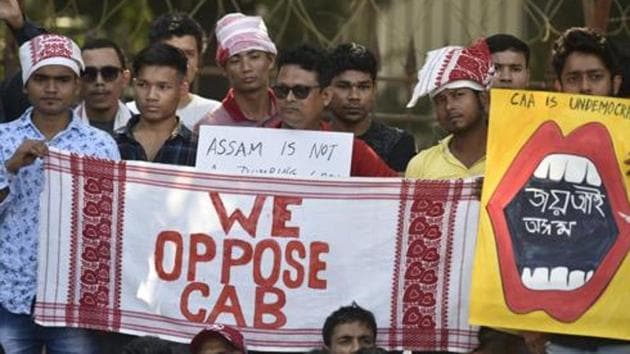
The opposition to the Act is due to two factors — apprehensions in the Northeastern states that this Act will alter their demography and linguistic uniqueness, and the other its exclusion of Muslims from the list. We need to understand why such an Act became necessary in the first place. India’s location, liberal values, economic growth and religious harmony drew many illegal migrants and refugees to its shores.
Since India has not signed the United Nations 1951 convention on the status of refugees and the 1967 protocol, we did not have any national policy to deal with refugees. Migration was dealt with under the Foreigner’s Act, 1946. This Act didn’t distinguish between refugees and illegal migrants. It also didn’t define refugees as a specific category for humanitarian aid. Herein lay the rub. People fleeing their country due to religious persecution were not able to avail services because they were clubbed with illegal migrants because of lack of clarity in the law.
The fact that they lacked access to essential services and were stateless, yet refused to go back to their country of origin shows just how much they feared persecution. According to a study by the Indian Statistical Institute, in 2004, 56% of illegal migrants said employment and economic insecurity were the main motives behind their migrating to India. Migrants put a burden on Indian citizens and decreases employment opportunities for them. Those opposing the Act have to understand that while one group came due to fear for their lives, another came to exploit Indian’s upward economic trajectory.
{{/usCountry}}The fact that they lacked access to essential services and were stateless, yet refused to go back to their country of origin shows just how much they feared persecution. According to a study by the Indian Statistical Institute, in 2004, 56% of illegal migrants said employment and economic insecurity were the main motives behind their migrating to India. Migrants put a burden on Indian citizens and decreases employment opportunities for them. Those opposing the Act have to understand that while one group came due to fear for their lives, another came to exploit Indian’s upward economic trajectory.
{{/usCountry}}According to answers given to parliamentary questions, there were at least 10 million illegal Bangladeshi migrants in India in 1997, 12 million in 2004 and 20 million in 2016. Illegal migrants have been treated as vote banks by the Congress, which explains its opposition to the Act. In a similar vein, the All India Trinamool Congress has made these illegal migrants their vote bank. Just recently, a mega fake voter ID racket was busted in the Bongaon area of West Bengal on the international border. In the past, efforts were made to address this issue through the Illegal Migrant (Determination by Tribunal) Act, 1983, but this failed with the Supreme Court in 2005 saying that the Act was the biggest impediment to the identification and deportation of illegal migrants.
As India was granting citizenship on a case-by-case basis, any Act based on granting asylum would have meant illegal migrants could prolong their stay by first seeking asylum and then, if rejected, could stay on while the review process was on. So, it was necessary to come up with a constitutionally valid Act that classifies and safeguards refugees who face religious persecution. And that is the geneisis of the Citizenship Amendment Act, 2019.
People from the Northeast don’t have to worry about this Act. First, the Act doesn’t apply to the tribal areas of Tripura, Mizoram, Assam and Meghalaya because they are included in the Sixth Schedule of the Constitution. Second, areas falling under the Bengal Eastern Frontier Regulation, 1873 i.e. Arunachal Pradesh, Mizoram, Nagaland, and now, Manipur, are out of the ambit of the Act. Those opposing the Act on the grounds that it violates Article 14 because of the non-inclusion of Muslims should re-examine it. Article 14 forbids class legislation, but allows for a separate class of people to be created by a law.
The Act says that the fear of religious persecution among those who do not practise the State religion in these three countries (Islam) is enough to classify as eligible to Indian citizenship. Muslims in India don’t have to worry as this Act concerns only migrants. At a time when European countries, on facing influx of migrants due to unrest in the Arab world and north Africa, started viewing the refugee situation not on humanitarian grounds but from the security perspective, India is being humane by providing refuge to those persecuted on religious grounds.
Citizens must not fall for the machinations of political vested interests who are desperate to rekindle their shrinking vote banks.
Gajendra Singh Shekhawat is Union Cabinet minister, Jal Shakti
The views expressed are personal