Photojournalism peaked in the 1940s in the middle of World War II, owing to images of destruction and victims of war, which were spectacular for the medium then. Not much has changed even now. The recent photograph of the Salvadoran migrant, Óscar Alberto Martínez Ramírez, and his nearly 2-year-old daughter, Valeria, on the banks of the Rio Grande in Mexico, after they drowned trying to cross the river to Texas, was published on the front pages of most leading newspapers in the world, including in India. It has also taken the social media by storm over the past couple of days. Julia Le Duc, a reporter for La Jornada in Mexico, rushed to the spot after she heard reports of a woman down by the river screaming about the current having taken her family. She wrote in The Guardian, “I’ve been a crime reporter for many years, and I’ve seen a lot of bodies — and a lot of drownings.” Yet, this one moved her more than the others. It “re-sensitized” her, she said.
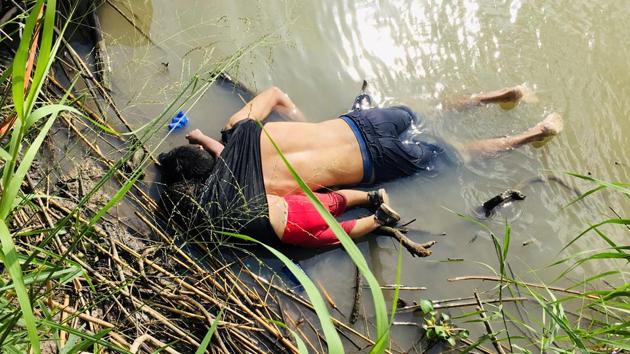
The softness of the apparent embrace contributes to the photograph’s impact, and makes it acceptable enough to be published in the mainstream media without any disclaimers of graphic content. This is dissimilar to Nick Ut’s 1972 image of a child, ‘The Napalm Girl’, which became symbolic of the horrors of the Vietnam War. Ut rushed to save the girl immediately after he made the photograph (her body suffered burn injuries from the bomb) and continued to be lifelong friends with her. The photograph of the drowned Salvadoran migrants is, however, similar to that of the Syrian boy whose body washed up on a beach in Turkey in 2015. The supposed embrace is also reminiscent of Taslima Akhter’s photograph of two workers, who were found holding each other in death, in the rubble of the garment factory building collapse in Bangladesh in 2013. There has been a definite shift in the aesthetic that now appeals to the mainstream viewer when it comes to an image of violence or conflict. Perhaps the graphic nature of violence doesn’t carry as much impact as a softer depiction of reality. Yet, the landscape of devastation still holds the spectacle as an integral part of its visual narrative, which is premised on the basic value of the shock it can deliver.
Social media platforms such as Twitter and Facebook had millions of users talking about the photograph of the Salvadoran father-daughter minutes after it was published. Unfortunately, there is beauty in damage, no matter how honest the photographer’s intent and that seems to have lent a new social afterlife to the visual. Susan Sontag, in her last book, Regarding the Pain of Others, wrote how photographs of victims of atrocities created the illusion of consensus and made real for the privileged, matters that they’d otherwise prefer to ignore. This played out well on social media as users discussed the photograph of the Salvadoran migrants’ bodies as a great tragedy of the American conscience, in the wake of President Donald Trump’s policy of forcing migrants to remain in Mexico while they await immigration hearings. While the original photograph did not show the faces of the dead, users had started to pull out old family photographs that showed the father and the daughter in happier times. It is almost as if the world wanted to see them living through the news of their death. Cartoons appeared online, showing Trump smiling at the bodies that had washed ashore. One (possibly algorithm driven) instance even threw up a tweet by a user a couple of hours into the news about how sea otters hold hands while they sleep so they don’t drift off from each other. A photograph of two sea otters in water accompanied the tweet.
{{/usCountry}}Social media platforms such as Twitter and Facebook had millions of users talking about the photograph of the Salvadoran father-daughter minutes after it was published. Unfortunately, there is beauty in damage, no matter how honest the photographer’s intent and that seems to have lent a new social afterlife to the visual. Susan Sontag, in her last book, Regarding the Pain of Others, wrote how photographs of victims of atrocities created the illusion of consensus and made real for the privileged, matters that they’d otherwise prefer to ignore. This played out well on social media as users discussed the photograph of the Salvadoran migrants’ bodies as a great tragedy of the American conscience, in the wake of President Donald Trump’s policy of forcing migrants to remain in Mexico while they await immigration hearings. While the original photograph did not show the faces of the dead, users had started to pull out old family photographs that showed the father and the daughter in happier times. It is almost as if the world wanted to see them living through the news of their death. Cartoons appeared online, showing Trump smiling at the bodies that had washed ashore. One (possibly algorithm driven) instance even threw up a tweet by a user a couple of hours into the news about how sea otters hold hands while they sleep so they don’t drift off from each other. A photograph of two sea otters in water accompanied the tweet.
{{/usCountry}}Much before Kevin Carter’s Pulitzer-winning 1994 photograph of a starving Sudanese girl with a vulture waiting to prey on her, artist Chittaprosad Bhattacharya had travelled painstakingly on foot through Midnapore in West Bengal to sketch the famine that had killed three million people in the state. It remains India’s worst man-made crisis, and in Unhonoured and Unsung, he depicts Kshetramohan Naik’s bare body being devoured by an animal, as vultures wait to take the rest. Yet, this is a visual that no Indian remembers, for it never made it to the public discourse. Today, the familiarity of a certain softness of aesthetic constantly references back to the last known conflict image of a similar kind. But it is important to remember the reason behind the image, for that should haunt our insides until there is any real change for the better.
paroma.mukherjee@htlive.com