After battling ill-health for years, while keeping up his engagements, Bihar’s foremost social scientist, its most visible public intellectual, and the man considered to be the one-person economic think-tank for the state government of the day passed away on Thursday.
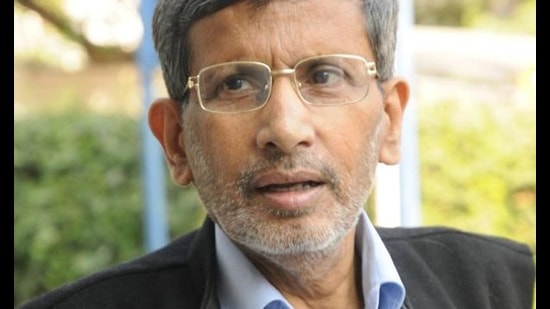
Shaibal Gupta was a remarkable figure in India’s intellectual life. From his base in Patna, he combined the local (he was deeply immersed in the politics, society, economy and finances of Bihar); the national (he paid close attention to central politics and worked closely both with government and institutions working in Delhi); and the international (he engaged with universities abroad, was a guide to a range of international academics who specialised in Bihar, and frequently hosted conferences that brought together fine global minds — the last such mega-conference, displaying Gupta’s intellectual breadth and interests, was to mark 200 years of Karl Marx’s birth and his legacy).
Indeed, Shaibal-da, as he was popularly known, had the ability to combine the practice of everyday politics with theory, and in a truly interdisciplinary fashion, weave together an understanding of statecraft, society and economy. And he did all of this while building and sustaining the institution that remained his true passion till the very end — the Asian Development Research Institute (ADRI). It was arguably Gupta’s presence and work that lent Patna a degree of intellectually vibrancy and edge often missing in other state capitals in the heartland, including Lucknow.
Gupta also made a pioneering contribution in explaining the historical roots and the evolution of Bihar’s politics, which have today become the staple of everyday political analysis.
{{/usCountry}}Gupta also made a pioneering contribution in explaining the historical roots and the evolution of Bihar’s politics, which have today become the staple of everyday political analysis.
{{/usCountry}}Conversations with him — either at his home or the ADRI office in Patna — often began with the debilitating, long-term impact of the Permanent Settlement regime, a severely exploitative method of extracting revenues during the colonial period, and how it set Bihar back. It meandered, in true adda-style over a cup of chai, to the absence of a sub-national identity in Bihar — Gupta was truly invested in efforts by Nitish Kumar, in his earlier terms, to bolster a broader Bihari identity beyond caste lines.
And then the conversation swung to the present political arithmetic, where Gupta’s formulation of a “coalition of extremes” — the dominant castes and the most marginalised sub-castes coming together within the Nitish Kumar-Bharatiya Janata Party alliance — was instrumental in explaining the persisting dominance of the National Democratic Alliance in the state. Returning to his economic roots, Gupta would often focus on State capacity and rule of law, where he thought that Kumar had done more than his predecessors in improving things. But he would also say, wistfully, that till Bihar got special status, it would not be able to move to the next stage of investment and industrialisation.
Beyond his intellectual beliefs and interests, two qualities of Gupta stood out. The first was his warmth, generosity and humour. He was often the first stop for anyone seeking to understand the state of play in Bihar. And Gupta was unfailingly courteous in sharing his wisdom and insights, and curious about the views and background of his interlocutors. In a way, besides his impressive written work, this came from his belief in the oral tradition of knowledge-transmission. And through it, Gupta never took himself seriously, often engaging in self-deprecatory humour.
The second was his commitment to institution-building, which, in the complex policy ecosystem in state capitals, also requires the ability to network and a high degree of pragmatism. Gupta was often seen as being too close to the government, especially with Kumar. But he appeared to believe that a policy institute, which used to produce the economic survey for the state government every year and worked with various departments on projects, had far more room in making a difference quietly than by engaging in blanket public criticism. This explained his relative reticence to criticise Kumar in public, even when he had apprehensions about his political moves in private.
Shaibal Gupta was rooted and cosmopolitan; idealistic and pragmatic; and an insider and outsider — all at the same time. Patna’s public life will not be the same without him.
The views expressed are personal