On October 8, the Intergovernmental Panel on Climate Change (IPCC), an international body for assessing the science related to climate change, released its landmark report on climate change at a special meeting in South Korea. The report is a scientific guide for government policymakers on how to implement the 2015 Paris Agreement, which aims to limit the rise in global average temperatures to “well below” 2C above pre-industrial levels, while seeking to tighten the goal to 1.5C. Meeting the 1.5C limit would demand “rapid, far-reaching and unprecedented change in all aspects of society”, the panel said. Temperatures would be 1.5C higher between 2030 and 2052 if the world continues at its current pace, it warned.
Even if we achieve the Paris Agreement target, a 2C rise in temperature will have an unprecedented impact on fauna and flora, including encroachment of boreal fauna into the tundra region. Similarly, marine species will shift to higher latitudes and the global tree lines to higher altitudes. With this kind of global warming, 18% of insects, 16% of plants and 8% of vertebrates will lose more than half of their ranges worldwide. The grimness of the situation can be gauged from the fact that we have set in motion, the sixth and the greatest mass extinction ever witnessed in the history of Earth.
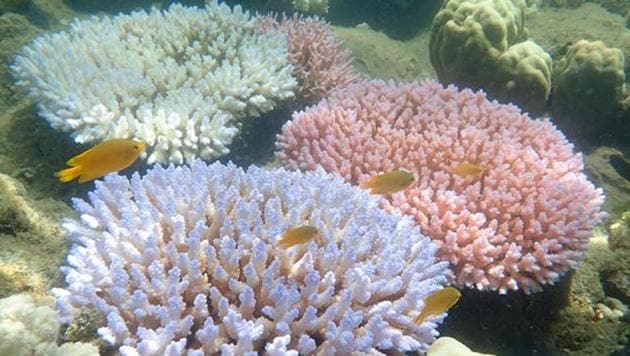
One of the most striking claims by the IPCC report is about the loss of coral reefs. Despite occupying only 0.1% of the ocean’s area, coral reefs support about one-fourth of marine species in the world. About 500 million people in the world are dependent on them for food and fisheries (Underwater Earth 2015). The corals ---- Charles Darwin defined them as “oasis in the desert of the ocean” ---- have an extensive presence along India’s vast coastline. Even in the best case scenario of achieving the Paris Agreement target, the world would still be losing about 70-90% of the corals. And if the rise is 2 degree celsius, we will lose almost all of the world’s coral. In the last two decades, corals have been dying due to bleaching, wherein they turn pale since they can’t support the algae population. This has been happening due to various factors: increased temperature of oceans, excessive surface runoff, overfishing, and oil spills or natural phenomenon like El Nino, to name a few.
Clive Wilkinson of the Global Coral Reef Monitoring Network says 10% of the Earth’s coral reefs have been reduced to skeletons, another 30% are in a critical condition and a further 30 are under severe environmental stress. Preliminary assessments indicate that the Indian Ocean is the most severely impacted region. More than 70% mortality has been observed off the coasts of Kenya, the Maldives, the Andamans and the Lakshwadweep islands. And about 75% of the corals have been reported to be dead in the Seychelles Marine Park System and the Mafia Marine Plant off Tanzania, says Wilkinson. The Wilkinson report also proved that corals were one of the first ecosystems to be affected by global warming. Other ecosystems will also be affected if the march of climate change continues unabated. Adequate mitigation and adaptation measures must be put in place to arrest such effects of climate change on human ecosystems.
{{/usCountry}}Clive Wilkinson of the Global Coral Reef Monitoring Network says 10% of the Earth’s coral reefs have been reduced to skeletons, another 30% are in a critical condition and a further 30 are under severe environmental stress. Preliminary assessments indicate that the Indian Ocean is the most severely impacted region. More than 70% mortality has been observed off the coasts of Kenya, the Maldives, the Andamans and the Lakshwadweep islands. And about 75% of the corals have been reported to be dead in the Seychelles Marine Park System and the Mafia Marine Plant off Tanzania, says Wilkinson. The Wilkinson report also proved that corals were one of the first ecosystems to be affected by global warming. Other ecosystems will also be affected if the march of climate change continues unabated. Adequate mitigation and adaptation measures must be put in place to arrest such effects of climate change on human ecosystems.
{{/usCountry}}We must devise policies to provide protection to existing carbon sinks such as corals along with developing an adaptation frameworks for others. Reducing emissions will be critical here. This mean increasing electricity generation from the renewable sources from 20% (2018) to 70 to 85% by 2050 rather than depend on the artificial removal of carbon dioxide from the atmosphere, which will not only require huge finances but the possibility of a leak of the sequestered carbon will always be there.
Parveen Kaswan and Akash Deep Badhawan are with the Indian Forest Service
The views expressed are personal