For Prime Minister Narendra Modi, replicating the performance of his first Independence Day address would have been a difficult task.
His speech from the ramparts of the Red Fort last year was masterful. Modi was new to Delhi; he spoke without a prepared text; from the headgear to getting rid of the bulletproof glass, there was a novelty; the national mood was optimistic.
Modi spoke of the confusion and discord he witnessed within government and his desire to make institutional structures coherent. He spoke of a moratorium on communal and caste-related violence. He announced new schemes, from the ambitious ones like Make in India and Jan Dhan Yojana to the more specific appeal to MPs to adopt a village. He also spoke of the responsibility of citizens in the spirit of shared responsibility.
The context, however, had changed by the time he arrived at Red Fort this year.
There is no national crisis, but the enthusiasm has partly faded. A narrative has built up about how the Prime Minister is losing the plot; it is business as usual; and India is again unable to tackle the core governance challenges it confronts.
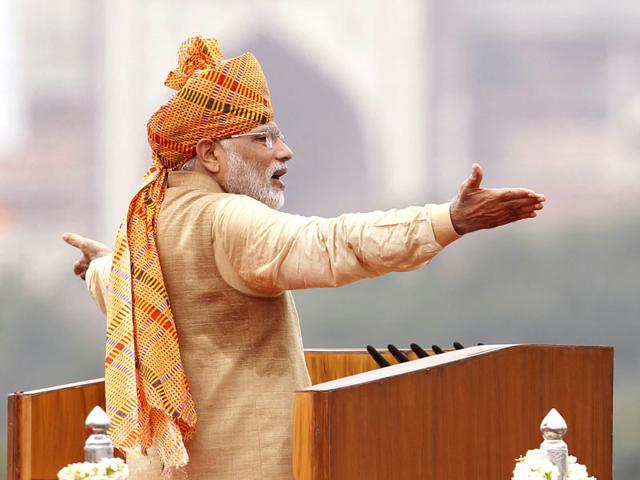
Video:PM Modi's I-Day speech
Traces of disillusionment have set in among key constituencies which supported Modi during the polls –army veterans angry about one rank one pension (OROP); young people who cannot yet see the jobs they had been promised; corporate India which is not satisfied at the rate of reforms; farmers who have seen a tough year.
Despite an overwhelming majority, the government had to confront a belligerent opposition and Parliament remained dysfunctional. Even the partial successes on the foreign policy front have done little to revive morale – in fact, many citizens appear to feel it has distracted from the core domestic challenges.
The primary challenge for Modi then was to tackle this perception; to convey that India was on track and the government was at work, on top of issues.
He spoke of the success under Jan Dhan Yojana and construction of toilets for girls in schools. To his credit, the Prime Minister reiterated the need for unity and attacked casteism and communalism – this assumes special salience because of the activities of foot-soldiers of the Hindutva parivar, which caused insecurity among minorities.
Modi did speak about corruption – the issue which has rocked Parliament over the past month. He said the problem was widespread, but claimed there had been no allegation against his government over the past 15 months.
Read:PM Modi wages war against graft in I-Day speech, says hopeful of OROP outcome
He reiterated his commitment to tackle black money; announced a new “Start Up India” theme to encourage entrepreneurship and said the government would encourage capital which generated jobs. With an eye on upcoming elections, he spoke of the need to help eastern India rise. Despite popular pressure, he did not go beyond an in-principle commitment to OROP.
But at the end of it, it was difficult to miss the sense that the parts did not add up to the whole. Despite the length of the speech, which triggered barbs on social media, Modi was unable to create a new narrative or tackle the sense of drift. This, in turn, could be attributed to a set of reasons.
One, Modi should have dealt with contentious issues facing his government more candidly. He may not have personally faced any corruption allegation, but there is now a stamp of impropriety associated with his regime. A firmer commitment to rework mechanisms of India’s political economy which facilitate corruption and adhere to stronger norms on conflict of interest – which is entirely missing in India – would have been reassuring.
His suggestion that delivery mechanisms for services have transformed radically and gone a long way in eliminating corruption is way too premature.
Second, the problem with the Modi sarkar is it is seen as strong on rhetoric and poor on implementation, because it has not thought through the policy implications.
OROP has become an albatross around the government’s neck because Modi promised it during the campaign and its own ministers have given artificial deadlines to veterans after coming to power.
Read:PM Modi wages war against graft in I-Day speech, says hopeful of OROP outcome
He reiterated his commitment to tackle black money; announced a new “Start Up India” theme to encourage entrepreneurship and said the government would encourage capital which generated jobs. With an eye on upcoming elections, he spoke of the need to help eastern India rise. Despite popular pressure, he did not go beyond an in-principle commitment to OROP.
But at the end of it, it was difficult to miss the sense that the parts did not add up to the whole. Despite the length of the speech, which triggered barbs on social media, Modi was unable to create a new narrative or tackle the sense of drift. This, in turn, could be attributed to a set of reasons.
One, Modi should have dealt with contentious issues facing his government more candidly. He may not have personally faced any corruption allegation, but there is now a stamp of impropriety associated with his regime. A firmer commitment to rework mechanisms of India’s political economy which facilitate corruption and adhere to stronger norms on conflict of interest – which is entirely missing in India – would have been reassuring.
His suggestion that delivery mechanisms for services have transformed radically and gone a long way in eliminating corruption is way too premature.
Second, the problem with the Modi sarkar is it is seen as strong on rhetoric and poor on implementation, because it has not thought through the policy implications.
OROP has become an albatross around the government’s neck because Modi promised it during the campaign and its own ministers have given artificial deadlines to veterans after coming to power.
Make in India is no longer as inspirational a slogan as it was last year because the systemic issues that need to be addressed to boost manufacturing have been neglected.
The Prime Minister spoke of how children are today flag-bearers of Swachh Bharat, but go to any government office and it will be difficult to find it clean – there has been little structural change to enable a cleaner India across the country.
There is a danger that Start Up India will end up being yet another slogan because Modi gave little sense of how this will work on the ground. Maybe he should have refrained from picking another slogan, and instead focused on articulating how past promises will be fulfilled.
Three, the tone of the speech was defensive. For instance, it is fine for Modi to caustically comment on those who issue negative comments in a poll rally but to spend a few minutes of a landmark Independence Speech to have a dig at critics and “political pundits” – a favourite straw-man – by calling them eternally negative comes across as petty.
Last year, when he spoke of the role of citizens, it came across as statesman-like. This year, his repeated references to Team India with 125 crore people came across as a way to escape from his own individual responsibilities by palming them off to a national collective.
Modi came across as positive, inspirational and energetic last year. This time around, one could not but feel there were traces of bitterness that had crept in. As the challenge of governing India seeps in, Modi will lead India into its 70th year as a free country with his hands full.
(The views expressed by the writer are personal. He tweets as @prashantktm)
Read:
Modi's Mann Ki Baat on I-Day: Silence speaks louder than words
No OROP deadline in Modi's I-Day speech, ex-servicemen upset
Modi makes strong pitch for poor, floats 'Start-up India' dream