A Neanderthal skeleton unearthed in an Iraqi cave already famous for fossils of these extinct cousins of our species is providing fresh evidence that they buried their dead - and intriguing clues that flowers may have been used in such rituals.
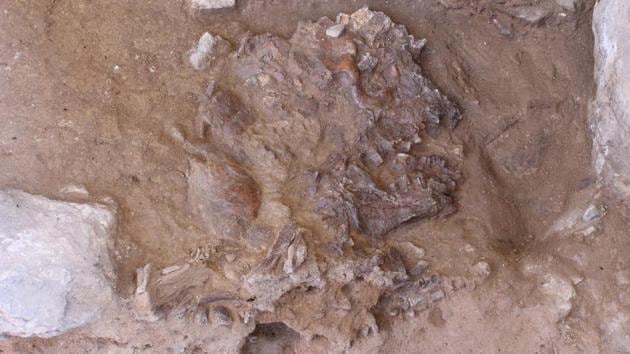
Scientists said on Tuesday they had discovered in Shanidar Cave in the semi-autonomous Kurdistan region of northern Iraq the well-preserved upper body skeleton of an adult Neanderthal who lived about 70,000 years ago. The individual - dubbed Shanidar Z - was perhaps in his or her 40s or 50s. The sex was undetermined.
The cave was a pivotal site for mid-20th century archaeology. Remains of 10 Neanderthals - seven adults and three infants - were dug up there six decades ago, offering insight into the physical characteristics, behaviour and diet of this species.
Clusters of flower pollen were found at that time in soil samples associated with one of the skeletons, a discovery that prompted scientists involved in that research to propose that Neanderthals buried their dead and conducted funerary rites with flowers.
That hypothesis helped change the prevailing popular view at the time of Neanderthals as dimwitted and brutish, a notion increasingly discredited by new discoveries. Critics cast doubt, however, on the “flower burial,” arguing the pollen could have been modern contamination from people working and living in the cave or from burrowing rodents or insects.
{{/usCountry}}That hypothesis helped change the prevailing popular view at the time of Neanderthals as dimwitted and brutish, a notion increasingly discredited by new discoveries. Critics cast doubt, however, on the “flower burial,” arguing the pollen could have been modern contamination from people working and living in the cave or from burrowing rodents or insects.
{{/usCountry}}But Shanidar Z’s bones, which appear to be the top half of a partial skeleton unearthed in 1960, were found in sediment containing ancient pollen and other mineralized plant remains, reviving the possibility of flower burials. The material is being examined to determine its age and the plants represented.
“So from initially being a sceptic based on many of the other published critiques of the flower-burial evidence, I am coming round to think this scenario is much more plausible and I am excited to see the full results of our new analyses,” said University of Cambridge osteologist and paleoanthropologist Emma Pomeroy, lead author of the research published in the journal Antiquity.
Cognitive Sophistication
Scholars have argued for years about whether Neanderthals buried their dead with mortuary rituals much as our species does, part of the larger debate over their levels of cognitive sophistication.
“What is key here is the intentionality behind the burial. You might bury a body for purely practical reasons, in order to avoid attracting dangerous scavengers and/or to reduce the smell. But when this goes beyond practical elements it is important because that indicates more complex, symbolic and abstract thinking, compassion and care for the dead, and perhaps feelings of mourning and loss,” Pomeroy said.
Shanidar Z appears to have been deliberately placed in an intentionally dug depression cut into the subsoil and part of a cluster of four individuals.
“Whether the Neanderthal group of dead placed around 70,000 years ago in the cave were a few years, a few decades or centuries - or even millennia - apart, it seems clear that Shanidar was a special place, with bodies being placed just in one part of a large cave,” said University of Cambridge archaeologist and study co-author Graeme Barker.
Neanderthals - more robustly built than Homo sapiens and with larger brows - inhabited Eurasia from the Atlantic coast to the Ural Mountains from about 400,000 years ago until a bit after 40,000 years ago, disappearing after our species established itself in the region.
The two species interbred, with modern non-African human populations bearing residual Neanderthal DNA.
Shanidar Z was found to be reclining on his or her back, with the left arm tucked under the head and the right arm bent and sticking out to the side.
(This story has been published from a wire agency feed without modifications to the text.)
Follow more stories on Facebook and Twitter