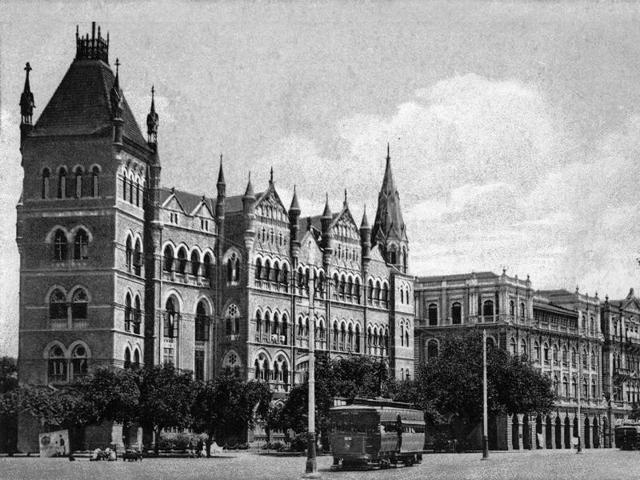
The British empire at the dawn of the 20th century was never vaster, stronger, more determined to last for a thousand years. India was the jewel in its crown, and Bombay, literally, its gateway, where rulers, civil servants, soldiers, merchants, missionaries, hunters in search of big game, maidens in search of husbands, and tourists, had their first glimpse of the fabulous East.
And what a glimpse it was: the sun-drenched harbour dotted with a hundred cheering sails; the barebacked coolies jostling for the honour to carry ashore the trunks of the sahibs; the victorias, garris, ekkas (carriages), recklas (cart pulled with two oxe, popular in many parts of Maharastra at the turn of the 19th century) and palanquins at Ballard Pier, vying for the same honour; the wide roads with their horse-drawn trams; the grand public buildings; the haughty statues; the ‘Europeans only’ hotels and clubs; the shops that catered to the refined; the churches; the picturesque native bazaars; the 360-degree panorama of the city from Rajabai Tower; the race course; the Malabar Hill; the vultures atop the Parsi Towers of Silence, waiting, waiting, waiting . . .
And the people! Just like those in the hand-coloured picture postcards from the Ravi Verma Press: the proud Mahratta brahmin; the fat Guzerati merchant; the bearded Mohammedan at prayer; the strangely attired Bohra; the equally strangely attired Khoja; the beautiful but, alas, unattainable, sari-clad Parsi woman; the polite Goan waiter; the plump Madrassi ayah; the fierce Afghan, the Gurkha; the Iranian; the Armenian Jew; the hook-nosed Arab horse trader; the inscrutable Chinese antique dealer; the tailor; the shoemaker; the punkah-puller; the bhistee who watered the roads twice a day; the snake charmer; the monkey man; the bear man; the juggler; the street dancer; the knife-sharpener; the dhobi; the hawker; the shoeshine boy; the scantily-clad fisherwoman . . . Truly, 1903 was the best of times in Bombay.
{{/usCountry}}And the people! Just like those in the hand-coloured picture postcards from the Ravi Verma Press: the proud Mahratta brahmin; the fat Guzerati merchant; the bearded Mohammedan at prayer; the strangely attired Bohra; the equally strangely attired Khoja; the beautiful but, alas, unattainable, sari-clad Parsi woman; the polite Goan waiter; the plump Madrassi ayah; the fierce Afghan, the Gurkha; the Iranian; the Armenian Jew; the hook-nosed Arab horse trader; the inscrutable Chinese antique dealer; the tailor; the shoemaker; the punkah-puller; the bhistee who watered the roads twice a day; the snake charmer; the monkey man; the bear man; the juggler; the street dancer; the knife-sharpener; the dhobi; the hawker; the shoeshine boy; the scantily-clad fisherwoman . . . Truly, 1903 was the best of times in Bombay.
{{/usCountry}}It was, alas, also the worst of times — for those who were not British, and not among the few Indians who were close to them or had been just born lucky. For years, Bombay had been battered by famines, plague, malaria, TB and cholera (what the British termed natural causes). The population of the city had actually fallen during those years — devastating families, destroying property prices and bringing mills to their knees from want of labour.
True, the worst of the nightmare seemed to be over by 1903 (though no one could be sure of it). Goaded by the British Parliament, the authorities in Bombay had started cleaning up the native quarters, widening roads and improving sanitation. The population of Bombay had begun to rise again and probably stood at 8 lakh. The mills were beginning to hum again. So were also construction sites and, happily, business, the lifeblood of Bombay. Food prices, which had gone sky-high, were coming down to affordable levels again.
But poverty stalked the land. Beggars abounded. And in some circles, among the educated people, resentment against the British rule. The resentment mostly found expression in the odd newspaper (such as Kesri, published by the great Bal Gangadhar Tilak) and in speeches at the annual sessions of the Indian National Congress. Nothing much, the British thought.
The real problem, they believed, lay in Calcutta, with its combative, English-educated, bhadralog (gentleman). The answer, Lord Curzon decided, was to partition Bengal into a largely Mohammedan East Bengal and a largely Hindu West Bengal.
And so the British partitioned Bengal. India—and Bombay—were never the same again.
Kiran Doshi is a former IFS officer and author of books such as Birds of Passage and Diplomatic Tales.
* Jinnah Often Came to Our House, Tranquebar, Rs 695