7 Vyapam accused summoned under wrong section by CBI, get bail
The CBI had summoned 88 people of the 490 accused under wrong Section 160 of CrPC, which empowers an investigating officer to summon people for recording statement at the office.
The Central Bureau of Investigation (CBI) that submitted chargesheet against 490 people in the alleged irregularities in the PMT 2013 examination conducted by Vyapam suffered a major embarrassment on Tuesday. The court granted bail to all the seven accused who were arrested as the agency had summoned them under a wrong section of the Criminal Procedure Code (CrPC).
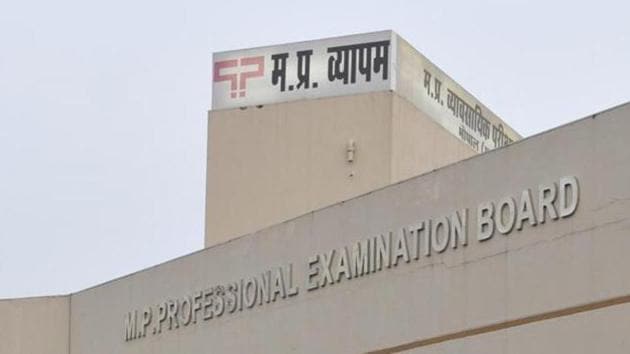
The Madhya Pradesh Professional examination board (Vyapam) building in Bhopal. (HT File Photo)
{{^htLoading}} {{/htLoading}}
Advocate Gopesh Shikkewal told HT that the CBI had demanded that the accused be sent to jail, but the court agreed with the defense since all of them were summoned under a wrong CrPC section and deserved bail.
The CBI had summoned 88 people out of the 490 accused under Section 160 of CrPC, which empowers an investigating officer to summon people for recording statement at the office. However, when the accused reached the CBI office in Bhopal, they were told to come to the court.
“In the court, the accused were told that a supplementary charge sheet was being filed. This meant that the accused would have been arrested and it was not certain whether bail would be granted or not. When the accused realised this, many of them ran away from the court premises,” said advocate Dinesh Tiwari who is representing 300 persons in the Vyapam case.
{{^htLoading}} {{/htLoading}}
{{^usCountry}}
The CBI then demanded that all those who fled should be declared as absconders under Section 224 of IPC, but the court refused when the defense argued that they were not summoned under Section 170 of CrPC.
{{/usCountry}}
{{#usCountry}}
The CBI then demanded that all those who fled should be declared as absconders under Section 224 of IPC, but the court refused when the defense argued that they were not summoned under Section 170 of CrPC.
{{/usCountry}}
The court gave 15 days time to other accused to file for their bail.
I have spent over a decade chronicling Madhya Pradesh’s political and social landscape, covering politics, investigative journalism, crime, human interest, and government policy, blending sharp insight with ground‑level depth. I have closely tracked three assembly elections, three Lok Sabha elections, leadership transitions in MP while exposing governance lapses, tender irregularities, and flawed policy rollouts. My reports have revealed gaps in the Cheetah project, irregularities in medical education, rigging in recruitment exams, and loopholes in policy implementation. In crime reporting, I have moved beyond FIRs to map systemic patterns — from organised crime networks and gender‑based violence to custodial accountability — balancing urgency with sensitivity. My journalism is defined by a commitment to human interest. I have profiled the marginalised Bancchda community, documented atrocities against tribal groups, and highlighted efforts to preserve their culture through heritage liquor and revival of spiritual practices. I have reported on farmers struggling with failed MSP promises, giving voice to those often reduced to statistics in policy files. Passionate about field reporting, I have reported on rampant sand mining in Chambal and Narmada, pharmaceutical companies supplying medicines under altered names, the dire condition of schools and colleges, the plight of commercial sex workers, and skewed sex ratios in specific districts. Beyond deadlines, and as HT’s state correspondent and assistant editor in Madhya Pradesh, I engage with ministers, farmers, students, and activists, believing the best policy stories begin with a single human voice. A postgraduate in Journalism and Mass Communication, I also hold a diploma in sports journalism.