In 2009, Greek film-maker Yorgos Lanthimos made a film called Kynodontas (Dogtooth in English), a dystopian drama about three children brought up in absolute isolation within a fenced-in home by controlling parents who govern their language, behaviour and sexual conduct. It was a tale of terrifying distortions.
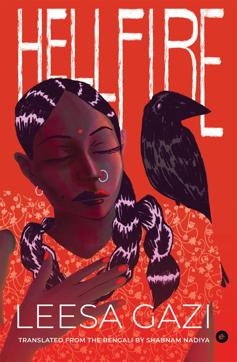
Bangladeshi-British writer, actor, scriptwriter and filmmaker, Leesa Gazi’s Bengali novel Rourob is mildly reminiscent of Dogtooth. Written a few years ago, and recently translated by Shabnam Nadiya, Hellfire is the intriguing story of a household ruled by fierce matriarch Farida Khanam, who exercises autocratic control over the family, the support staff, and especially her two daughters, Lovely and Beauty.
The story begins on a winter morning in Dhaka. Lovely, the older sister, is allowed to step out of home all by herself for the first time in her life on her fortieth birthday with explicit instructions to be back home by lunchtime. For Lovely, the unprecedented event of going to a market is nothing short of the adventure of a lifetime. The first half of the narrative is about Lovely’s day out as she people watches in a park after her shopping expedition, and has ordinary encounters in the outside world -- a little girl selling peanuts and a man in a red muffler who falteringly propositions her. All the while, she converses and parries with the voice in her head, a male alter ego who guides, chides, provokes and often cackles wickedly at her many predicaments. Seizing the day, she deliberately commits an act of transgression and returns home hours beyond her curfew.
The linearity of what takes place within the span of a single day unfolds visually one frame after another. The present is punctuated with back stories that reveal the complex web of unhealthy family dynamics via the interplay of characters. In an acutely patriarchal society, here is a family paradoxically ruled by a woman with an iron fist. In the guise of protecting her children, Farida usurps personal space and inflicts emotional abuse. Juvenile punishments are doled out to grown women. There is a moment of candour with the man with the red muffler in the park when he asks Lovely: “What does your mother do when she is angry?” and she replies:”She sends us to our rooms and locks our doors from the outside. Sometimes it’s just two or three hours, but sometimes it’s like two or three days. Amma opens the door and brings in food, she stays and chats, asks what we want for lunch or dinner. Sometimes, she sits and watches television with us, then she locks the door and leaves.” It is an existence where hours are filled with watching television, indulging in elaborate beauty routines or playing secret games. Birthday meals have a ritualistic rigour, year after year for 40 years, the birthday menu has been: hilsa polao, eggplant cooked in yoghurt and spicy duck curry, a tomato salad, tossed with onions, green chillies and cilantro, and brown rice to go with the duck meat. “The thought of having to eat hilsa polao when she got home nauseated her.” thinks Lovely as she makes time stretch for her in the outer world.
{{/usCountry}}The linearity of what takes place within the span of a single day unfolds visually one frame after another. The present is punctuated with back stories that reveal the complex web of unhealthy family dynamics via the interplay of characters. In an acutely patriarchal society, here is a family paradoxically ruled by a woman with an iron fist. In the guise of protecting her children, Farida usurps personal space and inflicts emotional abuse. Juvenile punishments are doled out to grown women. There is a moment of candour with the man with the red muffler in the park when he asks Lovely: “What does your mother do when she is angry?” and she replies:”She sends us to our rooms and locks our doors from the outside. Sometimes it’s just two or three hours, but sometimes it’s like two or three days. Amma opens the door and brings in food, she stays and chats, asks what we want for lunch or dinner. Sometimes, she sits and watches television with us, then she locks the door and leaves.” It is an existence where hours are filled with watching television, indulging in elaborate beauty routines or playing secret games. Birthday meals have a ritualistic rigour, year after year for 40 years, the birthday menu has been: hilsa polao, eggplant cooked in yoghurt and spicy duck curry, a tomato salad, tossed with onions, green chillies and cilantro, and brown rice to go with the duck meat. “The thought of having to eat hilsa polao when she got home nauseated her.” thinks Lovely as she makes time stretch for her in the outer world.
{{/usCountry}}As the story progresses, the many shades of Farida Khanam emerge to reveal her gradually crumbling core. “She was sacrificing her life to make sure her daughters enjoyed all creature comforts. Nothing took priority over their needs and their safety. What else could she have done for them? She hadn’t even married them off.” “How she had shielded the girls every livelong day that Allah had created! She had sheltered them the way hens kept their chicks under their wings.” she tells herself even as her carefully engineered world starts unravelling.
The father is a man who lives in the shadows. Sweetly lulled by old Hindi film songs, Mukhles Shaheb keeps a wary distance from his wife’s wrathful personality. Lip-service is paid to his position as head of the family in the form of a seat at the head of the dining table. “He had been planted into this household like an alien tree. He didn’t have much to do with the household. He was neither loving nor neglectful towards the girls. His relationship with everything was similar - without attachment. However he was blind in his dependence on and faith in her (Farida Khanam).”
Hierarchical norms and roles are etched in stone just like the class divide between the family and the house help is immutable. As Farida Khanam’s mother, a formidable woman herself, whose “enormous household operated completely under her thumb” advises her newly married daughter, a young Farida, “The duty of a worthy woman is to absorb… Now that house is your own, that man is your husband - no matter what he’s like.” It sums up the collective conditioning of an entire subcontinent, across generations.
But Gazi does not entirely circumscribe the inner lives of her characters even as they acquiesce to their repressed lives. The girls explore the salacious world of Rashomoy Gupta’s porn booklets smuggled into the house by a visiting male cousin. His presence gives Lovely an opportunity to engage in a furtive fling. In one of her conversations with her alter ego in the park, he nudges her with a memory, “.... fingers aren’t half bad. Apumoni, do you remember that first time? You, the bed, the room - everything just shook and shimmied!” just as she is contemplating accompanying the stranger in the red muffler, “I want to know, just once, what it feels like.” Beauty, the mercurial one finds her release through clandestinely bought marijuana sticks.
Nadiya’s translation is justly stark and captures the mood of inevitable foreboding. On occasion, there are lines that transcend the act of storytelling: “Her gaze is as unshifting as the white of a riverine island, as the light of a half-moon, as the headlights of a night train stalled for eternity.” Or: “Darkness had congealed in the landing, but a sliver of fierce sunlight was busting its gut under the door, desperate to find a way in.” Gazi writes a dark, thought-provoking page-turner. Hellfire is a slim and easy read about a very uneasy story with a chilling denouement.
Sonali Mujumdar is an independent journalist. She lives in Mumbai.