On a balmy evening in the Aravalli hills, Suraj, a five-year-old girl, stood washing her hands and feet in a drain. Suddenly, her pitiful screams caught the attention of a few kids. Elders from the Bhil settlement of Kadua began their search and found her severed palm in the hilly forest, and her mutilated body further on.
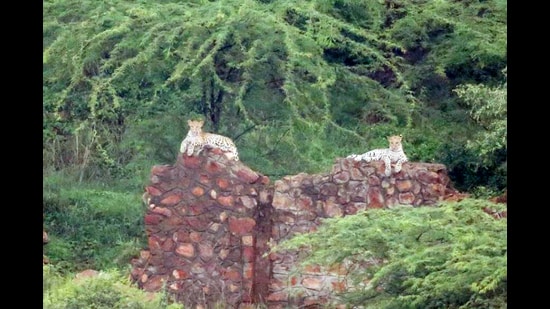
In another hut, “Cheetah! Cheetah!” the daughter of a woman who was killed by the same leopard keeps repeating. 10 people, including a
On a balmy evening in the Aravalli hills, Suraj, a five-year-old girl, stood washing her hands and feet in a drain. Suddenly, her pitiful screams caught the attention of a few kids. Elders from the Bhil settlement of Kadua began their search and found her severed palm in the hilly forest, and her mutilated body further on.
In another hut, “Cheetah! Cheetah!” the daughter of a woman who was killed by the same leopard keeps repeating. 10 people, including a temple priest, five women and a child, have been the victims of the maneater of Gogunda, Udaipur. The tale unfolded with a terror that is as ancient as it is visceral.
A Sharpshooter Amid Media Frenzy
After trying all measures, the Forest Department (FD) invited a sharp-shooter Nawab Shafat Ali Khan, highly experienced in dealing with troublesome wild animals, from Hyderabad. As the TRP chasing media sensationalised the story, someone in Delhi filed a PIL against the shoot-at-sight order. The FD got alarmed and worked on tranquilising the big cat instead of shooting it, a particularly difficult task in thick foliage after the rains. The shooter returned with his trained retinue amid cries of #GoBack on social media. A policeman subsequently fired an unsuccessful shot, leaving the leopard alert and wary.
A Nurse or Surgeon?
Four leopards were captured, none of which was the maneater. Another one was hacked to death. Yet another has been shot dead last week, which the FD is suspecting to be the maneater. The forest and the police department, from the ground staff to highest officials, have been working around the clock risking their lives. When you have a burst appendix, do you need twenty nurses or one surgeon? The FD is neither properly equipped nor trained to capture or kill a maneater. The teams even lack searchlights, let alone leopard behavioural experts. Police are trained to control mobs, not a clever, nocturnal ghost of the forest. The FD, although well-intentioned, is woefully short of expertise. I remember a senior officer once telling me how a leopard turns maneater by tasting human blood. I respectfully had to explain otherwise. Also, animals tend to get more aggressive when they are routinely caught and released. It has taken 10 people and six leopards so far, and everyone dearly hopes this is the end. The sharpshooter should have been given the timely order to kill.
The Nature of the Beast
My father, Raza H Tehsin, a wildlife behavioural expert and ex-member, Wildlife Advisory Board of Rajasthan, points out how generous leopards generally are. They do not hunt wantonly, let their prey suffer or kill a human during an unavoidable encounter. A tiger would mince a human in a similar scenario. However, when it turns a maneater, the leopard is more dangerous. Unlike the tiger, which kills in the forest, the leopard enters villages and houses. It can even open a swing latch by putting its paws on the other side of a door. And it is very difficult to kill due to its heightened shrewdness. Another less known fact is that animals, like humans, are generally right-handed. To avoid a cow butting you with its horn or a pig hitting you with its snout, you can jump on the left to confuse it. As leopards are not used to killing bipeds, he adds, they bring them to the ground first.
Tehsin has been vocal for decades about the dearth of prey in the Udaipur forests for carnivores. As a measure, he has been suggesting breeding and releasing hares, as they multiple quickly and provide a staple for many. The shooter Mr Khan, in an online interview, lamented how in the six hours while tracking the animal, he didn’t come across a single wild boar or hare, or even dogs in the village. Leopards often enter villages in search of stray dogs and cattle. They might come across a human and kill it accidentally or mistake a young child for monkey. Or an incapacitated or injured (say by killing a porcupine) leopard, or the cubs of a man-eating mother may resort to killing humans. Once they lose the fear of humans, they realise how easy it is to stalk and kill the biped.
The Ethics of Killing
My grandfather TH Tehsin, one of the earliest big game hunters turned conservationists of India, received requests from the royal court before independence and later the administration of Udaipur, to cull maneaters and cattle-lifters plaguing poor tribals. My father, the initiator of the wildlife conservation movement in southern Rajasthan, continued to receive these in later years. The Wildlife Protection Act, 1972 (Section 11) clearly states that the authorities have the right to issue an order to kill if an animal becomes dangerous to human life, crops or property.
Conservation, a word that bears so great a burden, comes with difficult choices. To kill a maneater is conservation to its core. It’s not only to save human lives, but also stops people from turning against every leopard that they come across. We can’t change the nature of the beast, and I am not talking only about the leopard.
The Limits of Empathy: A City’s Distant Compassion
Here’s where our anthropocentric view enters the most dangerous of territories — not just physically but morally. It goes deeper into the philosophical rabbit hole.
In the misguided fight for cruelty against animals — a front that is generally held by the affluent — tends to overlook the silent cruelty brought by cutting, slashing, killing, extracting the wild for “progress”. It reflects an increasing gulf between us and nature, the prosperous and the poor.
In any civilization, human lives come first. Why should saving lives be size specific? A bite-sized mosquito causing a dengue epidemic also has the right to life. Shouldn’t it be captured, not killed? Let’s stop fumigations and cruelly gassing these insects to death in the millions. Does that sound absurd? Well, the truth is we tend to have a much kinder outlook towards things that are not likely to happen to us. Like the rights of a leopard that is not going to decapitate our little girl. Is the plight of the poor a language we can never learn with our concrete imagination?
A Childhood Memory
When I was bite-sized myself, my father took us on one of our regular jungle trips to Kumbhalgarh. At night, while all others slept in the forest guesthouse that was beside the stream, my father and I slept on two cots outside. In the morning, we found the fresh pugmarks of a leopard that had passed between our cots. It would have come to drink water, and without disturbing us, drank it and went away.
The question we need to ask ourselves is — is it right to trade the lives of these innocent large-hearted cats and of humans too to save one maneater? I don’t need to ask ChatGPT to find an answer.
Arefa Tehsin is Ex-Honorary Wildlife Warden, Udaipur. She is also the author of The Witch in the Peepul Tree, which has been shortlisted for The Asian Prize for Fiction.
One Subscription.
Get 360° coverage—from daily headlines
to 100 year archives.
Archives
HT App & Website