
 E-Paper



Birender Yadav: “Caste is the engine that drives the bonded labour system”
The exhibit at the Kochi-Muziris Biennale, that dives into the lives of migrant brick kiln workers, forces viewers to acknowledge lives they usually ignore

 Prefer HTon Google


Growing up in Dhanbad with a father working in the coal mines, when did you first recognise the artistic potential in the tools, labour, and working-class culture that surrounded you?
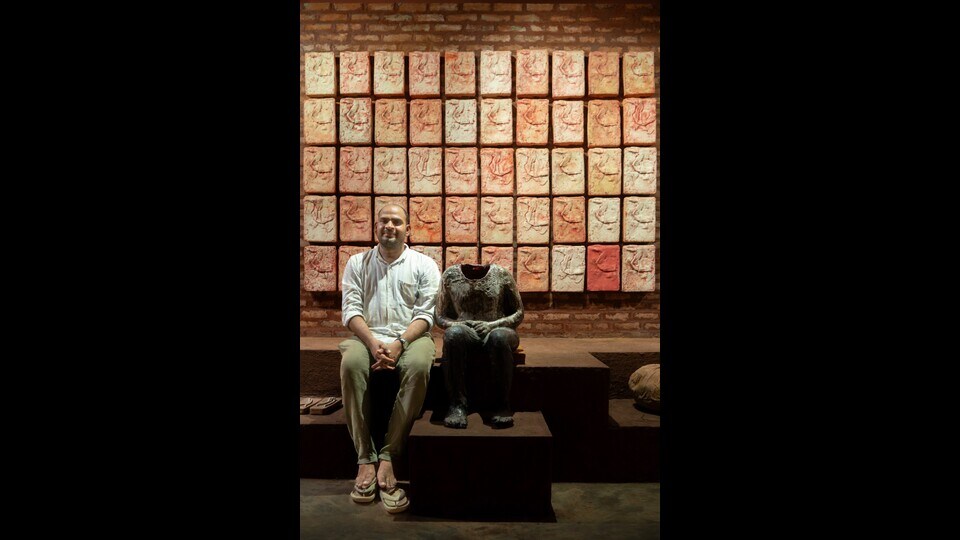
I didn’t see it as ‘art’ initially; it was just my reality. My father was a blacksmith for Tata Steel Coal Limited, and the soot, iron, and heavy manual labour were the backdrop of my childhood. The realisation came later, during my time at BHU (Banaras Hindu University). I looked at the ‘high art’ being taught and realised there was a massive disconnect between those aesthetics and the life I knew. I saw that the calloused hands of my father and the blackened tools he used possessed a profound sculptural language. That was when I decided that the labourer shouldn’t just be a subject of art, but that the tools and materials of labour should be the art.

You’ve described your work as “between art and activism — a kind of silent protest.” Please talk about where you draw the line between documentation and advocacy in your practice?
I don’t think there is a hard line. Documentation is the foundation — you must record the truth of the condition. But in the Indian context, simply documenting the lives of the marginalised is an act of advocacy because these people are often rendered invisible by the state and the urban elite. My ‘silent protest’ lies in the scale and the material. By recreating a labourer’s meagre possessions in terracotta and placing them in a gallery, I am forcing the viewer to acknowledge a life they usually ignore. The action happens in the mind of the viewer when they realise the ‘art’ they are admiring is the result of a system of exploitation.
Since 2014, you’ve been visiting the brick kilns of Mirzapur regularly. How has your relationship with these seasonal migrant workers evolved from observer to collaborator over the past decade?
Initially, I was an outsider with a sketchbook/camera. There was a lot of suspicion — workers often think outsiders are government officials or activists who will get them into trouble with the kiln owners. Over 10 years, I stopped being a visitor and became something else. I started staying with them, and actually making works with them, particularly the children. My work became a collaboration when I started using their techniques. I wasn’t just ‘drawing’ them anymore; I was using their physical labour processes to create my sculptures. They began to see their own lives reflected in my work, which changed the power dynamic from ‘subject/artist’ to ‘shared experience.

Many brick kiln workers are trapped in bonded labour systems — about 60% are lower-caste seasonal migrants. What did you learn about how caste, religion, and ethnicity intersect within the kiln hierarchy?
The kiln hierarchy is a microcosm of the Indian caste system. Statistics show that roughly 60% of these workers are from Scheduled Castes (Dalits) or Scheduled Tribes (Adivasis), and a significant portion are from minority religious groups. In the kilns, I observed that the ‘Patheras’ (moulders) are almost exclusively from these marginalized backgrounds. The ‘higher’ roles, like the ‘Munshi’ (accountant) or the contractors, usually come from dominant castes. Caste is the engine that drives the bonded labour system; it provides the social justification for keeping these families in a cycle of debt and physical toil. It is impossible to talk about labour in India without talking about the structural oppression of caste.
You’ve noted that most brick kiln workers suffer broken ribs from the hard labour. When you created the suspended bent vertebra in terracotta, what conversations or observations led to that specific sculptural decision?
The physical toll of carrying 50-70 kilograms of bricks on one’s head or back for 12 hours a day is devastating. Many workers told me about chronic pain, and many indeed suffer from stress fractures or collapsed vertebrae. The decision to create the suspended bent vertebra in terracotta came from seeing a worker slumped over after a shift — his spine looked like a curved tool. I wanted to freeze that deformity in clay. Suspending it makes it ghostly; it represents the ‘broken back’ of the working class that supports the weight of our entire construction industry and urban expansion.
Everything in the installation — the tools, folded clothes, the sandook (tin trunk), even fragments of bones and bodies — is rendered in terracotta, the same material the workers handle daily. Why was it essential that the installation be made from the very substance of their labour?
Terracotta is the basic of the brick kiln. The workers spend their lives with their hands in this mud, shaping it, drying it, and firing it. Using the same material was a way to create a physical and spiritual link between the object and the maker. If I made a tin trunk out of metal, it would just be a trunk. By making it out of the same clay as the bricks, the trunk becomes part of the worker’s body. It suggests that the worker, the tool, and the product are one and the same — eventually, the labour consumes the labourer until they are just another piece of fired earth.

The handcart packed with brick moulds sits at the centre of the installation. Why the handcart specifically — what does it symbolize beyond being just a tool?
The handcart is the vehicle of the migrant. It represents the perpetual state of transit. These workers are seasonal; they own nothing that cannot be moved. The handcart at the centre represents the burden of mobility — the fact that to survive, you must always be ready to move your entire life to the next kiln, the next site of exploitation. Beyond a tool, it is a symbol of the ‘unbelonging’ of the migrant worker in the very cities they help build.
At Aspinwall House, your installation occupies centre stage — a prominent position for a relatively young artist. What does this visibility mean to you, and what responsibility comes with it?
I’d be lying if I said there wasn’t a deep sense of excitement. As a young artist from a background like mine, standing in a space as storied as Aspinwall House is a massive personal and professional milestone. But that excitement is quickly met by a heavy realisation: the work didn’t get here because of me; I got here because of the work.
The danger of such a prominent stage is that the struggle of the labourers could easily become a ‘tool’ or a backdrop for my own career advancement. I have to be incredibly careful to reverse that dynamic. My goal is to ensure that I become the tool for their presence. The installation isn’t there to showcase my skill with terracotta; it’s there to occupy space on behalf of those who are usually evicted from it. The responsibility lies in making sure that when people walk through that central hall, they aren’t looking at my success, but are instead confronted by the systemic weight of the lives I’m representing. If I’ve done it right, the artist disappears, and the reality of the kiln remains.
Arunima Mazumdar is an independent writer. She is @sermoninstone on Twitter and @sermonsinstone on Instagram.


