
 E-Paper



Book Box: Loving The Other Reader
The Other Reader says he will read fiction when he retires. He says this lightly, conversationally.

 Prefer HTon Google


The Other Reader hasn’t read a novel in nineteen years.
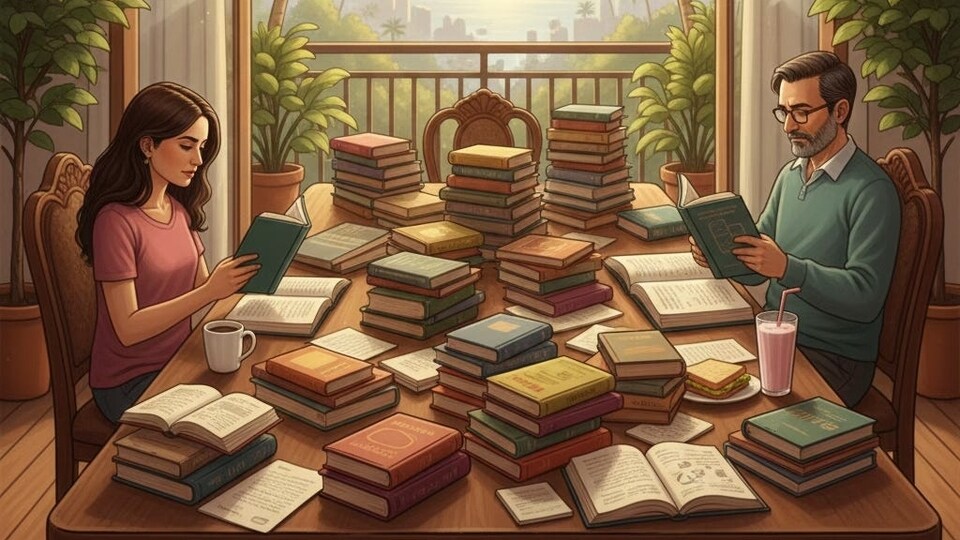
Once he read Rushdie and Sarat Chandra under hostel tube lights, Tolkien on overnight trains, Tagore on summer afternoons in Kolkata when the ceiling fan swirled the heavy humid air above him. This surprises people who know him now — the man whose shelves bend under the weight of business management and evolution, the Romans and the naked ape. Yes, I tell them. He used to read fiction.
On a July morning nineteen years ago, he stood in line for the final Harry Potter. He took the book home. He laid the hardback on the dining table, removed the dust jacket with the careful reverence of a man handling sacred objects. The house smelled of toast and impatience. The girls were already agitating, arguing. “Why not me first?” We drew lots. He won. He skipped office that day. He read.
There was a time this was an argument.
“You never read my non-fiction,” he said, pressing Guns, Germs, and Steel into my hands.
“Read this instead, this one is as important, this one you will love” I would say in turn, pulling out Cloud Atlas or Never Let Me Go from the bedroom bookshelf and handing it to him. He would accept it, politely. He would place it on his bedside table. But he wouldn’t even begin reading it. It upset me. It felt like a refusal to enter my world, a rejection of it.
And then I read If On a Winter's Night a Traveller by Italo Calvino, a seductive, cerebral and even maddening novel about reading.
The two protagonists are the narrator ‘I’ and the ‘Other Reader’ or Ludmilla.
They draw you in with them into hunting for a grand novel, and they find fragments — a spy thriller, a war story, an erotic mystery, a philosophical allegory, detective fiction and so on.
Every time you begin a story, it breaks off. You are denied immersion. You are forced to notice yourself noticing.
Calvino made me realise that there are different kinds of readers — and that loving one does not mean turning him into the other.
I understood myself then: stubborn Ludmilla, reading for immersion, and atmosphere and defender of the novel’s right to sprawl and dream and take its time to arrive at a thousand destinations. I refused his non-fiction, because it asked me to stay present, to analyse, to remain myself on the page. It felt worthy and productive and felt like something I should do. Fiction felt indulgent. But I was living in novels. I am, to be honest, still living in novels.
And he became, in my mind, the Other Reader, the one whose reading is not escape but engagement. He reads to understand the world he feels responsible for inhabiting. I realised that the July day with Harry Potter and the Deathly Hallows — the complete subjugation to a story, the skipping of office, the hours lost — had shaken him. His refusal to read more fiction was caution. It seemed to say: If I permit myself to be possessed by a story again, I may never find my way back.
I began to accept his reading, not seeking to possess it anymore and simply let him read what he needed to read.
Then last month: Ed Yong’s An Immense World. A book about animal senses, about all the invisible frequencies humming alongside our own. On a Sunday morning, I was reading this at the dining table with my mug of coffee. He looked across at me.
“You’re reading non-fiction,” he said, sounding surprised.
I looked up. “I do sometimes.”
He sat down beside me, his chair scraping against the floor. “Which one?”
I showed him the cover. He’d read it of course. “ Wait till you get to the electric fields. The surface vibrations. The magnetic fields,”
“I’m only on sight, on the jumping spiders with eight eyes that swivel,” I say.
The Other Reader says he will read fiction when he retires. He says this lightly, conversationally, the way one says I will learn Sanskrit when I have time or I will finally organise the study.
On a recent Sunday, over breakfast — I had made his favourite sandwiches, filled with slightly runny eggs and melted cheese — he brought it up again.
“When we’re in Manali,” he said, “I’ll have time to read fiction.”
“You’ll find something else to do.”
“Maybe.” He took a sip of strawberry milkshake . “But I might read.”
“You might ?”
He may. Or he may not.
As for me, I have started collecting books for us — Asimov, whose stories he once loved, Dan Simmons whose Hyperionseries he hasn’t yet read, Lawrence Block and Tana French and all the mystery writers I long to share with him. I stack them in cardboard cartons, the weight of them growing heavier with each addition. I mark each one with an M in black pen. M for Manali. M for mountain house. M for maybe.

I think back to Calvino, who ends his novel with the Reader and Ludmilla in bed, the light switched off, the Reader saying he has almost finished. It is a beautiful ending, poised and perfect. And I picture us, years from now in our Manali bedroom in our parallel readings, morning light pooling on pinewood floors. The air thinner, sharper.
I will have my stack of historical fiction, my murder mysteries, my literary award winners. And the Other Reader will have his Romans, religion, the history of evolution, etc.
I will hand him Brotherless Night. Or The Corrections. He will open the book and start to read. Or he will not.
We will sit in that high-altitude silence, reading the same book or different ones. It won’t matter. Outside the glass windows, the tall deodar trees and the snow capped Pir Panjal range will stand as witnesses to our story.
I wonder: do you have someone like this at home? Someone whose reading or refusal to read once stung you, and then you learned to let be?


