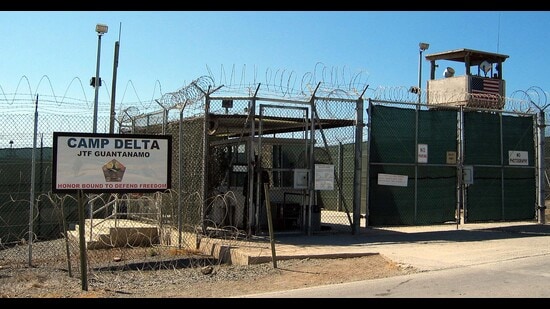
The London-based investigative journalists whose earlier books include The Exile, Deception and The Siege, lays bare the US official policy of torture or “Enhanced Interrogation” as the CIA calls it. This book focuses on the case of Abu Zubaydah, a stateless Palestinian, who grew up in Saudi Arabia, and was held six months after 9/11 and accused of being number three in the Al-Qaida. Tortured in custody, two decades on, he continues to remain imprisoned in Guantanamo, “incommunicado forever”, without being charged with any crimes. The Forever Prisoner includes extensive reporting and interviews with key protagonists, information from thousand of previously classified official documents, drawings by detainees, and excerpts from diaries that provide a comprehensive picture of the CIA torture program. The authors state the CIA “mischaracterised Abu Zubaydah – for their own ends – and then falsified his role, aims and actions, to better the CIA, and its relationship with the White House.” “CIA had vastly inflated Abu Zubaydah’s connections to Osama Bin Laden, lied about his knowledge of future attacks, and then covered up the wrongdoings by destroying or hiding evidence of abuse,” they write. Based on their research and what they discovered over the course of five years, and eventually corresponding with Abu Zubaydah via letters, the authors believe “almost everything ever written about Abu Zubaydah was wrong.” They’re hoping the book “goes some way to setting his record straight.”
How does your book challenge or expand upon the existing knowledge in the public domain about the treatment and torture of detainees by the US government at the black sites, in Thailand, for example, particularly focusing on Abu Zubaydah’s detention and his “enhanced interrogation” there?
The two principals in this CIA experiment were Zayn Abu Zubaydah and Dr James Mitchell. The former was a stateless Palestinian, who grew up in Saudi Arabia, seeking education in Pune and Mysore in India, and becoming a wealthy self-made merchant, before signing up to train for jihad in Afghanistan. Injured almost immediately, he was evacuated out of the war zone, to become, over the next decade, a logistics facilitator for others seeking training, before his capture by the ISI and CIA in Pakistan, in 2002. It is worth noting that the ISI was rewarded with millions of US dollars for giving up Abu Zubaydah. The ISI had learned where he was through the ISI-sponsored Lashkar-e-Toiba that helped jihadists flee Afghanistan after 9/11. After turning him in for reward money, the ISI then went along with the US story that Abu Zubaydah was an Al Qaeda leader responsible for 9/11 and planning a second wave of attacks against the United States.
{{/usCountry}}The two principals in this CIA experiment were Zayn Abu Zubaydah and Dr James Mitchell. The former was a stateless Palestinian, who grew up in Saudi Arabia, seeking education in Pune and Mysore in India, and becoming a wealthy self-made merchant, before signing up to train for jihad in Afghanistan. Injured almost immediately, he was evacuated out of the war zone, to become, over the next decade, a logistics facilitator for others seeking training, before his capture by the ISI and CIA in Pakistan, in 2002. It is worth noting that the ISI was rewarded with millions of US dollars for giving up Abu Zubaydah. The ISI had learned where he was through the ISI-sponsored Lashkar-e-Toiba that helped jihadists flee Afghanistan after 9/11. After turning him in for reward money, the ISI then went along with the US story that Abu Zubaydah was an Al Qaeda leader responsible for 9/11 and planning a second wave of attacks against the United States.
{{/usCountry}}James Mitchell was also self-made and rose from a blue collar family and considerable poverty to become a well-regarded military psychologist, who served for many years – repeatedly promoted and decorated – for helping US armed forces personnel survive or prepare for potential capture and interrogation. After 9/11, Mitchell volunteered to come out of retirement and assist the CIA in interrogating captives, having claimed they were trained to resist interrogation – something that was untrue and based on a misreading of available information by a psychologist with absolute no understanding of the culture in which Abu Zubaydah and others operated in – but also a man, who on a personal level was overcome, if not defined by his rampant Islamophobia. Dr Mitchell was also motivated by Agency talk that there was a second, devastating wave of attacks planned on US soil, potentially involving a dirty bomb or some kind of WMD.
Abu Zubaydah and James Mitchell met for the first time at a CIA black site in Chiang Mai, in northern Thailand – housed in the holiday home of a Thai general, who was friendly with the CIA station chief in Bangkok.
In our book, the detainee and his interrogator talk deeply and fluidly about their lives, what led them to this fateful meeting, and what the consequences were for both of them: devastating and life changing in both cases.
But if these two – the detainee and interrogator contracted to the CIA – are the principals in this story, we also got to many others who have never talked about this program openly or publicly, including the CIA’s chief counsel, its contracting interrogators, the Agency officer who designed and commissioned portable black site interrogation units that could be dropped off around the world, and, of course, the psychologists whose false science underpinned the program, and some of those detained within it, their families and loved ones.
As well as primary sources, we also obtained thousands of documents released by the legal process of disclosure in US courts where lawyers are still attempting to explore war crime charges against the CIA, and habeas corpus actions etc. These documents were often heavily redacted, and so we worked with lawyers from Yale to get them released in full using Freedom of Information Laws. We repeatedly sued the CIA, winning numerous unredactions. Eventually, we had thousands of cables and reports from medics, intelligence officers, White House lawyers, Justice Department officials, and even FBI notebooks filled during the first, pre-CIA interrogation sessions with Abu Zubaydah in March and April 2002.
The human sources and archive of official documents – which ran to thousands of pages – and drawings by detainees, their diaries – make this the most complete picture to date of the CIA torture program and it demolishes key planks of the CIA and White House reasoning in commissioning the torture program. The book also demonstrates its horrifying global consequences and exposes wholesale the lying and law breaking by spies and officials (elected and not) in the US and Europe.
How effective, in the end, was the CIA’s torture program in eliciting actionable intelligence from detainees, or in preventing the second wave of attacks and making the US – and the world – safer?
There was no useful intelligence derived from the torture program. Much of was obtained was either demonstrably false or dangerously misleading. The CIA knew this and continued to lie and was so worried about what it was commissioning in its black sites that it sought to indemnify all of its staff officers, who were given assurances they would never be prosecuted for war crimes, but also a verification from the US Justice department that Abu Zubaydah would never be released, not for who he was, but because of what he had endured.
There was, almost certainly, no credible second wave of attacks. Instead, these threats were misread or manufactured by the CIA that was trying to recover from the reputational damage of failing to stop the 9/11 attacks. Just like there were no WMD in Iraq – the principal reason for invading Iraq – and the intelligence for which was almost wholly derived from the torture of a detainee who, wanting the pain to stop, made up a claim that Al Qaeda had aided Saddam in manufacturing nuclear, chemical and biological weapons, having been told to say as much by his interrogators – who were supervised by the CIA.
Abu Zubaydah was verifiably never in Al Qaeda, and – as the evidence shows - he did not plot or help fund 9/11, or any other attack on the US and the West. He did not support Osama bin Laden and had never sworn a bayat to Al Qaeda. As a Palestinian, his focus was Israel’s occupation of his homeland, Palestine. As his lawyers describe it, Abu Zubaydah was not “Hollywood innocent,” meaning that he devoted his life to jihad, but he was not who the CIA portrayed him as. Projecting Abu Zubaydah’s capture as a major victory in the “war on terror,” that the US president, George W Bush, the CIA, and numerous high officials also falsely claimed it as a victory against Al Qaeda.
Torture did not work as the evidence shows. It undid the US rules bound system, the international conventions and rules of war, undermining the US psychological advantage also, leading to a proliferation of disappearances and torture utilised by US allies, including India, Thailand and the Philippines. The US program commissioned illegal acts by Britain, France, Germany, Poland, Lithuania, Morocco, Jordan, Saudi Arabia, Thailand and many, many other nations that are now facing court cases brought by Abu Zubaydah and others. Now, when Washington DC points at Russia’s president Vladmir Putin and accuses the Russian military of war crimes in Ukraine, the Kremlin points to CIA black sites, torture, and the post 9/11 wars. The same goes for Crown Prince Mohammed bin Salman of Saudi Arabia whenever Washington raises the spectre of Jamal Khashoggi’s gruesome murder.
Not only did torture fail to deliver the truth – at any time – but the mistreatment of captives did not make the US (or the West) safer, and in fact led to a proliferation of attacks on Western aid workers, journalists and service personnel, who were captured, tortured and killed in revenge.
The torture program was trialled on Abu Zubaydah in Thailand, the prisoner becoming Patient Zero, but it became a template, which then proliferated throughout the US military, as well as CIA and US Special Forces, from Abu Ghraib (and those appalling photos), to Camp Cropper, Guantanamo, and Bagram and hideous American torture centres with nick-names like the Salt Pit.
As a result, the original goals of all operations post 9/11 were completely undermined. Instead of justice for the victim families of 9/11, there was none. No trials have happened. No convictions have been secured. And many of the cases have been frustrated by the compromised evidence derived from torturing suspects, leading to a probability that there might never be any convictions for 9/11.
You write in the book that the CIA had “vastly inflated Abu Zubaydah’s connections to Osama Bin Laden, lied about his knowledge of future attacks, and then covered up the wrongdoings by destroying or hiding evidence of abuse”. Why are detainees like Abu Zubaydah, who have never been charged with any crimes, still imprisoned in Guantanamo even as there is no clear evidence of their involvement in terror attacks?
The CIA falsified the materials on Abu Zubaydah prior to his arrest, projecting him to be something he was not. They then doubled down on these lies after his capture, to present his detaining as an early victory in a war, that Abu Zubaydah had played no part in. He was a mirage, and having created this false figure, no one could or would back down. His torture was ramped up, despite protests from doctors, the FBI, and medical orderlies, but also from within CIA, and other US agencies.
His treatment in Thailand, and then his rendering to other black sites, including a bleak villa hidden in the forests of North Eastern Poland, and a riding school in Lithuania – and finally Guantanamo Bay – meant that he was a living witness – albeit a massively damaged one – to a US covert program built on lies that had undermined America, endangered Western lives, that had done colossal damage to a detainee and then others. His continuing imprisonment honours a pledge given to the CIA that Abu Zubaydah would never be released in case he talks about what the US did to him – and others.
You mention that the psychologist behind the CIA’s controversial enhanced interrogation program threatened to involve the FBI when you initially went to interview him at his home. How did he and other such sources, who were initially reluctant to speak to investigative journalists like you, ultimately end up cooperating, providing valuable information while researching for this book?
One reason Dr Mitchell agreed to talk was because we had already told the story of one of his closest friends. We had investigated the kidnappings of 1995 in Kashmir – by so-called Al Faran. Don Hutchings was an American hostage, who had lived in the same city as Mitchell – Spokane, in Washington State. Mitchell was a psychologist and Hutchings was a psychiatrist. They and their wives loved trekking and mountain climbing. Mitchell had looked after Don’s dog, when he and his wife Jane had left Spokane for Srinagar. The vanishing of Don, who would never been seen again, was a prime reason for Mitchell’s rampant Islamophobia. Our search for Don, and Al Faran, and our narrating the story of disappearances in Kashmir was enshrined in our book The Meadow.
From Dr Mitchell, we reached out to fellow psychologists, Agency officers, analysts and contractors – and on the other side to Al Qaeda members, religious scholars, detainee families and detainees. We built a pyramid of participants – visiting all of them personally – apart from Abu Zubaydah, with whom we communicated, eventually, by letter.
Abu Zubaydah, the central figure in your book, has a complex background, including his involvement with jihadists in the past. You write that he did not authorize or approve this book. How difficult was it to write about such a multifaceted character, and what were the reasons why the US government was so determined to keep him “incommunicado forever”?
We are all complex figures, morally and emotionally, and treating all contributors sensitively and truthfully is all we ever pledged to do. We did not want to portray anything in a black and white fashion, and rather that the whole truth be accessible, even if it is complex.
A man can support violent struggle but not for the causes ascribed to him. He could be convicted of membership of an armed outfit but acquitted of claims that he had planned and participated in terror. A criminal court would have tried to determine the truth and presented a judgement, assisted by a jury.
The CIA actions mischaracterised Abu Zubaydah – for their own ends – and then falsified his role, aims and actions, to better the CIA, and its relationship with the White House.
It is possible for a person to be incomplete, controversial, and hold views you dislike, but for him not to be the terrorist the Agencies made him out to be. A complex truth was what we were prepared for – and this is what we arrived at.
Its conclusions are not complex. The detainee was not in Al Qaeda. He did not plan or carry out 9/11. He had not trained other detainees to resist torture. He willingly co-operated with FBI and others but was still tortured. From that moment on, there was nothing of use that he told anyone. On his part, he wanted to cooperate with our book because he was sick and tired of reading books written by famed writers that still portrayed him as an evil Al Qaeda mastermind. As we discovered, over the course of five years of corresponding, almost everything ever written about Abu Zubaydah was wrong. We hope that The Forever Prisoner goes some way to setting his record straight.
The dissenting Supreme Court Justice Neil Gorsuch has said that the story of Abu Zubaydah’s time at the Polish black site remains unclear. How does your book contribute to a better understanding of what happened to him there?
We got to the contractors who worked there, and the CIA officers who designed the site, and had it built. We knew, by the end, for this place, and many others, how they were designed, for what purpose, what happened inside them – and the consequences. Both James Mitchell and Abu Zubaydah described this place to us, the latter also drawing pictures.
The book also includes testimonies from other interrogators at the Polish black site and exclusive material from Abu Zubaydah himself. How do these accounts shed more light on the treatment of detainees and the techniques used during interrogations?
We finally got to understand the syllabus for torture – or Enhanced Interrogation as CIA called it. And we finally could explain how this syllabus proliferated, in ways unknown before. We explained how new interrogators were trained and used live detainees as training props. We revealed how some detainees died or/and vanished – and how the illegal sites were used for training and interrogation, as well as finally pointing to the locations of the licensed CIA black sites, mapping its network.
We have been able to quantify the damage done – physically and psychologically – to detainees. Most were destroyed by the process, and might never recover, and yet their medical records were also classified so as to be made inaccessible. More than 20 years on, they all remain in US military detention at Guantanamo Bay, where they are denied the most basic medical and psychological care.
The experiment was an utter failure. Its repercussions are calamitous.
There are references in the book to the involvement of CIA headquarters and the decision-making processes regarding the treatment of detainees. What was the role of the highest leadership at the CIA headquarters? Were there any conflicts or dissent in the top leadership during the operation of these black sites?
The books documents through primary sources – executive officers, and government lawyers, using also CIA cable and memos and reports – the chain of command. It went from the top down, and horizontally it reached from the White House to the Treasury and US Justice, to CIA, FBI and the Pentagon. These were not a few bad apples. The entire establishment collaborated and approved.
What impact are you hoping this book will have on the public understanding and perception of the CIA’s covert interrogation program and the use of torture in the context of counterterrorism efforts?
Obviously, we would hope that Abu Zubaydah – who has never been charged and who is now acknowledged by the US military as not responsible for 9/11 or an Al Qaeda affiliate – will one day be released.
We hope there is justice for the 9/11 victim families. More pressing and yet harder to describe, we wanted to trigger a debate on torture and the rules bound system. In our popular culture, on the show Homeland, and in Jack Bauer’s 24, and throughout the movie Zero Dark 30 – all series and films made with the co-operation of the CIA – audiences have repeatedly been told that torture works.
At the International Spy Museum in Washington DC, there was a voting counter erected outside a display on Enhanced Interrogation, and visitors could push a button to say if torture worked or not. A majority pushed the button to say torture works. When it clearly is immoral and does not!
Many populists around the world are undermining the judiciary, sponsoring disappearances and extra judicial killings, and trying to fast track justice to fit their own ends.
This story, exhaustively documented, shows what can happen. How society unravels. And how countries become un-safer and often weaker internationally.
How important is it for the US government to acknowledge what it did to Abu Zubaydah as he remains in prison more than 20 years on, and also take responsibility for past human rights abuses and torture of detainees in their prisons in order to restore public trust and the credibility of its institutions?
It would be a huge step forward but it will never ever happen.
Majid Maqbool is an independent journalist based in Kashmir.