Five floors and shelves stacked with more than 300,000 books is the definition of a problem of plenty. As I look around and walk the aisles, I see a telling sign: “You may not find a book, but a book will find you.”
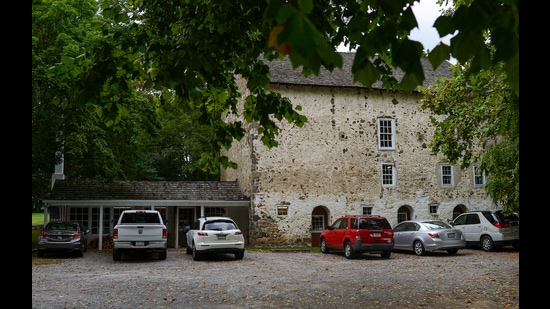
I traipse around Baldwin’s Book Barn, a five-storey barn located in the leafy quiet outside Philadelphia, in the charming borough of West Chester, Pennsylvania. Housed in a historic 1822 structure with thick stone walls, creaky wooden floors,
Five floors and shelves stacked with more than 300,000 books is the definition of a problem of plenty. As I look around and walk the aisles, I see a telling sign: “You may not find a book, but a book will find you.”
I traipse around Baldwin’s Book Barn, a five-storey barn located in the leafy quiet outside Philadelphia, in the charming borough of West Chester, Pennsylvania. Housed in a historic 1822 structure with thick stone walls, creaky wooden floors, and ancient corners, it’s one of the most unusual second-hand bookstores in the United States.
Baldwin’s story goes back to 1934, when William and Lilla Baldwin launched a humble bookstore in their Wilmington home. The couple initially sold rare and used books from their living room, drawing a modest but passionate community of readers. Their vision soon outgrew the four walls of their home, and they purchased a sprawling barn in West Chester in 1946.
“The barn was built in 1822 by Brinton and Sarah Darlington, a Quaker family, as part of their 75-acre farm and dairy business. It remained in their family for more a century until it was closed during the 1930s depression,” I learn from the woman at reception desk as I hand over my hotel keys and tell her where I am heading.
In 1946, the Baldwins moved their “used book and collectibles business” to “the Barn”, where it took root, literally and figuratively, amidst haylofts and livestock stalls. The old milking house was converted into a home for the family, and the stone barn soon became a bookshop much loved by the entire community.
After William’s death in 1988, his son Thomas Baldwin stepped in to carry forward the Barn’s legacy. His deep love for books and warm personality helped him preserve the store’s distinctive charm and historical character. Locals still recall how Thomas (who passed in June 2019) would strike up long, thoughtful conversations beside the iconic pot-bellied stove, making the space feel as much like a community gathering place as a bookstore.
Leslie Grandstaff started going to Baldwin’s Book Barn in the late 1960s. A post on social media detailed that, “In the early ’80s, I would go in search of illustrated books by Howard Pyle and NC Wyeth. I also used to talk with the owner; he was a great source of history and also was a friend of Henry Francis DuPont.”
The Barn’s five floors of books, rare artifacts, and cosy nooks complete with chairs made it a beloved landmark for bibliophiles in the region, and beyond. Although Tom briefly considered selling the business in 2010, he ultimately stayed committed to preserving it as a cherished part of Chester County’s heritage.
In an interview to Reading Eagle, he said, “We’re so well known, and because of our big barn and our location, we’ve become a destination. People who don’t even care that much about books come here just to see the place – and, happily, they usually leave with a book or two.”
Under him, Baldwin’s Book Barn navigated the rise and fall of chain bookstores, and evolved into a beloved destination for literary explorers and nostalgia seekers.
A tribute published by Chester County Press stated that Baldwin was the “keeper of the kingdom, the man with the keys that unlocked the doors to a five-floor, endless bounty of discovery.”
The family-run bookstore still continues to delight bibliophiles from around the world, with people not stopping in to just buy a book, but to enter a mood, a state of mind.
A labyrinth of literary treasures
The Barn’s narrow staircases lead me into a series of lofts, stalls, and alcoves where books are organised less by algorithm and more by atmosphere. Bound manuscripts rest beside dusty maps, 18th-century treatises sit cheek by jowl with vintage Penguin paperbacks, and niches that once housed farm equipment now shelter poetry collections.
I look at the hand-drawn map, handed to me as I entered the bookshop, and find that each floor holds a distinct collection. The map makes it easy to navigate the barn’s winding passageways and creaky floors.
On the first floor, the shelves are stacked with books on local history, cookery, and leather-bound volumes often sought after by decorators – along with a “military room”. The second floor has new arrivals, American biographies, and works on art and architecture. The third floor is home to modern literature, a wall dedicated entirely to sports, and sections for mysteries and the Wild West. Higher still, the fourth floor features tiny rooms devoted to books on science and countries of the world. Scattered throughout are timeless classics, and paper bags that anyone can pop their books into.
I spot fine art atlases tucked between barrels and trunks, interesting books propped up on small tables. Some rooms feel like medieval guild halls; others, ghostly cathedrals of paper. Baldwin’s draws collectors of rare books, stamp and map aficionados, and casual readers hoping to unearth hidden gems.
“I came for a specific volume on maritime exploration and ended up with six others,” Ariel Gomez, a local teacher and Barn regular, tells me. “I never know what I’ll find — and that’s the magic.”
A timeless atmosphere
Baldwin Book Barn’s collection spans everything from fragile centuries-old volumes, decorative leather-bound books, and vintage prints and maps to more contemporary titles. The setting invites exploration.
The immersive mood is hard to replicate online. Visitors often linger, plonking themselves on the many chairs or steps with their finds. Seasonal events, from story hours for kids to collector fairs and manuscript signings create a rich reading community.
In a world of e-readers and algorithm-driven recommendations, Baldwin’s Book Barn seems both delightfully anachronistic and profoundly necessary. Its success lies in the serendipity of discovery. You never know what you’ll stumble upon: perhaps a 19th-century travelogue, a first edition of The Great Gatsby, or an antique children’s book with coloured lithographs. And while it stocks classics and collectibles, the store also indulges in whimsy — pop-up tables for postcards, novelties, and collectibles.
“I once found a 1790 alchemical treatise tucked behind a stack of cookbooks,” Gomez recalls. “I never would have typed that title into a search bar, but I’m so glad I discovered it here.”
To me, the barn’s allure isn’t just in what it contains — it’s in how it curates experience. Browsers are encouraged to touch, flip through, wander. In this age of swipes and clicks, the place is a living homage to the lost art of slow reading.
Carol Pfaff-Rauch, who became a manager at Baldwin’s Book Barn in 2019, reveals that she had stopped working after she had colon cancer in 2007.
“I came here in 2010 and asked to volunteer,” she recalls. Tom reportedly asked an employee if she could walk up and down the many staircases, and, when told that she looked like the kind of person who could, decided to hire her. “For me, Baldwin’s Book Barn has been about good health and happiness. It’s very rewarding. It’s a happy place,” “ she says.
Surviving the digital onslaught
Sustaining a physical bookstore today isn’t easy, yet Baldwin’s continues to thrive. It sells online — but remains anchored to the barn because of what the place means to its visitors: a community, a sanctuary for shared discovery.
The store’s commitment to keeping a largely analogue experience alive —handwritten recommendation cards, periodic book fairs — suits a generation yearning for tactile connection. “It’s not a warehouse with aisles. It’s a proper barn, with creaks, light, life, and layers of history – and books,” Gomez says.
Exploring the Barn is a sensory experience. It looks beautiful, smells of old books, feels old – sometimes downright spooky. No wonder the antiquarian establishment has three resident ghosts documented by the paranormal society: that of Sarah Darlington, the woman who helped build the Barn; Tom Baldwin, whose spirit is said to be deeply intertwined with the store; and an elderly man who’s often seen sitting in a chair as he peruses a newspaper.
As I browse, touching the stone walls and the wooden beams, I listen to the creaks and scrapes of the old structure and the hushed voices of other booklovers and travellers. Finding a book could not be more enjoyable or adventurous, I think as I scour the stacks in this literary time capsule.
Hours later, I hand over my finds at the till. I did not find a book, it’s true, but many books found me!
Teja Lele is an independent editor and writes on books, travel and lifestyle.
One Subscription.
Get 360° coverage—from daily headlines
to 100 year archives.
Archives
HT App & Website