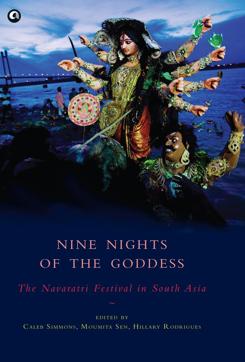
The Durgā Pūjā is a complex series of devotional rites to worship the Great Goddess, who is generally referred to as Devī, Mā, or Durgā. The rite typically takes place during the śāradiya Navarātra (or Navarātri), which occurs during the first nine days of the waxing fortnight (śukla pakṣa) of the autumn month of Āśvina…
The Durgā Pūjā typically begins with the bodhana (awakening rite) and ideally takes place in the vicinity of a bilva (wood-apple) tree. This normally occurs on the sixth day of Navarātra, or on the evening of the fifth day (pañcamī) if the sixth lunar day (ṣaṣṭhī tithi) will end before four p.m. Since the Durgā Pūjā takes place in autumn, when the gods are generally regarded as sleeping, this rite is often called an akāla bodhana (untimely awakening). The term relates to a myth best known through the Bengali Rāmāyaṇa by Kṛttivāsa (15th century CE), in which the desperate prince Rāma wakes up the Goddess, unseasonably, to enlist her help in defeating his demon adversary, Rāvaṇa… The Goddess is first awakened in the bilva (wood-apple) tree, and from there, she is established in a jar or pot effigy, referred to as the ghaṭa or kalaśa. If there is no bilva tree present, a branch from the tree, ideally possessing two pieces of fruit symbolizing the Devī’s breasts, is ritually severed, “planted” in a pot, and taken to the ritual space (pūjālaya).
The purohita then draws a sacred diagram (yantra) upon the ground. This may be a simple downward pointing triangle or the more elaborate sarvatobhadra maṇḍala, into which the Goddess will be more formally established on the eighth day. Onto this yantra, a low altar of soil is constructed, identified as Aditi, the mother of the gods, and as the goddess Earth, supporter of the world. The purohita sows five types of grain into the altar and places a narrow-necked, wide-bodied jar atop it. The earthen or metal jar is filled with water, has five types of leaf-bearing twigs placed in its mouth, and is topped, ideally, with a twig-bearing green coconut, a symbol of fertility. It is shrouded with a scarf until it resembles a pregnant or squatting woman wearing a sari. The Devī, as Śrī, the goddess associated with grace and bounty, is invoked into the jar. This brimming jar, the pūrṇa kalaśa, the Asian equivalent of the cornucopia, is an ancient symbol of fertility and abundance often found in iconographic contexts with Lakṣmī and the lotus. …When the jar is being filled with pure water, the priest invokes all rivers, beginning with the Gaṅgā, to abide in it. Thus, the element (bhūta) of water (through all the riverine goddesses), along with the earth element (in the earthen altar and clay jar), and the vital essence of life (in the seeds, the leaf-bearing twigs, the green coconut, and a fruit-bearing bilva tree branch) are all present at the very inception of the Durgā Pūjā...
{{/usCountry}}The purohita then draws a sacred diagram (yantra) upon the ground. This may be a simple downward pointing triangle or the more elaborate sarvatobhadra maṇḍala, into which the Goddess will be more formally established on the eighth day. Onto this yantra, a low altar of soil is constructed, identified as Aditi, the mother of the gods, and as the goddess Earth, supporter of the world. The purohita sows five types of grain into the altar and places a narrow-necked, wide-bodied jar atop it. The earthen or metal jar is filled with water, has five types of leaf-bearing twigs placed in its mouth, and is topped, ideally, with a twig-bearing green coconut, a symbol of fertility. It is shrouded with a scarf until it resembles a pregnant or squatting woman wearing a sari. The Devī, as Śrī, the goddess associated with grace and bounty, is invoked into the jar. This brimming jar, the pūrṇa kalaśa, the Asian equivalent of the cornucopia, is an ancient symbol of fertility and abundance often found in iconographic contexts with Lakṣmī and the lotus. …When the jar is being filled with pure water, the priest invokes all rivers, beginning with the Gaṅgā, to abide in it. Thus, the element (bhūta) of water (through all the riverine goddesses), along with the earth element (in the earthen altar and clay jar), and the vital essence of life (in the seeds, the leaf-bearing twigs, the green coconut, and a fruit-bearing bilva tree branch) are all present at the very inception of the Durgā Pūjā...
{{/usCountry}}For most devotees, the Durgā Pūjā proper begins on Mahāsaptamī, the so-called Great Seventh day of Navarātra. However, as we have seen, the crucial bodhana rites actually begin on the sixth or even the fifth day. A significant rite of the sixth day is the adhivāsanam (or adhivāsa), or perfuming. During the adhivāsa, as many as twenty items are offered to the jar and the bilva tree, and then to all the other abodes into which the Devī will subsequently be invoked, such as the Navapattrikā (a cluster of nine leaves or plants), the sacrificial sword or mirror, and the clay images. The items offered in this perfuming rite include sandalwood paste (gandha), soil, a small stone, rice, flowers, dūrvā grass, collyrium, cow bile, yellow mustard, precious metals, a mirror, and a fly whisk (cāmara). Again, I note the many elemental substances that are offered, as well as items pertaining to royalty. If the bodhana was the awakening rite, one could imagine the adhivāsa as a sort of “getting up” process, because as the abodes of the goddess are anointed with each item, the purohita continuously rings a bell. A dhāk drum may also be sounded continuously. The sounds not only symbolically arouse the Devī; they enliven the worshippers in the household and community, who begin to feel the intensifying presence of the arrival of the Goddess.
The extensive rituals of the following day, the Great Seventh include the official appointment of the purohita and his commitment to perform the entire sequence of rites over the course of subsequent days. One of the day’s first set of activities is an extensive series of bathings and anointings of the nine plants of the Navapattrikā. The shape of the Navapattrikā is derived primarily from a plantain sapling, to which the bilva branch with two pieces of fruit is attached, along with seven other plants. The items used for the bathing/ anointing include the five products of the cow (urine, dung, milk, curd, and ghī), five nectars (sugar, honey, curd, milk, and ghī), various kinds of water (from a tank, hot water, dew, water mixed with flour, water with powered herbs, ocean water, water with oil, water from the Gaṅgā, rainwater, from a waterfall, and so on). Each of the waters and ointments must first be purified and then applied to the plant effigy of the Goddess. Then the clay image cluster is bathed in the same way. However, because it is impractical to pour so much water onto the unbaked clay mūrti, the ministrations are performed to the image’s reflection in a mirror. In more martially oriented celebrations of the Durgā Pūjā, the shining surface of the sacrificial sword’s blade captures the Devī’s reflection. However, the mirror is now a substitute that orients the pūjā toward adoration of the Goddess and her feminine beauty and away from original, militaristic notions that the Devī’s essence enters into the sword, which will eventually taste the blood of the sacrificial offering…
During the Great Bath or Mahāsnāna rite, he (the purohit) bathes the Goddess with water from a bhṛṅgāra (a golden pitcher), a conch shell, and a sahasradhārā (a type of millifluent sieve with numerous openings), all implements associated with royal consecrations. After also installing Gaṇeśa into an earthen pot (ghaṭa), the priest moves to invoke Durgā into the clay image. After performing many self-transformation rites… he invites the Goddess to take up her abode in the clay image. The great lion mount of Durgā, Mahāsiṅgha, and Mahiṣāsura, are also invoked into their images at this time. The high point is when the images are brought to life through the rites to open the Devī’s three eyes (cakṣur dāna) and install vital energy (prāṇa pratiṣṭhā) in the deities. Now that this is done, the Goddess is rendered worship…. Durgā is worshipped with dozens of offerings, including clothes, sweets, and adornments. The other deities are also invoked to preside at the ritual. Nine goddesses are invoked into the nine plants of the Navapattrikā, and Gaṇeśa, Kārttikeya, Lakṣmī, and Sarasvatī, who are often thought of by worshippers as Durgā’s family, are invoked into their images and rendered worship. The lion mount and Mahiṣāsura are rendered homage. The Navapattrikā, which takes its lithe form from the plantain tree, is draped in a sari and placed next to Gaṇeśa. …
Now that all the deities are present and enlivened, the priest again worships Durgā by repeating her mantra “Om duṃ durgāyai namaḥ” at least ten times. After the flame worship and a recitation of a hymn of praise, such as the “Durgā Stava” from the Mahābhārata, devotees in the audience may participate in a nominal act of worship. The worshippers are first purified by the priest and may then shower the Goddess with flowers in what is known as the puṣpāñjali (adoration with flowers). The rites of Mahāsaptamī conclude with the collective recitation of the famous namaskāra mantra, found within the Devī Māhātmya.
Sarva maṅgala maṅgalye śive sarvārtha sādhike/
śaraṇye tryambake gauri nārāyaṇi namo ‘stute//
O auspicious one, blessed with every blessing, who fulfils every aim; O three-eyed Gaurī, who are a refuge,
O Nārāyaṇī, praise be to you. (My translation)
The ritual sequences on each of the days of Durgā Pūjā, like rāgas in Indian classical music, are repeated patterns with distinctive variations, which build up to a great climax…While the key ritual variation of the Durga Pūjā rituals on Mahāsaptamī was the invocation of the deities into the Navapattrikā and the clay image cluster, on Mahāṣṭamī it is the installation and worship of Durgā in the yantric form of the Sarvatobhadra Maṇḍala, the Sphere of All-directional Auspiciousness. … Durgā and her eight accompanying śaktis (goddesses) are invoked into this maṇḍala, along with the sixty-four Yoginīs (Tantric goddesses of “yoga”), the Mātṛs (Mothers), and all other gods and goddesses, including Baṭukas (boy forms of Śiva), Kṣetrapālas (guardians of the field), and Bhairavas (fierce forms of Śiva), each of which is placed into an appropriate segment of the diagram. The Devī’s weapons and ornaments, which in this case are simply made out of tin, are also worshipped. In appropriate militaristic contexts, actual weapons would be worshipped at this time. In certain temple settings, persons may bring their weapons to the Devī on Mahāṣṭamī for them to be blessed.
In the Bengali tradition, the sandhi or juncture between the eighth and ninth lunar days (tithis) is crucial. The key event during this forty-eight-minute period, when Durgā is invoked in her fierce form as Cāmuṇḍā, is the offering of a blood sacrifice. In the Lahiris’ (A Bengali family from Banaras) Durgā Pūjā, a kūṣmāṇḍā melon is a substitute, “sacrificed” by the men and prepared into bhog (cooked food offering) by the women. The bhog is one of the most important blessings (prasada) to be handed out to participants and consumed. While the priest is conducting rituals in the pūjālaya, the kitchen is another hidden ritual arena, where initiated postmenopausal women, often widows, are engaged in food preparation. As part of the ārati segment of worship, 108 lamps are lit, perhaps evoking the tale in Kṛttivāsa’s Rāmāyaṇa, where Rāma must offer 108 blue lotuses to the Devī. The Goddess tests his devotion by hiding one of the flowers and only appears to him when he is about to pluck out one of his own lotus eyes as a substitute. Virgin worship is also recommended to be performed during this short period of sacred time…However, because of the logistics involved, the kumārī pūjā now often takes place on Mahānavamī. In the kumārī pūjā, one, nine, seventeen, 108 or more prepubescent, virgin girls are worshipped as living forms of the goddess. At the most basic level of interpretation, this sandhi is a highly auspicious astrological time. As the result of all the prior worship, which culminates in the dramatic 108-lamp ārati and the blood sacrifice, the Devī’s grace is thought to be most available at this juncture. She manifests in the living form of the kūmārī and in the sword that beheads the symbolic demon. She has made herself manifest in multiple forms and abodes through which ardent votaries may apprehend her presence and avail themselves of her grace. If ever one were going to “perceive” the Goddess, it might be then, at this climax of the pūjā.
The key variant ritual on Mahānavamī, apart from the kumārī pūjā if it is performed on this day, is the homa or fire oblation. One hundred and eight unblemished, tripartite bilva leaves are offered into the fire, with the mantra: durge durge rakṣaṇi svāhā. The purohita also receives his platter of offerings and performs the final oblation. The ashes may be used to anoint one’s head, throat, shoulders, and heart. Navarātra has come to an end, but the Durgā Pūjā has not, for there are several rites on the following day, known as Vijayā Daśamī (Tenth for Victory). With various mantras, the priest dislodges the ghaṭa and the pratimā, the clay image cluster. He worships the Goddess in the cast-off remnants of the pūjā, the old flowers and debris from the worship. He sends her on her way but asks her to remain in the earth, the water, and the home. .. Finally, the images, from which the deities have already departed, are carried to the river for immersion. It is a bittersweet event, because not only is the Devī thought to be departing to her distant abode, but the family too will disperse, and the married daughters will return to their husbands’ homes. The atmosphere at the riverbank is raucous. The air is full of incense smoke, and the rhythmic beat of the dhāk drums fills one’s ears...
The Durgā Pūjā, in part, precisely tries to illustrate to devotees that the Devī’s presence is ubiquitous. She is everywhere and in everything. She is in the earth, in water, in living things, and in the home. She is in speech, in blood, in fire, and in ash. Likewise, she is in rituals of worship and in the cast-off remnants of existence as well. She is in women and the gods. She is both life and death. A line from the “Nārāyaṇī Stuti” a well-known hymn of praise within the Devī-Māhātmya (11.5), states:
sarvabhūtā yadā devī svargamuktipradāyinī/
tvaṃ stutā stutaye kā vā bhavantu paramoktayaḥ//
O Goddess, when you, the granter of heaven and supreme liberation, who are everything (sarvabhūtā), are glorified (stutā), what could be the words exquisite enough to exalt you? (My translation)
In a similar vein, the Durgā Pūjā implies, “What rites of worship would be adequate to do you justice? What substances can we offer that are not already from you? What words can we utter that are not also from you? And yet, ultimately we shall try.” And by doing so, every year, devotees, communities, kings, kingdoms, even the entire cosmos are intrinsically revitalized, reinvigorated, even reborn through the awakened and consecrated presence of the Great Goddess by and within her own creation.