
 E-Paper



Giles Tillotson: “A map, even more obviously than a portrait, is a document”
Art historian Giles Tillotson spoke about the cultural context of art, maps as alternative archival documents, and the unique character of Jaigarh fort

 Prefer HTon Google


Curation as an intentional endeavour is also inevitably a political exercise in archiving. What has been your experience?

It’s political in the sense that any interpretation of history comes from a particular place. So, with the work of Sahib Ram (active 1778–1803), given the scale of the paintings, they must have been meant for public viewing, not for private handling. That puts them into a different category of things. In a similar period in Europe, major portraits of aristocrats and royalty would be displayed publicly through the academies. If somebody does a new portrait of King George III, it would be shown at the Royal Academy before going to wherever it’s supposed to be. So, it’s seen and understood and then disseminated in print form, actually, which comes to India only later. So, the painting itself is a political act. Or at least some paintings are. I was interested in trying to unpack that. It seemed to me that the public imagination, certainly around this part of the world, has certain received ideas about Sawai Jai Singh in particular. And my question is, where do they come from? It’s not like they’re just sort of a residue of fact that has been remembered. No, it’s something that has been constructed. I’m interested in that process of construction and the role played by art in that process.
Historians look for context outside the paintings to understand them, but then the paintings themselves are in fact making that historical context in a manner. Please elaborate on that.
It’s a two-way street. It’s kind of obvious to say, if you want to understand a work of art, you have to understand something of the historical circumstances in which it was made. Or the literary context. You can’t look at a picture of Krishna and the gopis without understanding that it comes out of the Gita Govinda and what the story is. Otherwise, what are you looking at? How could you possibly interpret it? So, understanding cultural context is crucial. But yes, the work of art itself constructs its own context. And what we think of certain things arises partly from paintings as historical documents.
READ MORE: Report: Jaigarh Heritage Festival
You spoke about how maps may be seen as alternative archival documents that also give a lot of information for those who are looking for it.
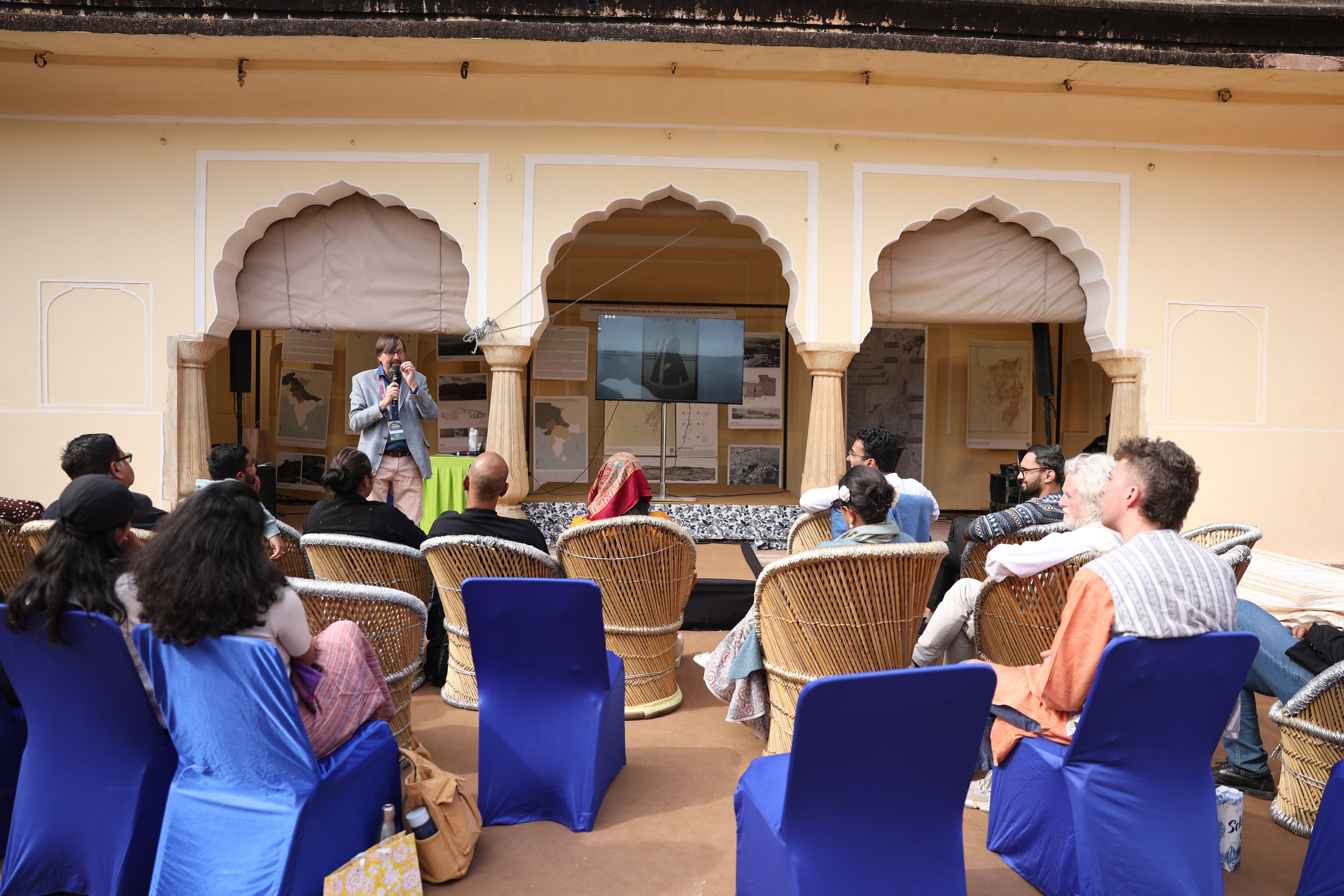
I thought there was a sense in which a map, even more obviously than a portrait, is a document. I mean, it is made to chart territory. So, even if it’s not a topographically accurate map, it’s not the work of a surveyor. None of the maps I showed you [during a masterclass on Reading Portraits and Plans at the Jaigarh Heritage Festival] were made by a modern mapmaker using surveying techniques. But even so, it’s showing you or trying to record historical realities. My point is that there’s another layer of this where if you ask questions like, why is this map here? Who made it? And why did that person make it? Then it’s telling you more. And the two Mughal examples, they’re both Jaipur objects, showing Mughal objects. So, they throw light on the Jaipur-Mughal relationship in the 18th century. Which is something we know about from other sources, but it gives you strikingly clear evidence of that. The second example, where you’ve actually got a detailed plan of the imperial residence. It’s just mind-blowing to think that there’s that level of proximity and access and trust between Jai Singh and Muhammad Shah.
LISTEN MORE: Company Painting; A transformative moment in Indian art
Please talk about your experience at the City Palace Galleries.
I worked for the Trust for 10 years, from 2011 up until COVID. I was the consultant director. So, I was a visiting director, if you like, with a specific brief to work on developing new galleries and to run a publications programme. We did six volumes of books, highlighting different aspects of the collection.
And we did the gallery here in Jaigarh and the painting and photography gallery in the City Palace. We were working on the next gallery, which was the old transport gallery, the Buggy Khana, which is now the Rath Khana when COVID interrupted work and it was a little slow to kind of get back on its feet, partly because Mrinalini (Venkateswaran), who worked with me and is now the head of collections, left to go to the UK for three years. And I started working in Delhi. I worked for DAG. But we got the thing back on track and we finished the Rath Khana. We’ve redone the Sabha Niwas, which underwent a complete re-architectural conservation as well as changing the interior. And now, we’ve just redone the Sileh Khana (gallery of arms and armour). The new display in that space is called Power and Diplomacy. The idea is warfare is only one kind of power and it’s the last kind. And, in a sense, it represents failure because you want at all costs to avoid it. So, Power and Diplomacy is about how you assert your authority and negotiate relations with other powers. We felt that story was told not just by weapons. It was told in paintings, in textiles, courtly textiles, in all sorts of objects, in manuscripts. What kind of books did they read? What kind of manuscripts did they read and promote?
Similarly, when we get to the textile gallery, we’re going to replace it with something on the theme of Jaipur and the world: how did Jaipur project itself globally in the realms of science, art and industry? Textiles are an important part of that story. Till today, everybody knows about Jaipur textiles. That’s a major trading commodity that’s produced in Jaipur. In the 19th century, Jaipur was very into promoting itself globally through the production of decorative art objects in brassware and stoneware and woodwork and so on. It exhibited all over the world. And that’s the story we want to tell.
Jaigarh is something different because Jaigarh is still owned by the former royal family. It’s a separate trust. It does get a lot of visitors, but obviously it doesn’t have the collections that the palace has. It’s a different kind of experience. And it’s got a lot of open space. I think the feeling was that having an event like this, an annual Jaigarh Heritage Festival, promotes it locally as well as internationally. It just animates the space. If you did this in the City Palace, it would look like we’re turning it into Johri Bazaar; it wouldn’t work. But there’s so much space here that you can set up a two-day bazaar in Laxmi Vilas. And it looks great. It’s a refreshing way of seeing it. It brings more people in.
What role do festivals like this play in the preservation and promotion of heritage sites?
Speaking as a historian, Jaigarh is very little studied, very little understood. And there are particular reasons for that. In the case of Jaigarh, it didn’t just continue in the ownership of the family. It continued to operate with a military garrison of the old Rajasthan state forces. Believe it or not, up until the 1970s, until the Emergency. So even after Independence, they kept a bit because Man Singh had a military career. Bhawani Singh had a military career. They kept a bit of the state’s forces going and they were garrisoned here. So, no one was allowed in. So, all the historians of military architecture who got to study the other great forts of Rajasthan and may have written about Chittor or about Mehrangarh or Jaisalmer, they couldn’t get in here.
I was just comparing notes with one of the few people who did write about it early on. In the 1980s, when it opened to the public, Rajendra Singh Khangarot, who has written the first and only book on it, said that there were books called The Forts of India, which would take Amer Palace as the fort because they couldn’t get in here. Everyone, even the Rajasthan Tourism Development Corporation calls the thing down the hill Amber Fort. It’s not a fort, it’s a palace. This is the fort. And there are two parts of the single entity: one belongs to the State Archaeology Department now and one still belongs to the family. But you should see them together. I’m happy to say the road connecting them is now open again. So, the reason it was not studied very much was because it still had a military garrison.
No one was allowed in. During the Emergency, Indira Gandhi sent forces in with bulldozers to kind of knock their way in. She thought she was going to find some hidden treasure. I’m happy to say she did not find it. So, it’s not that well known. Obviously, everybody in the region knows it. You see it all the time perched on the hill. But it’s lovely to see it animated with so many people, so many things going on.
Simar Bhasin is a literary critic and research scholar who lives in Delhi. Her essay ‘A Qissa of Resistance: Desire and Dissent in Selma Dabbagh’s Short Fiction’ was awarded ‘Highly Commended’ by the Wasafiri Essay Prize 2024.


