
 E-Paper



Hanako Footman: “You write what you fear”
At the Jaipur Literature Festival, the author of Mongrel spoke about how being an actor affected her writing and about telling a story in multiple voices

 Prefer HTon Google


Mongrel feels like a novel written from the body as much as from the mind. Did it begin as a story you consciously wanted to tell?
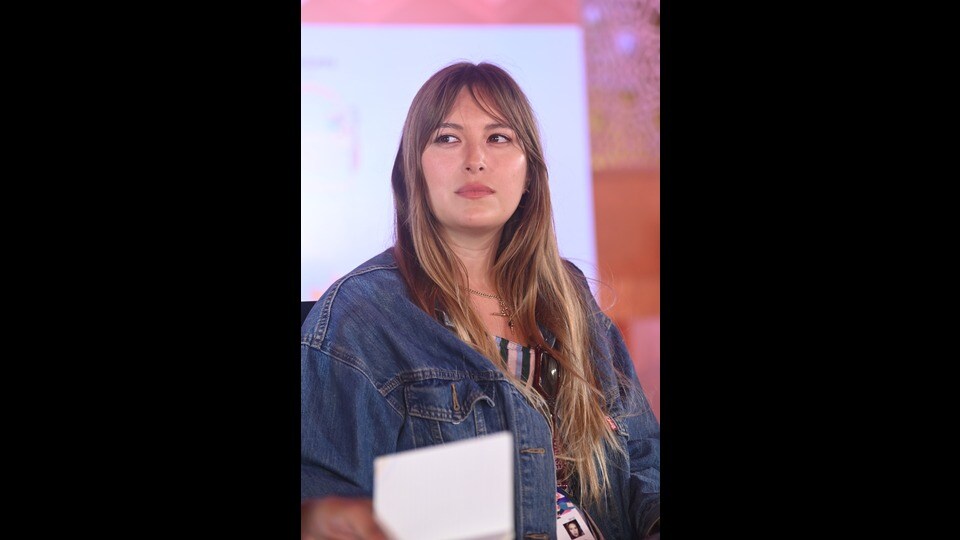
The story came about because, as an actor, I wasn’t being offered roles — or at times, even the opportunity to audition for roles — that reflected my lived experience as a Japanese-British woman. When the Caucasian roles came in, I was told I wasn’t white enough. When the Japanese roles came in, I was told I wasn’t Japanese enough. Mongrel came out of that frustration, that anger, that desire to be understood. It was a way I could bridge how I was externally perceived to how I internally understand myself.
I was raised on my Japanese mum’s love for food and culture, and so I feel very Japanese; but that is not how I’m perceived externally. As an actor, that’s amplified because you’re constantly being asked to fit into boxes other people create for you. So yes, it came from the body — because that’s where my anger lives.
The novel moves between three women across different geographies, yet the structure of it never feels fragmented. Instead, it is emotionally cohesive. Why did you decide that the story needed multiple voices rather than a single one?
I was really inspired by Lisa Taddeo’s Three Women — the way she explores Sloane, Lina, Maggie. I was my true north when I was writing Mongrel. Out of the three women, I was most familiar with the character of Mei, because she resembles me the most. Once I had a grasp on how I wanted to write her, I tackled Yuki, because she is the closest to my mother. Haruka was the most unknown. As soon as I started exploring them, they revealed themselves to me and became more three dimensional as I spent time with them.

Grief — particularly maternal grief — runs through the novel. Were you consciously exploring how loss mutates across cultures and spaces, or did those emotional differences emerge instinctively as you wrote?
It emerged very instinctively. I’m very interested in grief because it’s something I am deeply afraid of. One of my biggest fears in life is losing my mother — it is a bit selfish in the sense that I fear what it would mean for me. My mother represents my Japanese-ness. So, when she goes, what becomes of my Japanese-ness? Where does it go?
I’m also completely obsessed with my mum, as many people are, so the idea of losing her is untenable. That became a central theme in the book. I think, no matter how much you try not to, you write what you fear.
Desire in the novel often exists alongside imbalance of power. In contemporary fiction, there is an ongoing conversation about how to depict intimacy without romanticizing harm, or flattening complexity. How did you approach writing those charged moments with honesty while also resisting simplification?
As with all my writing, I have to emotionally and imaginatively take myself there. That’s always my way in, and it informs the way I write. Being an actor allows me to get there quickly because actors are constantly asked to inhabit and embody someone else. That’s how I write those scenes. I really have to just imagine and go there, stop being the writer, and become the character a bit.
Unlike acting, writing fiction allows you to shape not just the characters but also the emotional landscape of the world. What shifted internally when you moved into authorship from performance?
It’s interesting because I feel like I actually don’t control my characters. For me it feels like my characters appear, and then gradually as I spend time with them, I get to know them. Sometimes, I would try to control them and think, “We need to do this because that’s what I think is best for the story.” And they would fight back and go, “No. There’s no way I would do that. What are you on about? I’m going to do this instead!”
So, that was interesting to me. I had to just let them flow. In the end, I supposed being able to tell a story that fully reflects who I am, in all my multiplicity, was very powerful.
Acting is collaborative, public, and often mediated by directors, producers, and even audiences, while writing is solitary and private, at times even lonely. At this point in your creative life, which space feels more truthful to you?
Honestly, I need both. I enjoy talking to people, being sociable, being seen and perceived. Acting allows me to do that with a certain safety because you’re inhabiting someone else. Disappearing into imaginative worlds — both as an actor or an author — is incredible. I’ve been doing it since I was a child and I’ve made sure that I never let that childish instinct go.
Now that you’ve written a novel and engaged so closely with narrative structure and language, has it changed the way you read scripts or approach acting roles?
Yes, I’m a lot more discerning when it comes to acting roles now because I’d like to think I know what decent writing is. So, if it’s not good, if it doesn’t speak to me, then I genuinely won’t audition or do the role.
What did the writing process for Mongrel look like? Was it structured and disciplined, or did it arrive in fragments around your work?
I was pretty disciplined for the most part. There were bouts where I wouldn’t write because of my filming schedule. I would wake up every morning, do my morning pages and then I would do a bit of tarot actually. I’m obsessed with tarot. It actually informed a lot of my writing as well.
There is a moment in Yuki’s arc that I was fairly certain would happen, but I wasn’t entirely sure. And the card I pulled was exactly what I thought would happen to her. Out of 78 cards, that was the one that fell out. It was crazy.
Are there any writers whose work essentially gave you permission to be unresolved, angry or emotionally raw on the page — especially as a woman writing about identity and desire?
Definitely Lisa Taddeo. When I read her work — especially Three Women — I thought, “Oh wow, that’s how I feel all the time.” I felt elated in a way, that someone had finally put that to page.
I think Ocean Vuong is incredible. Also, Sarah Waters; she writes historical, lesbian fiction. Her writing is stunning — very different to mine. I’m drawn to the lush, the poetic, the truthful.
Looking back, what part of Mongrel still feels unresolved to you? Do you see it as a flaw or something you’ve learned to live with?
The one thing that feels unresolved about Mongrel is that when I set out to write it, I wrote it as a TV pilot. That was the first iteration of the story. And it’s yet to be made into a TV series. When it’s made into a TV series, my work will be done.
Rutvik Bhandari is an independent writer. He lives in Pune. You can find him talking about books on Instagram and YouTube (@themindlessmess).


