
 E-Paper



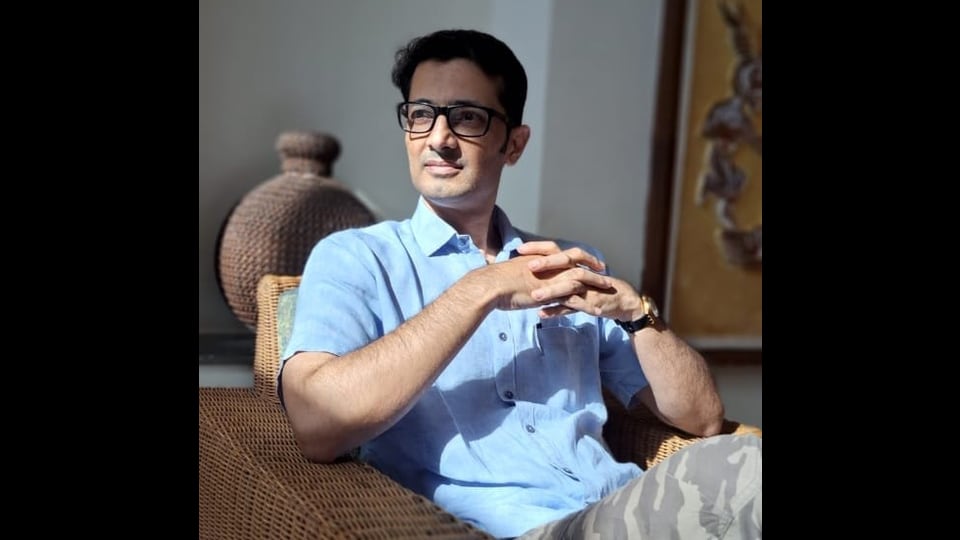
Hemang Ashwinkumar: “I have seen words transform lives”
On The Dawn of Life, his translation of MK Gandhi’s grand-nephew Prabhudas Gandhi’s memoir, Jivannu Parodh, from the original Gujarati

 Prefer HTon Google


How would you introduce Prabhudas Gandhi to readers who are unfamiliar with his work?
Prabhudas Gandhi was a freedom fighter, satyagrahi, writer, translator and social activist. As a young man, he participated in the Non-cooperation Movement, Bardoli Satyagraha, Quit India Movement, and courted arrests. In addition to that, he worked with Mamasaheb Phalke in Godhra for the upliftment of scavengers in 1921, and with Gulzarilal Nanda in the great strike of the mill workers in Ahmedabad in 1923. Apart from his active involvement in Gandhian constructive activities, he is known for having invented the Magan charkha, a spinning wheel, named after his uncle Maganlal Gandhi, that could be operated with legs and used for spinning cotton with both hands at a time. But his reputation in Gujarat is primarily based on his book Jivannu Parodh, a fascinating memoir of his years at the Phoenix Settlement in South Africa where, as a child, he witnessed and participated in the civil disobedience movement of Mahatma Gandhi against a colonial, apartheid state.
What led you to translate his book from Gujarati to English?
I think that the decision to translate the book was a result of the convergence of multiple factors and contexts; some immediate and others building up over years. The immediate context was the Long Walk Home of the migrant workers following the national lockdown imposed in 2020 at a four-hour notice by invoking the provisions of a colonial era act.
The visuals of the enormous hardships that they underwent, and the callous response of the state broke my heart. Hopeless and distraught, I was looking for narratives of pain and suffering of migrant workers in history to understand what was going on in my country. A friend suggested Giriraj Kishore’s Pehla Girmitiya and Prabhudas Gandhi’s Jivannu Parodh. I could lay my hands on the latter first.
The reading of the book helped me find answers to the Gandhi question that had come under scathing criticism from scholars and senseless trolls over the years; especially, the charge of him being a casteist, racist, patriarch etc in his South African years. The book seemed to me to be complicating my understanding of the early Gandhi’s views on caste, race and gender. I needed to make it a part of a larger debate.
On the other hand, it was distressing to see the pandemic of rising intolerance, mindless consumption, the dreadful condition of education and media-managed degradation of public discourse grip India. Much to my surprise and satisfaction, the book contained answers to many of these pathologies too.

How did the process of translating this book affect you emotionally and intellectually?
Translation is proverbially an intimate act of reading and writing. But a book like Jivannu Parodh literally sucks you in. One doesn’t just translate it but one is led, in the process, to read and re-read other books it is in conversation with. The outcome of such diverse reading is extremely sobering and humanising. Apart from the enriching intellectual stimulation, the translator undergoes an emotional makeover, comes face to face with their prejudices, blind spots and misbeliefs and begins to weave their ‘self’ afresh. The translator, to my mind, is doubly blessed. For he or she not only confronts the word-mediated pictures of another’s experience but eventually creates similar and equally powerful pictures of those experiences in a different language. This double whammy of experience makes one a more sorted, if not a better, human being.
What do you think of Prabhudas Gandhi’s writing style, and his relationship to the Gujarati language both during his years in South Africa and after he came to India?
Prabhudas Gandhi’s narrative in Jivannu Parodh follows the Gandhian dictates of language use and literary writing. Again, the format of the book, the fact that the speaking voice in the book is a young boy of 10 or 12, might have necessitated a tone of innocence and a use of readable Gujarati. Thus, the source text flows in simple, accessible language which makes for a seamless, sustaining reading. But often the simplicity and innocence, as the reader realizes, are deceptive. For Prabhudas Gandhi slips in a subtle and yet sharp critique of human follies, institutions and structures when the reader is not looking or least expecting it. In its breath of scholarship, allusions, systematic exploration of child psychology, and argumentation, the book rubs shoulders with the best of non-fiction across the globe. These traits of the author’s creative practice find echoes in his later writings and translations as well, for example, in his extensively researched book Ootabapa no Vadlo (The Family Tree of Otabapa) which came out in 1982.
What kind of support did you receive from Tridip Suhrud, Rita Kothari and Prabodh Parikh, all towering literary figures in their own right, while you were working on the manuscript?
I am thankful to Tridip Suhrud for cutting the clutter and giving back our Gandhi to us, to Rita Kothari for the immense and insightful work she has done in translation Studies, and to Prabodh Parikh for his unconditional friendship and moral support. All of them loomed over my horizons while I was working on the manuscript, which is as meaningful as an editor’s real-time intervention in the translation process.
In the introduction, you mention that caste was “uncompromisingly central” to MK Gandhi’s “project of equality and social re-engineering”. How did his years in South Africa, where he encountered racism, shape his approach towards the caste system in India?
Contrary to popular belief, Gandhi was thinking of the caste question from early on. Some of my Dalit friends argue that Hind Swaraj doesn’t make even a passing reference to caste and untouchability. In the book, there is an elaborate chapter titled “Toilet Cleaning” where Prabhudas Gandhi gives a brilliant account of how MK Gandhi subjected the ‘self’ of all ashramites to the experience of negotiating shit as a way of sensitizing them to the degradation and dehumanization of the ‘other’, a whole community condemned to a life of wretchedness and insufferable woes. I have come to call this phenomenon “ontological inhabitation”.
It beggars belief that one who was waging a battle of rights for and with poor girmitiyas in South Africa was oblivious to the question of caste discrimination in India. Or that he could not see the structural similarities between race and caste. The Dawn Life forces the reader to complicate her view of Gandhian politics of caste and race. The way a young Prabhudas looks upon the superior humanity of the Zulus living on the outskirts of Phoenix, for example, is instructive and confirms Gandhi’s position on racial discrimination.
Let us not forget that, once back in India, Gandhi was the only individual in the Indian National Congress who placed the caste question on the same pedestal as the question of freedom. His decades of well-meaning agitation against the removal of untouchability, temple entry, education for the ostracized eventually culminate into his espousal of inter-caste marriage. And once that happens, you know, caste is annihilated.
You have translated Dalpat Chauhan’s work — Vultures (2022) and Fear and Other Stories (2023). It holds up a mirror to the violence sanctioned and perpetuated by the caste system. What was it like to encounter MK Gandhi’s thoughts on caste after Chauhan’s writing?
It was the other way round. It was Gandhi’s and Ambedkar’s thoughts that led me to Chauhan’s fiction and now, to another Dalit writer-activist, Chandu Maheria’s non-fiction. Maheria’s memoir has an essay titled That Fellow, Gandhido which takes a deep dive into the reasons why we cannot fall for the either-or proposition between Gandhi and Ambedkar, when it comes to imagining a casteless society. The towering Kannada scholar DR Nagraj too brilliantly brought out how these two leaders complemented each other on the caste question. Why caste persists today, despite the struggles waged by Dr Ambedkar and Gandhiji, is a question that I ask along with Dalpat Chauhan and Chandu Maheria, a question we should all ask ourselves, our family and friends in the 21st century.
In the acknowledgements section, you write about your belief in “the strength of words and ideas to make this world a better place for all”. When did this belief take root?
As a bilingual poet, translator, editor and cultural critic, I couldn’t have thought otherwise. I think that Fidel Castro was prescient about the advent of the post-truth era when he called for the “Battle of Ideas” in his 2004 speech at Havana University. I have seen words and ideas touch and transform lives, as also damage and destroy societies. The challenge is to seize the right moment and pitch them at the right frequency to audiences, the way Gandhi did it through Indian Opinion in South Africa and later through a slew of newspapers that he edited in India. Tukaram puts it brilliantly in Dilip Chitre’s translation:
Words are the only Jewels I possess Words are the only Clothes I wear Words are the only food That sustains my life Words are the only wealth I distribute among people Says Tuka Witness the Word He is God I worship Him With words
Chintan Girish Modi is a writer, educator, journalist and tree hugger based in Mumbai.


