Hidden lives of those who make cities
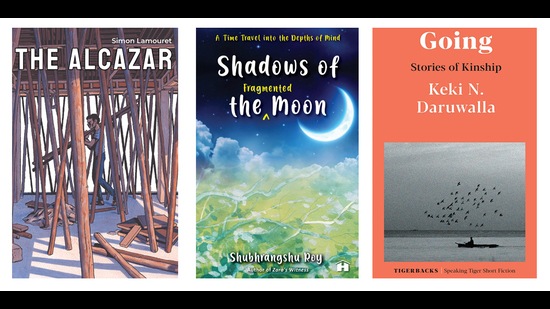
A big city, an empty plot, a residential complex is to be built. Migrant construction workers toil as they erect dreams in concrete. A story about the hidden lives of people who make cities… yet remain on the periphery. Simon Lamouret is a graphic novelist and illustrator based out of Toulouse France. A few years after graduating from Les Arts Decoratifs de Strasbourg, he decided to move to Bangalore for a year. This journey is witnessed through his two graphic novels, Bangalore (2017) and L’Alcazar (2020) which he published in France.
Publishing The Alcazar in India was very important to him as he believes the voices of his characters will resonate a lot more in Indian society than anywhere else. Though the work approaches a version of documentary realism, the author says he didn’t want to slot it as documentary. “I didn’t want to use the ‘reality’ label to value my work more. It should just be a good story to begin with”.
Time travel into the mind
This collection of poems attempts to unlock the wisdom of ancient seers for the benefit of lay folk. Often eulogised for their resilience in the face of the depredations of time, but with no one to turn to ― not even the gods ― for succour, mercy, and redemption, they are far removed from expensive and time-consuming modern psychiatric intervention. These poems are for them. They have nothing to do with religion or rituals; nothing to do with an exclusive or an exclusivist lifestyle. Rather, they seek to help us cope with the circumstances that confront us on our eventful walk through life.
In Shadows of the Fragmented Moon, each poem has a hidden and unexplored facet of a human trait that needs confronting to clear the path of ill-informed illusions. For, as the seers have claimed down the ages, the mind is only an aggregate of desires and nothing else. We humans are a conglomerate of our emotions and reason... without purpose, without a second chance.
{{/usCountry}}In Shadows of the Fragmented Moon, each poem has a hidden and unexplored facet of a human trait that needs confronting to clear the path of ill-informed illusions. For, as the seers have claimed down the ages, the mind is only an aggregate of desires and nothing else. We humans are a conglomerate of our emotions and reason... without purpose, without a second chance.
{{/usCountry}}Understanding this one truth alone sets us free.*
Fine explorations of family ties
He had turned footloose, moving from vihara to vihara, an exile not from his faith so much as from the times, and a family is a part of the times? He wrote to his mother?it was some years since he had seen her. He wanted to become a bhikshu, he wrote.
A man drifts away from family and home and becomes a monk, yet nothing fills the void. The only constants are dreams and hallucinations where his mother sometimes appears.
Another son retreats to his room, then disappears. It has been 10 years and the father, Sudhakar, doesn’t want to harbour false hope, but the mother, Hemlata, clings to it.
Ardeshir and Firoza face a similar predicament. Only their daughter, Arnavaz, hasn’t gone missing; she lives with them, even in her absence.
A woman, half-estranged from her mother, comes to visit her grandmother, perhaps for the last time.
The stories in this collection are among the finest explorations of family ties you will read; ties that injure and heal; ties that can be everything, yet never enough. Keki Daruwalla, a great poet of our time, proves again that he is also a great master of the short story.*
*All matter from book flap/publicity material.