Writings on the Indian hills
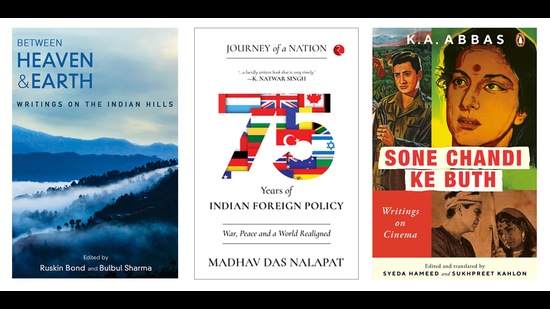
Millions travel to the hills from the dusty plains — seeking release from heat and tedium, from afflictions of the body and the mind; or seeking, simply, a view of snow-capped mountains lit by the rising sun. And millions also live in these high places, residents who sometimes leave, but keep returning, for the hills are homes like no other.
“What is it about the hills that draws us to them again and again?” asks one of the editors of this collection. In these pages, over 40 writers — from a daughter of the Tagore family and a British colonial officer in the 19th century, to a young poet and an Adivasi daily-wage worker in the 21st century — show us what the many reasons could be: Green hillsides glowing in the sun; the scent of pine and mist; the wind soughing in the deodars; the song of the whistling thrush; a ritual of worship; a picnic, a party, an illicit affair. They show us, too, the complex histories of hill stations built for the Raj and reshaped in free India; the hardship and squalour behind the beauty; the mixed blessings of progress.
Rich in deep experience and lyrical expression, and containing some stunning images of the hills, Between Heaven and Earth is a glorious collection put together by two of India’s finest writers, both with a lifelong connection with the hills. Among the writers you will read in it — who write on the hills in almost every region of India — are Rumer Godden, Rabindranath and Abanindranath Tagore, Emily Eden, Francis Younghusband, Jim Corbett, Jawaharlal Nehru, Khushwant Singh, Keki Daruwalla, and, of course, the two editors themselves. Together, they make this a book that you will keep returning to for years to come.*
{{/usCountry}}Rich in deep experience and lyrical expression, and containing some stunning images of the hills, Between Heaven and Earth is a glorious collection put together by two of India’s finest writers, both with a lifelong connection with the hills. Among the writers you will read in it — who write on the hills in almost every region of India — are Rumer Godden, Rabindranath and Abanindranath Tagore, Emily Eden, Francis Younghusband, Jim Corbett, Jawaharlal Nehru, Khushwant Singh, Keki Daruwalla, and, of course, the two editors themselves. Together, they make this a book that you will keep returning to for years to come.*
{{/usCountry}}Journey of a nation
In early 2020, Covid-19 ravaged the globe, affecting every single nation and its population. In 2021, the Taliban took over Afghanistan even as the US troops made a hasty exit. In 2022, Russia invaded Ukraine, leading to a severe political and economic backlash. In recent years, such transformational events have disrupted the world order and brought to the limelight the interplay of dynamics between nations. The global scene is characterized by changes that often erupt with very little warning and which require major adjustments in outlook and policy.
The world has to be studied in terms of what it is, rather than what it should have been, or would be, were conditions to remain unchanged or ideal. As a potential superpower, India’s foreign policy framework requires a foundation built on an admixture of present-day realities as well as long-term trend lines. It requires resilience and flexibility, so as to overcome geopolitical storms and strategic setbacks, not to mention taking advantage of opportunities.
75 Years of Indian Foreign Policy, a part of the series Journey of a Nation, describes such a framework for Indian foreign policy, even as it traces past decisions and errors that have had a lasting impact on the nation and its relations with neighbours and global superpowers. Further, it charts a path for the future of the nation and forecasts the potential impacts of decisions made today. A must-read for those in policy circles as well as anyone interested in the place of the nation in the emerging world order.*
Glitz, glamour and gritty reality
Sone Chandi ke Buth is a collection of writings on cinema that includes the observations, thoughts and reflections of Khwaja Ahmad Abbas. Originally written in Urdu by the well-known journalist, screenwriter and film-maker, it has now been translated for the first time into English. The book is a collection of short stories, essays and articles on famous film personalities and varied aspects of the film industry. Abbas was a prolific writer who published 74 books in his 73 years, besides writing extensively on the film industry for the Bombay Chronicle newspaper. Sone Chandi Ke Buth, published a year before he died, was his last book -- a final word on the glitz, glamour and gritty reality of the Hindi film world. It includes his candid observations on famous actors, writers and directors such as Raj Kapoor, Amitabh Bachchan, Dilip Kumar, Satyajit Ray, Meena Kumari, Balraj Sahni and V Shantaram. A series of essay focuses on various aspects of cinema, from the changes in the film industry to the power of film stars. The book also includes short stories set in the context of the film industry, some having veiled references to actual film stars. A common thread running through them all is his emphasis on making socially-relevant films rather than those that succumb to the pull of glamour and the box office.This book also presents a section of his writings as a film journalist for the Bombay Chronicle. His column, The Last Page, one of the longest running in Indian journalism, began in 1935, and moved to the Blitz after the Chronicle‘s closure, where it continued until his death in 1987. They complement the writings in Sone Chandi Ke Buth and are invaluable for cinema lovers.Abbas’s matter-of-fact style and the didactic element in his prose illustrate the humanistic ideals that were at the very core of his thought. His writing, both humorous and incisive, is like a laser that pierces right to the heart of the matter.*
*All matter from book flap.