The hidden life of forest guards
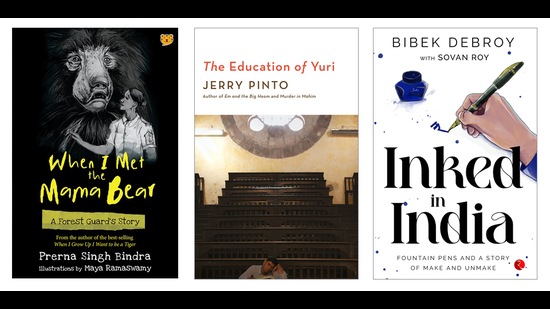
It’s a tough call for Priya and her fellow forest guards, Ahmedji, Bhim and Anil. They were trained not to interfere in the lives of the wild animals. But how can they just stand by and do nothing?
As they think of a plan that will work, Priya, a mother herself, thinks of her own little ‘cub’, her daughter Astha, who lives far away in the town with her grandmother. Priya is a single mother who lives in a lonely outpost in the forest so she can earn a living. Perhaps the Mama Bear too was ‘out at work’, foraging for food, when her cubs got into trouble.
Based on a real incident, this moving, dramatic story illuminates the hidden life of forest guards, the courageous and unsung women and men who work tirelessly to protect India’s forests and its wildlife.
When I Met the Mama Bear is also a powerful story of mothers — both human and animal — and their struggle to balance work with bringing up their young.*
On urban adolescence in India
{{/usCountry}}On urban adolescence in India
{{/usCountry}}‘We are born alone and we die alone. In between, we reach out to other people.’At 15, Yuri Fonseca of downmarket Mahim — sometimes awkward, sometimes lonely — gets lucky. He finds a friend, Muzammil Merchant of upmarket Pedder Road. Then he loses him, and almost finds him again. In between, he learns something about jealousy, shame, desire and guilt. He stumbles into his first sexual encounter, and he thinks he has fallen in love. He understands how one can hurt and be hurt, and how one can give and find unexplained happiness. He struggles to write poetry, worries if he will ever get and hold a job, and flirts briefly with Naxalism.Over five years in the strange crucible of Elphinstone College in 1980s’ Bombay — the vast and throbbing city that both claims and disowns him — Yuri tries to make sense of himself. And we are drawn, effortlessly and completely, into the spell of his story.The Education of Yuri proves yet again that few authors anywhere write with greater warmth, wit and compassion about human emotions and relationships than Jerry Pinto. This glorious novel is among the best ever written on urban adolescence in India.*
Fountain pens and a story of make and unmake
‘The exchange of the reed pen for the fountain pen is part of India’s economic transition and is reflected in the attitudes of these two great leaders, Gandhi and Ambedkar.’In the early 1900s, a Bengali doctor created the first Indian fountain pen in Varanasi. Despite this early start, foreign-made pens dominate the Indian market, with no notable Indian brand available to customers.Inked in India traces this journey of make and unmake, from a pre-Independence India with a strong manufacturing base for pens, nibs and ink, to the post-Independence economic policies which eroded that competitive advantage and led to economic churn and the exit of foreign firms from the country. Going beyond the nostalgia and lost sheen of fountain pens, it tackles economic transition and the impact of policy on local enterprise.Just as there has been exit, post-liberalization, there has been entry too, in what is often perceived to be a sunset sector. The book takes stock of what it will take to transform the unmake in India to make in India, so that Indian fountain pens have a global presence. The first-ever documentation of all known fountain pen, nib and ink manufacturers, Inked in India will be of great interest to fountain pen aficionados and economic enthusiasts alike.*
*All copy from book flap.