Subversive, profound, and essential stories
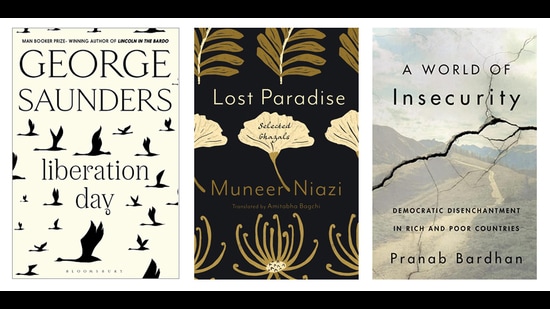
The first short story collection in 10 years from the Man Booker Prize-winning author of Lincoln in the Bardo, Liberation Day tries to make sense of our increasingly troubled world. Here, Saunders explores ideas of power, ethics, and justice and cuts to the very heart of what it means to live in community with our fellow humans. His prose is wickedly funny, unsentimental, and exquisitely tuned in this collection of resonant stories that encompass joy and despair, oppression and revolution, bizarre fantasy and brutal reality.
Love Letter is a tender missive from grandfather to grandson in the midst of a dystopian political situation in the not too distant future, that reminds us of our obligations to our ideals, ourselves, and one another. Ghoul is set in a hell-themed section of an underground amusement park in Colorado and follows the exploits of a lonely, morally complex character named Brian, who comes to question everything he takes for granted about his reality. In Mother’s Day, two women who loved the same man come to an existential reckoning in the middle of a hailstorm. In Elliott Spencer, the 89-year-old protagonist finds himself brainwashed, his memory “scraped” — a victim of a scheme in which poor, vulnerable people are reprogrammed and deployed as political protesters. And My House comes to terms with the haunting nature of unfulfilled dreams and the inevitability of decay. Together, these nine subversive, profound, and essential stories coalesce into a case for viewing the world with the same generosity and clear-eyed attention Saunders does, even in the most absurd of circumstances.*
The jungle within us
{{/usCountry}}The jungle within us
{{/usCountry}}Muneer Niazi (1922-2006), born in Hoshiarpur district on the Indian side of Punjab, was one of Pakistan’s greatest poets. Now also acknowledged as one of the greatest poets of Urdu and Punjabi in the twentieth century, many of his poems became iconic songs making him a celebrated songwriter. The blurb on the book cover quotes Intizar Husain on Niazi: “We came out of the jungle and built big cities and surrounded ourselves with walls, but, unknown to us, the jungle entered into us and sat hidden behind seven veils. And now it is sleeping inside us. Muneer Niazi is that person within whom the jungle has awoken and is stirring.” In this marvellous translation of Niazi’s works into English, novelist Amitabha Bagchi, whose Half the Night is Gone won the DSC Prize for South Asian Literature in 2019, brings Muneer’s melancholic, dark, hauntingly beautiful verses alive for a new readership.*
Democratic Disenchantment in Rich and Poor Countries
An ambitious account of the corrosion of liberal democracy in rich and poor countries alike, arguing that anti-democratic sentiment reflects fear of material and cultural loss, not a critique of liberalism’s failure to deliver equality, and suggesting possible ways out.
The retreat of liberal democracy in the twenty-first century has been impossible to ignore. From Wisconsin to Warsaw, Budapest to Bangalore, the public is turning against pluralism and liberal institutions and instead professing unapologetic nationalism and majoritarianism. Critics of inequality argue that this is a predictable response to failures of capitalism and liberalism, but Pranab Bardhan, a development economist, sees things differently. The problem is not inequality but insecurity ― financial and cultural.
Bardhan notes that antidemocratic movements have taken root globally in a wide range of demographic and socioeconomic groups. In the United States, older, less-educated, rural populations have withdrawn from democracy. But in India, the prevailing Hindu Nationalists enjoy the support of educated, aspirational urban youth. And in Europe, antidemocratic populists firmly back the welfare state (but for nonimmigrants). What is consistent among antidemocrats is fear of losing what they have. That could be money but is most often national pride and culture and the comfort of tradition.
A World of Insecurity argues for context-sensitive responses. Some, like universal basic income schemes, are better suited to poor countries. Others, like worker empowerment and international coordination, have broader appeal. But improving material security won’t be enough to sustain democracy. Nor, Bardhan writes, should we be tempted by the ultimately hollow lure of China’s authoritarian model. He urges liberals to adopt at least a grudging respect for fellow citizens’ local attachments. By affirming civic forms of community pride, we might hope to temper cultural anxieties before they become pathological.*
*All copy from book flap/promotional material.