From Ancient Wisdom to Modern Magic
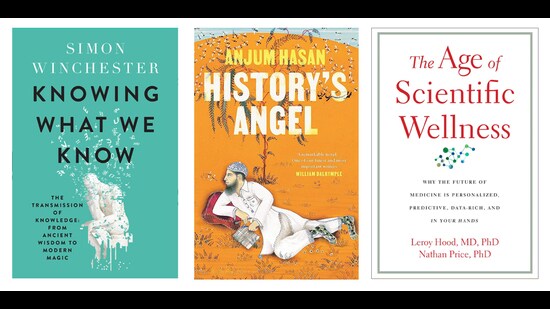
From the creation of the first encyclopedia to Wikipedia, from ancient museums to modern kindergarten classes — this is Simon Winchester’s all-encompassing look at how humans acquire, retain, and pass on information and data, and how technology continues to change our lives and our minds.
With the advent of the internet, any topic we want to know about is instantly available with the touch of a smartphone button. With so much knowledge at our fingertips, what is there left for our brains to do? At a time when we seem to be stripping all value from the idea of knowing things — no need for math, no need for map-reading, no need for memorization — are we risking our ability to think? As we empty our minds, will we one day be incapable of thoughtfulness?
Addressing these questions, Simon Winchester explores how humans have attained, stored, and disseminated knowledge. Examining such disciplines as education, journalism, encyclopedia creation, museum curation, photography, and broadcasting, he looks at a whole range of knowledge diffusion — from the cuneiform writings of Babylon to the machine-made genius of artificial intelligence, by way of Gutenberg, Google, and Wikipedia to the huge Victorian assemblage of the Mundanaeum, the collection of everything ever known, currently stored in a damp basement in northern Belgium.
Studded with strange and fascinating details, Knowing What We Know is a deep dive into learning and the human mind. Throughout this fascinating tour, Winchester forces us to ponder what rational humans are becoming. What good is all this knowledge if it leads to lack of thought? What is information without wisdom? Does Rene Descartes’s Cogito, ergo sum — “I think therefore I am,” the foundation for human knowledge widely accepted since the Enlightenment — still hold?
{{/usCountry}}Studded with strange and fascinating details, Knowing What We Know is a deep dive into learning and the human mind. Throughout this fascinating tour, Winchester forces us to ponder what rational humans are becoming. What good is all this knowledge if it leads to lack of thought? What is information without wisdom? Does Rene Descartes’s Cogito, ergo sum — “I think therefore I am,” the foundation for human knowledge widely accepted since the Enlightenment — still hold?
{{/usCountry}}And what will the world be like if no one in it is wise?*
A darkly funny novel
Alif is a middle-aged, mild-mannered history teacher, living in contemporary Delhi, at a time in India’s history when Muslims are seen either as hapless victims or live threats. Though his life’s passion is the history he teaches, it’s the present that presses down on him: his wife is set on a bigger house and a better car while trying to ace her MBA exams; his teenage son wants to quit school to get rich; his supercilious colleagues are suspicious of a Muslim teaching India’s history; and his old friend Ganesh has just reconnected with a childhood sweetheart with whom Alif was always rather enamored himself.
And then the unthinkable happens. While Alif is leading a school field trip, a student goads him, and in a fit of anger, Alif twists his ear. His job suddenly on the line, Alif finds his life rapidly descending into chaos. Meanwhile, his home city, too, darkens under the spreading shadow of violence.
In this darkly funny, sharply observed, and moving novel, Anjum Hasan deftly and delicately explores the life of Muslims in India and the force and consequence of remembering your people’s history in an increasingly indifferent milieu.*
The future of medicine is in your hands
Taking us to the cutting edge of the new frontier of medicine, a visionary biotechnologist and a path breaking researcher show how we can optimize our health in ways that were previously unimaginable.
We are on the cusp of a major transformation in health care — yet few people know it. At top hospitals and a few innovative health-tech startups, scientists are working closely with patients to dramatically extend their “healthspan” — the number of healthy years before disease sets in. In The Age of Scientific Wellness, two visionary leaders of this revolution in health take us on a thrilling journey to this new frontier of medicine.
Today, most doctors wait for clinical symptoms to appear before they act, and the 10 most commonly prescribed medications confer little or no benefit to most people taking them. Leroy Hood and Nathan Price argue that we must move beyond this reactive, hit-or-miss approach to usher in real precision health — a form of highly personalized care they call “scientific wellness.” Using information gleaned from our blood and genes and tapping into the data revolution made possible by AI, doctors can catch the onset of disease years before symptoms arise, revolutionizing prevention. Current applications have shown startling results: diabetes reversed, cancers eliminated, Alzheimer’s avoided, autoimmune conditions kept at bay.
This is not a future fantasy: it is already happening, but only for a few patients and at high cost. It’s time to make this gold standard of care more widely available. Inspiring in its possibilities, radical in its conclusions, The Age of Scientific Wellness shares actionable insights to help you chart a course to a longer, healthier, and more fulfilling life.*
*All copy from book flap.