Capturing a diverse culinary landscape
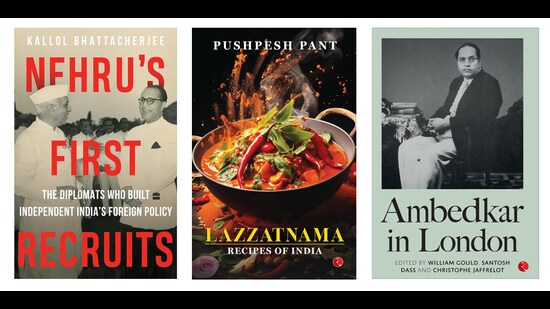
Food critic and historian Pushpesh Pant welcomes the reader to a world of Indian cooking with its special tastes, smells and sights. With recipes spanning the length and breadth of India, Lazzatnama captures the diverse culinary landscape of a country rich in exemplary cuisines. From the beguiling sweetness of Gujarati kadhi and the rollicking flavours of meen biryani to the deliciously enfolding comfort of gulab ki kheer and the calming coolness of bael ka sherbet, this cuisine-based chronicle of a culture-rich country is sure to entice readers to not just savour these delicacies — each with its own wonderfully specific recipe — but also enter their kitchens to make them.
The foundational story of the IFS
Independent India’s first Prime Minister Jawaharlal Nehru and his team faced the colossal task of building the infrastructure for a new state that was rising from the ashes of war, famine and communal strife. One of the first administrative innovations was the formation of the Indian Foreign Service (IFS). In 1958, once its posts were finally filled, it was decided that the names of the extraordinary men and women who were the first to represent India on the world stage would be published as the History of Services of Officers of the Indian Foreign Service (Branches A and B). That slim, “restricted - for official use only” volume is the inspiration for Nehru’s First Recruits.
Among others, author Kallol Bhattacherjee writes about Brajesh Mishra, who initiated dialogue with Beijing to restart relations disrupted in 1962; Mira Ishardas Malik, the first Indian woman diplomat to serve in China; Eric Gonsalves, who handled the biggest ever evacuation of Indians from a foreign crisis; K Natwar Singh and Romesh Bhandari, who served for many years even after retiring from the IFS; Cyril John Stracey, who served with Netaji Subhas Chandra Bose; Harivansh Rai Bachchan, who was responsible for the name “Videsh Mantralaya”; and Mirza Rashid Ali Baig, MA Jinnah’s former private secretary who became a towering chief of protocol whose legacy resonates in South Block even today.
{{/usCountry}}Among others, author Kallol Bhattacherjee writes about Brajesh Mishra, who initiated dialogue with Beijing to restart relations disrupted in 1962; Mira Ishardas Malik, the first Indian woman diplomat to serve in China; Eric Gonsalves, who handled the biggest ever evacuation of Indians from a foreign crisis; K Natwar Singh and Romesh Bhandari, who served for many years even after retiring from the IFS; Cyril John Stracey, who served with Netaji Subhas Chandra Bose; Harivansh Rai Bachchan, who was responsible for the name “Videsh Mantralaya”; and Mirza Rashid Ali Baig, MA Jinnah’s former private secretary who became a towering chief of protocol whose legacy resonates in South Block even today.
{{/usCountry}}Through the stories and experiences of India’s earliest diplomats, this book, for the first time, presents the foundational history of the country’s diplomatic corps and indeed the beginning of the country’s engagement in global affairs.
Viewed through a fresh lens
Bhimrao R Ambedkar (1891–1956) was one of India’s greatest intellectuals and social reformers. His political ideas continue to inspire and mobilise some of the world’s poorest and most socially disadvantaged, in India and the global Indian diaspora. Ambedkar’s thought on labour, legal rights, women’s rights, education, caste, political representation and the economy are international in importance.
This book explores his lesser-known period of London-based study and publication during the early 1920s, presenting that experience as a lens for thinking about Ambedkar’s global intellectual significance. Some of his later canon on caste, and Dalit rights and representation, was rooted in and shaped by his earlier work around the economy, governance, labour, and representation during his time as a law student and as a doctoral candidate at the London School of Economics.
The Indian diaspora in the UK is the country’s single largest national minority. This volume connects Ambedkar’s influence during his lifetime, and his legacy today, to this early phase of his career and intellectual life in London, and its immediate aftermath. It contains new material on the establishment of the city’s Ambedkar Museum, explores Britain’s Ambedkarite movement, and charts the campaign to outlaw caste discrimination in the UK.
*All copy from book flap.