
 E-Paper



HT Picks: New Reads
On the reading list this week is a volume that takes Kipling’s Jungle Book forward, one that looks at how China’s reassessment of the experience of WWII is nurturing a new nationalism, and a book on traditional Indian literary criticism


Mowgli returns
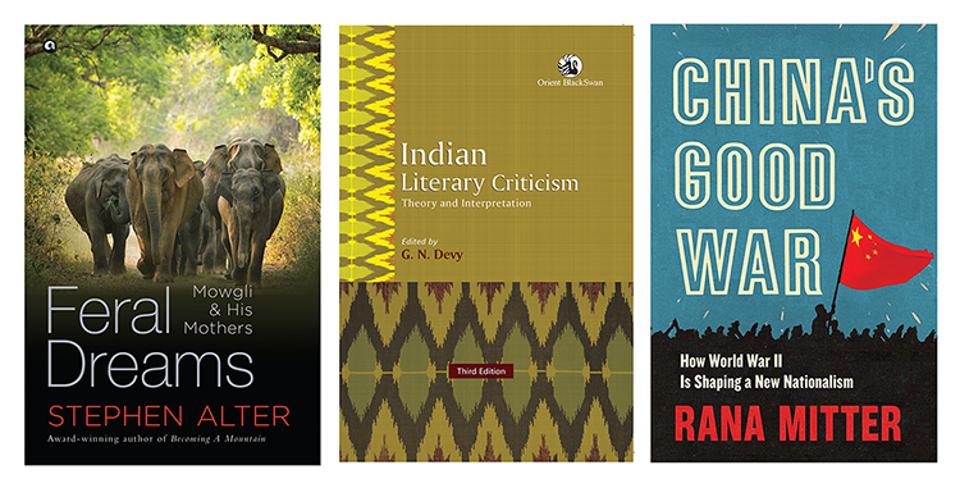
More than a century after it was first published, Rudyard Kipling’s The Jungle Book remains one of the world’s favourite collections of stories. Mowgli, the human child brought up by wild animals, has imprinted himself on the minds of readers as one of the most-loved literary characters of all time. In this fascinating novel, award-winning author Stephen Alter takes Mowgli’s story forward in time, transposing the classic jungle tale into unexplored terrain where animated movies and other adaptations have never gone before.
Here, we see Mowgli being raised by an elephant matriarch, leader of a herd that lives in a wildlife sanctuary that he calls home. After a series of adventures, the story shifts to the discovery of the boy deep in the jungle by forest rangers. The rescued child is delivered to an orphanage run by an American missionary, Mrs Cranston, in a dusty village on the Gangetic plain. Christened Daniel, the boy grows up, rebelling against the restraints of civilization, yearning for the forests he was taken from, and ultimately settling into an alien, discontented life as an adult.
Set against the backdrop of a newly independent India, and amongst a host of brilliantly imagined characters, Feral Dreams: Mowgli and His Mothers is at once a heartbreaking story of identity, love, and belonging, as it is an exquisite ode to the fast vanishing, beautiful, and sometimes menacing jungles of India.*
A radical reassessment of collective memory
Chinese leaders once tried to suppress memories of their nation’s brutal experience during World War II. Now they celebrate the ‘victory’ — a key foundation of China’s rising nationalism.
For most of its history, the People’s Republic of China limited public discussion of the war against Japan. It was an experience of victimization — and one that saw Mao Zedong and Chiang Kai-shek fighting for the same goals. But now, as China grows more powerful, the meaning of the war is changing. Rana Mitter argues that China’s reassessment of the World War II years is central to its newfound confidence abroad and to mounting nationalism at home.
China’s Good War begins with the academics who shepherded the once-taboo subject into wider discourse. Encouraged by reforms under Deng Xiaoping, they researched the Guomindang war effort, collaboration with the Japanese, and China’s role in forming the post-1945 global order. But interest in the war would not stay confined to scholarly journals. Today public sites of memory — including museums, movies and television shows, street art, popular writing, and social media — define the war as a founding myth for an ascendant China. Wartime China emerges as victor rather than victim.
The shifting story has nurtured a number of new views. One rehabilitates Chiang Kai-shek’s war efforts, minimizing the bloody conflicts between him and Mao and aiming to heal the wounds of the Cultural Revolution. Another narrative positions Beijing as creator and protector of the international order that emerged from the war — an order, China argues, under threat today largely from the United States. China’s radical reassessment of its collective memory of the war has created a new foundation for a people destined to shape the world.*
Key concepts in the Indian tradition of literary theory
Indian Literary Criticism: Theory and Interpretation is a collection of essays by various scholars; the book traces out the Indian tradition of literary criticism. Students of Indian literature need to have access to India’s critical tradition. This volume provides teachers, students, and scholars-in-the-making access to some of the key concepts and ideas in the Indian tradition of literary theory. It contains essays from Abhinavagupta, Dandin, Kuntaka, Jnanesvara, Khusrau, Ghalib, Tagore, Aurobindo as well as contemporary critics like Mardhekar, Matilal, Krishnamoorthy and Patankar. In doing so it brings together in one volume some of the most significant literary thinkers in the Indian tradition of the last two thousand years.*
*All copy from press releases


