Life and Legacy of Vivekananda
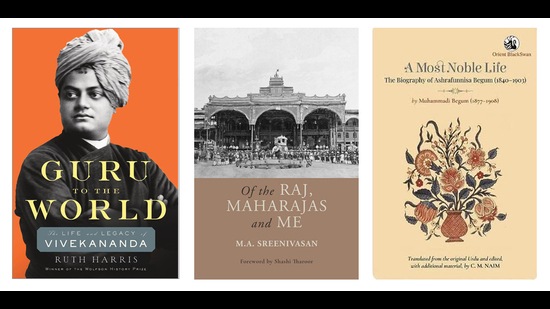
Few thinkers have had so enduring an impact on both Eastern and Western life as Swami Vivekananda, the Indian monk who inspired the likes of Freud, Gandhi, and Tagore. Blending science, religion, and politics, Vivekananda introduced Westerners to yoga and the universalist school of Hinduism called Vedanta. His teachings fostered a more tolerant form of mainstream spirituality in Europe and North America and forever changed the Western relationship to meditation and spirituality.
Guru to the World traces Vivekananda’s transformation from son of a Calcutta-based attorney into saffron-robed ascetic. At the 1893 World Parliament of Religions in Chicago, he fascinated audiences with teachings from Hinduism, Western esoteric spirituality, physics, and the sciences of the mind, in the process advocating a more inclusive conception of religion and expounding the evils of colonialism. Vivekananda won many disciples, most prominently the Irish activist Margaret Noble, who disseminated his ideas in the face of much disdain for the wisdom of a “subject race.” At home, he challenged the notion that religion was antithetical to nationalist goals.*
A portrait of India during the British Raj
MA Sreenivasan (1897-1998) lived through almost the entire 20th century, and was among the very few people who witnessed at close quarters the enormous changes that took place in India during this period. Born in Madras, he belonged to a family that were Pradhans (ministers) of successive kings of Mysore for 150 years. Sreenivasan himself joined the Mysore Civil Service in 1918 and, after a varied career both with the Mysore Government and the Government of British India, became a Pradhan of the Maharaja of Mysore in 1943. In 1947 he was invited by the Maharaja of Gwalior to become the Dewan of that State. During that momentous year, he was a member of the Constituent Assembly of India and in regular touch with many of the leading figures (including Mountbatten) involved in the transfer of power from British to Indian hands.
Much more than an autobiography, Of the Raj, Maharajas and Me is also a rare portrait of India during and immediately after the British Raj. The former princely states of India have been neglected by scholars, many of whom have tended to be unfairly critical. There is much in this book on the effectiveness of administration in two major princely states, which redresses the balance and makes the book a valuable document on the subject. Further, Sreenivasan provides sharp insights on the negotiations that led to the end of the Raj, and on the new polity that emerged after Independence. This absorbing book will be of particular interest to students and scholars of modern Indian history.*
{{/usCountry}}Much more than an autobiography, Of the Raj, Maharajas and Me is also a rare portrait of India during and immediately after the British Raj. The former princely states of India have been neglected by scholars, many of whom have tended to be unfairly critical. There is much in this book on the effectiveness of administration in two major princely states, which redresses the balance and makes the book a valuable document on the subject. Further, Sreenivasan provides sharp insights on the negotiations that led to the end of the Raj, and on the new polity that emerged after Independence. This absorbing book will be of particular interest to students and scholars of modern Indian history.*
{{/usCountry}}The Biography of Ashrafunnisa Begum
A Most Noble Life is the extraordinary story of Ashrafunnisa Begum, who was born in an obscure village in Bijnor, Uttar Pradesh, taught herself to read and write, in secret, against the wishes of her elders and prevailing norms, and went on to teach and inspire generations of young girls at the Victoria Girls’ School — the first school for girls in Lahore. Her unusual life was written about with great poignancy by Muhammadi Begum — the first woman to edit a journal in Urdu, and a prolific writer of fiction and poetry for adults and children, and instructional books for women during her brief life. She aptly titled the biography Hayat-e Ashraf: it echoes the name of her subject, but also means “the noblest life”.
The two women, who met by chance at a wedding, instantly developed a strong mutual affinity, which grew into a lifelong bond. In Ashrafunnisa Begum, Muhammadi Begum saw not only the mother she had lost as a child, but also an inspiring role model who had led a principled life of her own making, and shown amazing grace and strength against grave odds.
This is the first complete English translation of Hayat-e Ashraf (1904). The translator, a long time scholar of Urdu literature and culture, also provides the first detailed study of the life and works of its author, Muhammadi Begum, and highlights, in the afterword, two key social issues of the time, women’s literacy and widow remarriage, which remain as relevant today.
An absorbing narrative, observant, witty and poignant, lovingly translated and annotated by CM Naim, it affords us precious and candid glimpses of ordinary Muslim women in the nineteenth century who, unknown to themselves, led less than ordinary lives.*
*All copy from book flap.