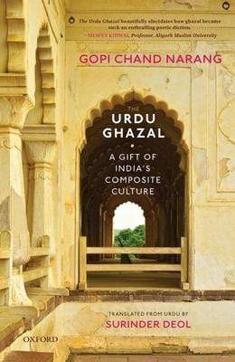
Your book The Urdu Ghazal: A Gift of India’s Composite Culture (Oxford Books, 2020) has been translated from Urdu by Surinder Deol. The ghazal and Ghalib have been at the core of your life’s work. Tell us about your early association with both.
I was born in the small town of Dukki in Balochistan, which is on the border between Pakistan and Afghanistan. I fondly remember the intellectually nurturing influence of my father, Dharam Chand Narang, who was a scholar of Sanskrit and Persian. The language that was spoken at home was Saraiki, which is a beautiful mix of Indic and Western Punjabi. It is a very soft language for one’s ears. My father was passionate about literature, and he actively encouraged me to be a serious reader. As a result, I devoured writings by authors like Ratan Nath Sarshar, the poetry of Ghalib, Iqbal, and other great Urdu poets, in addition to serious works of theology, Bhakti, and Sufism by authors like Dr Radhakrishanan and Dr Syed Abid Husain at a very young age.
At Partition, I was lucky that I was able to migrate to India in a Red Cross plane along with my elder brother in the midst of the Quetta holocaust of 1947. The rest of the family arrived later. I learned to live on my own in the alien city of Delhi and I enrolled myself in Dilli College to continue my studies. I received my BA degree in 1950 and a Master’s in Urdu four years later. My father did not join the rest of the family until his retirement from the revenue service in 1956. I was happy that I had made great academic progress in very difficult circumstances but, at the same time, my father was not happy that I had chosen Urdu as the field of study instead of mathematics, physics or chemistry that could make me an engineer or a scientist. But, for me, the pursuit of my heart’s passion was more important than gaining a professional position in life. That is why I have never regretted my decision to become a student and a champion of the Urdu language. It was clear to me that I wanted to follow my “bliss,” which I had found in Urdu and, later in my life, in the broader field of linguistics and cultural studies.
You write in the preface to The Urdu Ghazal that Urdu’s cross-cultural appeal, its indigenous sensibility, its rich and varied heritage and its challenging mystique made you fall in love with it when you migrated after Partition. Tell us about the cultural atmosphere of Delhi with regard to Urdu language then, especially in the light of your association with some of the brightest minds of the time, like Professor Ale Ahmad Suroor, Sajjad Zaheer and Malik Ram.
When I entered Delhi University in 1952 for my Master’s degree in Urdu, the classes were held in the historic Dilli College (Now known as Zakir Husain College) located in the vicinity of Ajmeri Gate. This is the same college where Mirza Ghalib was once offered professorship. The alumni of this college included Urdu’s great writers and poets such as Imam Bakhsh Sehbai, Mohammad Husain Azad, Maulana Hali, Nazir Ahmed, Zaka Ullah and many more. Partition had created a great vacuum. This was not the Dilli that everyone knew. Although there were new students who were enrolling in different programmes, I was the only student in the Urdu post-graduate studies. Everything had changed. There was a time before the Partition when Baba-e Urdu Maulvi Abdul Haq used to come here for teaching Sabras by Wajhi, a Dakhini prose masterpiece. In the riots preceding the Partition, the office of AnjumanTarraqqi Urdu in Daryaganj, where the esteemed Maulvi was secretary, had been reduced to ashes. Some half-burnt Urdu books of the Anjuman were available on the pavements of the nearby Urdu Bazar, which I bought for keeps. Ibadat Barelvi, who was popular among the Progressives, had also left Dilli and gone to Lahore and joined the Oriental College there. Among the old hands, only Khwaja Ahmed Faruqi was still there, and he lived in a little shack next to the historic Ghaziuddin madrasa adjoining the college building.
Interestingly for me, Khwaja Sahib was writing a book on Mir. During those days, Urdu text for printing was handwritten, and he assigned me the responsibility of proofreading the calligraphed text on chemically treated yellow sheets. I came to know great Urdu scholars like Maulana Imtiaz Ali Arshi, Qazi Abdul Wudood, Najeeb Ashraf Nadvi, Sajjad Zaheer, Syed Abid Husain, Professor Ale Ahmad Suroor and Malik Ram, and many others during my academic life. These were exceptional people who were fully committed to their scholarly pursuits. I met Sajjad Zaheer when he returned from Pakistan after imprisonment following the Rawalpindi Conspiracy case. All these people had a great love for the country, its democratic institutions, and the values of secularism.
The Urdu ghazal has come a long way — from the hybrid proto-model of Amir Khusrau in the 14th century to the works of Dakhini poets in the 16th and 17th century to stalwarts such Ghalib, Mir and Momin, Zafar and Daagh in the 18th and 19th centuries to the Moderns like Faiz, Josh and Firaq and many others, and, finally, contemporary poets like Gulzar and Javed Akhtar. The centuries saw the ghazal emerge from the shadow of Sufism to become the medium for the expressions of love, longing and revolution. Please outline for us some changes in form and thematic concerns across the centuries.
There are two kinds of poetry in Urdu. First, there is narrative poetry that takes the form of qasida, marsia, and masnavi. The narrative is used to describe something real or historic, an event, or a person. There is a rich tradition of marsia and masnavi writing going back to some of the early poets like Mir, Sauda, Anis, Dabeer, Nasikh, and Mir Hasan. The second form of poetry is suggestive, and the ghazal is the prime example of this form. The ghazal is all about the continuous tension between love, beauty, and the poet’s imagination. Each couplet is a poem within a poem. The poet often tells a compressed imaginative narrative that is both existential and universal in as few words as possible. There is imagery that is created with the liberal use of metaphors and similes which run through a chain of denotations and connotations. But as the kernel is love, the heart of the ghazal is its musicality. It is the very soul of a ghazal. The journey of the ghazal has been long, and we see clear patterns of its evolution. In the early Dakan poetry, the emphasis was solely on the beloved’s beauty and charm. But as we come to Mir and Dabistan-e Delhi, the themes that poets embraced had changed. It was not only love and the tribulations faced by the lovers, the ghazal had become a mirror of socio-political events that were taking place, such as the devastation of Delhi by invaders like Nadir Shah and Ahmed Shah Abdali. The political uncertainties of life in Delhi were also the main reason that several leading poets migrated to Lucknow and consequently, embraced themes popular with local poets, like the simple pleasures of life.
Delhi regained its lost literary stature in the early decades of the nineteenth century with poets like Ghalib, Zauq, Momin, and Shefta taking centre stage. These poets revived some old themes of classical Urdu poetry, but this period of the flowering of Urdu verse was short-lived and ended with the events of 1857 followed shortly after by the death of Ghalib. The second half of the century was really hard for the ghazal because the British, the new rulers, saw no merit in verse that made people lazy in their assessment. It was left to Hali, who had relocated himself to Lahore along with Mohammad Husain Azad, to keep the flame of the ghazal burning in the face of very tough wafts of opposition. As we entered the twentieth century, many of the old names like Hali, Daagh, and Shibli disappeared from the scene, but fortunately, their place was taken up by very talented poets like Hasrat Mohani, Akbar Allahabadi, Allama Iqbal, and the poets of the Progressive Writers’ Movement, with Faiz in the lead for his most innovative nazms and ghazals. Overall, the last century saw the ghazal rise to pristine heights in terms of the variety of themes and its appeal to millions of people, many of whom could not read Urdu but enjoyed ghazals in the voices of several talented and melodious singers. Radio, TV, and other forms of electronic media have also helped the ghazal in achieving great popularity.
The Urdu ghazal has come a long way — from the hybrid proto-model of Amir Khusrau in the 14th century to the works of Dakhini poets in the 16th and 17th century to stalwarts such Ghalib, Mir and Momin, Zafar and Daagh in the 18th and 19th centuries to the Moderns like Faiz, Josh and Firaq and many others, and, finally, contemporary poets like Gulzar and Javed Akhtar. The centuries saw the ghazal emerge from the shadow of Sufism to become the medium for the expressions of love, longing and revolution. Please outline for us some changes in form and thematic concerns across the centuries.
There are two kinds of poetry in Urdu. First, there is narrative poetry that takes the form of qasida, marsia, and masnavi. The narrative is used to describe something real or historic, an event, or a person. There is a rich tradition of marsia and masnavi writing going back to some of the early poets like Mir, Sauda, Anis, Dabeer, Nasikh, and Mir Hasan. The second form of poetry is suggestive, and the ghazal is the prime example of this form. The ghazal is all about the continuous tension between love, beauty, and the poet’s imagination. Each couplet is a poem within a poem. The poet often tells a compressed imaginative narrative that is both existential and universal in as few words as possible. There is imagery that is created with the liberal use of metaphors and similes which run through a chain of denotations and connotations. But as the kernel is love, the heart of the ghazal is its musicality. It is the very soul of a ghazal. The journey of the ghazal has been long, and we see clear patterns of its evolution. In the early Dakan poetry, the emphasis was solely on the beloved’s beauty and charm. But as we come to Mir and Dabistan-e Delhi, the themes that poets embraced had changed. It was not only love and the tribulations faced by the lovers, the ghazal had become a mirror of socio-political events that were taking place, such as the devastation of Delhi by invaders like Nadir Shah and Ahmed Shah Abdali. The political uncertainties of life in Delhi were also the main reason that several leading poets migrated to Lucknow and consequently, embraced themes popular with local poets, like the simple pleasures of life.
Delhi regained its lost literary stature in the early decades of the nineteenth century with poets like Ghalib, Zauq, Momin, and Shefta taking centre stage. These poets revived some old themes of classical Urdu poetry, but this period of the flowering of Urdu verse was short-lived and ended with the events of 1857 followed shortly after by the death of Ghalib. The second half of the century was really hard for the ghazal because the British, the new rulers, saw no merit in verse that made people lazy in their assessment. It was left to Hali, who had relocated himself to Lahore along with Mohammad Husain Azad, to keep the flame of the ghazal burning in the face of very tough wafts of opposition. As we entered the twentieth century, many of the old names like Hali, Daagh, and Shibli disappeared from the scene, but fortunately, their place was taken up by very talented poets like Hasrat Mohani, Akbar Allahabadi, Allama Iqbal, and the poets of the Progressive Writers’ Movement, with Faiz in the lead for his most innovative nazms and ghazals. Overall, the last century saw the ghazal rise to pristine heights in terms of the variety of themes and its appeal to millions of people, many of whom could not read Urdu but enjoyed ghazals in the voices of several talented and melodious singers. Radio, TV, and other forms of electronic media have also helped the ghazal in achieving great popularity.
Ghalib and Mir could be credited with changing the shape of the Urdu ghazal, leaving their permanent imprint on its history. How do you compare the two and in what ways do you see them changing the form of the ghazal forever?
I don’t think we should compare these two great poets by listing their distinctive gifts. Mir came from Agra. He was well-versed in the language that was spoken in the Agra-Akbarabad region. Therefore, we find simplicity in Mir’s verse that is incomparable in terms of its beauty, musicality, and free flow of meaning. He did not embrace Faarsiyat (domination of Persian ghazal styles) and continued to write in the peoples’ language. Ghalib, on the other hand, aspired to be recognised as a Persian poet, and as a result, his Urdu verse is filled with Persian phrases which are sometimes hard to understand. Mirza was also a master in the use of izafat (a feature of Urdu orthography to combine two words), one izafat after another in a single line, following Bedil, his mentor, and some Persian poets. Both Mir and Ghalib changed the ghazal form. Mir perfected rekhta as its master poet and established the poetics by showing how a poet could create great complexity by using simple language. Ghalib revealed the depths that the ghazal could reach and how it could become a tool for paradoxical ingenuity and philosophical reflection. While maintaining the classical mode, he revolutionised it from within. He opened paths that led to the embrace of modernistic values like freedom and secularism. After him, Urdu poetry has not been the same.
Ghalib continues to tower over Urdu poetry. What do you think makes his poetry relevant for all time?
Understanding Ghalib, it is said, is a journey to the unknown. Hali mentioned two main aspects of Ghalib’s poetry: depth of thought, and innovative freshness of subjects. I agree with that assessment. To this, I would add another thing, which I discussed at some length in my book. It is the dialectical or paradoxical spin of negative dialectics, which is key to Ghalib’s unique creativeness. It is through the use of open-ended negative dialectics, and we can connect his ideas with archetypal traces of ancient texts of India like the Upanishads and Buddhist philosophy. Although he was a philosopher poet, he stayed away from topics relating to spiritual deliverance like ma’refat (God-realisation) or jnana (knowledge). His main concern was the mystery of being, the human condition, the wishes and yearnings of the people, and everyday life’s paradoxes. Just like Buddhists use shunyata to examine all truths, Ghalib looks at things while rejecting all givens, preconceived notions, showing everything is paradoxical, that existence, and non-existence is a single organic whole. These are the things that we do not find in any other Urdu poet. I have called Ghalib the last of the classicists and the first of the modernists. That is part of his iconoclastic legacy rooted in freedom and love, which is at the heart of his relevance today. When democracy is under attack in many parts and the values of secularism and tolerance are being flouted, Ghalib’s verse is relevant at this very moment and it will remain so in the future.
At a time when the Urdu language is being linked to a particular religion, just as it happened during the Partition, what future do you see for it, and for the ghazal?
Urdu has been maligned repeatedly, especially after the Partition. But are not 70 years enough to finish off a language? Urdu is surviving, and rather I should say it is thriving. Why? Languages do not obey agendas; they grow or shrink or die only by their inner genius. Urdu’s script, of course, was dealt a blow when Urdu was denied its democratic place in the three language formula, but Urdu’s genius has found other avenues to survive. Urdu is close to being the soul of the lingua franca of India. It cannot be wished away. It is a valuable part of our rainbow-like heritage.
Nawaid Anjum is a Delhi-based freelance feature writer, translator and poet.