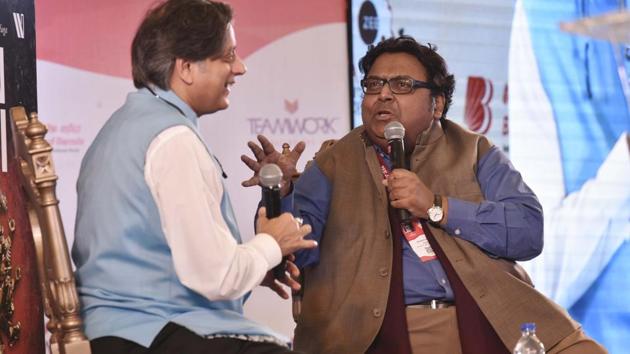
“This has been the most difficult book to write. The reason being I am not a scientist; I don’t have a background in physics. I have realised that there is a huge overlap between what the sages were telling us through the Vedanta and the Upanishads and what quantum physicists are telling us now. So, the aim was to find the merging, the meeting ground between these two,” Ashwin Sanghi said after the release of his new book Keepers of the Kaalachakra, at the Jaipur Literature festival.
For Jaipur Literature Festival full coverage, click here
Exclusive: Ashwin Sanghi in conversation with Poulomi Banerjee from #HT on the writer’s new book Keepers of the Kaalchakra at the Jaipur Literature Festival
After The Rosabal Line, Chanakya’s Chant, The Krishna Key and The Sialkot Saga, this is Sanghi’s fifth book in what he calls Bharat series. “The Kaalchakra is the wheel of time. But if you look at the symbolic representations of the Kaalchakra, it represents your mind, your body, your consciousness, all encapsulated within the universe, where you are not separate from the universe, but are merely an infinitesimal portion of the entire whole. The aim was to bring across that fundamental notion of oneness through the Kaalchakra. Of course, it is in the form of a fast-paced, thrilling read,” he said. All five books are rooted in an Indian ethos; in its culture, mythology, history and religion.
How difficult is it to write such books at a time when Indian society is growing increasingly sensitive about representations of its history and culture? “It is a fine line. But one has to observe two-three things, what I call the golden rule. Whenever you are writing something that involves someone’s faith, it is important to approach the subject with respect. Secondly, you owe it to your readers to do a lot of research, so even when you are making some comments, you are as close to reality as possible.”
{{/usCountry}}How difficult is it to write such books at a time when Indian society is growing increasingly sensitive about representations of its history and culture? “It is a fine line. But one has to observe two-three things, what I call the golden rule. Whenever you are writing something that involves someone’s faith, it is important to approach the subject with respect. Secondly, you owe it to your readers to do a lot of research, so even when you are making some comments, you are as close to reality as possible.”
{{/usCountry}}Sanghi takes about two years to research and then write each of his books, and provides a list of additional reading material at the end. This helps readers delve deeper into the subject and follow his works.
The Bharat series is not the only thing he is working on. His self help books include 13 Steps to Bloody Good Luck and he has co-authored two books with James Patterson, Private India and Private Delhi. But the Bharat series is his favourite. “I enjoy the Bharat series the most because it allows me to be involved in a subject for two years,” he says.
Follow @htlifeandstyle for more