
 E-Paper



Michael Hofmann: “Nothing is forever”
At the Kerala Literature Festival, the poet, critic and translator of the International Booker Prize winning novel, ‘Kairos’ by Jenny Erpenbeck, spoke about translating from German to English for the last four decades, his relationship with the authors he translates, and his views about the future

 Prefer HTon Google


What were the aesthetic, political and emotional reasons that made you translate Jenny Erpenbeck’s novel Kairos from German to English?
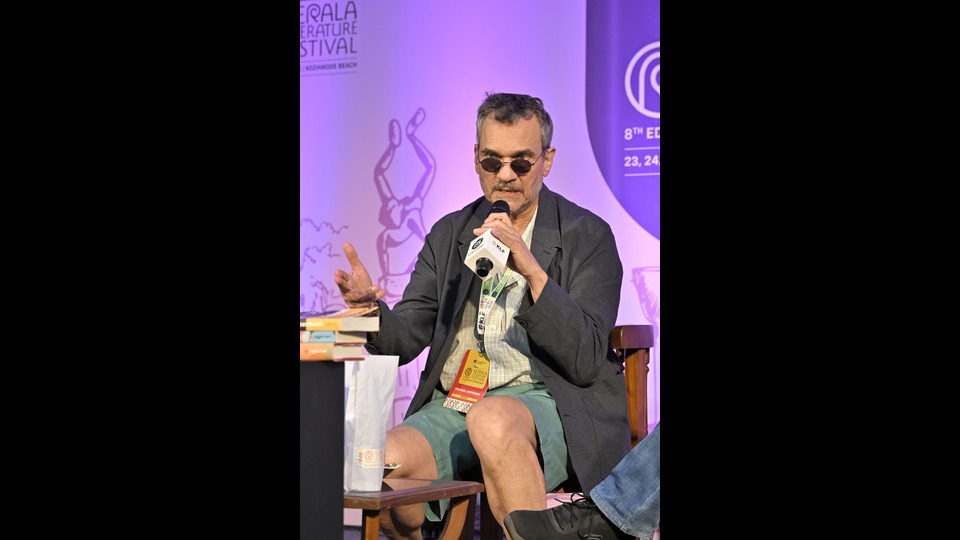
I was asked for by the author. That counts for a lot, at least with me. If someone knows enough to ask for me, then I will be disposed to try and give them my work. Trust is definitely part of it. Also, I see part of my work as a translator as informing on Germany.
Germany has changed a lot over the last 40 years. It will change again, of course, but what I mean is that it has become stabler and more comfortable in the world than it was 40 years ago. I never thought it would be. It is important to tell Germans this. For a long time, our world could be divided into East and West Germany like North and South Korea.
There are scenes, junctures and fissures in the world that we come to terms with, especially through books that address those divides. Translating books for the English and the Americans is to let them see how other people live, what other people think about, what other people’s history is. I hope a book like Kairos can help them see what happens when a country is divided, and how a system like democracy that people thought was here forever happens to go away. Things exist for a time; nothing is forever. And history is quite unpredictable.

To what extent have your life experiences changed the way that you translate?
I think it was always important to me that I was a poet first, then a reviewer, and a translator after that. When Jenny and I talked about the book, I said to her, “With me, you don’t just get a translator. You get the critic and poet thrown in.” That has been the package for 40 years. I started translating back in 1985, and I have translated 90-odd books since.
I like to think that I am my father’s son. My father (Gert Hofmann) was a German novelist and university teacher. We are literary people. I was that when I was 25, and I will be that as long as I live. In fact, words have always meant probably far too much to me even as far back as the time when I was 15. I guess all I am saying is that consistency is important to me.
Well, I have become very experienced. I have translated things that I’ve long wanted to translate. I’ve also translated things I’ve not wanted to translate (laughs). Translation is what I do. It has become part of my inner geography. When things present themselves to me in German, they move into English. I take bunches of German words and turn them into English. I have given my life to that. And that’s one way of getting through life.
Kairos is the first German novel to win the International Booker Prize. How does it feel to be responsible for this landmark moment for German literature?
It feels very good. I am delighted. I think that Jenny is a great author, and people will look forward to her work in the years to come. When the Berlin Wall came down in 1989, some of the early ‘Wall’ novels came out a year or two after the event. Back then, I said that it would take at least 20 years for a great book about the Wall to come out. This is it.
This book has come out a time when the #MeToo movement has led to a lot of debate around consent in relationships where there is a huge age gap. Katharina is 19, Hans is over 50 years old. To what extent did those conversations inform the way you translated? Also, since the author you were translating is a woman, did you consider ideas like ‘male gaze’ and ‘female gaze’?
It seems to me that they Katharina and Hans enter the relationship with full awareness and equal desire on both sides. Hans, of course, is much older, married, and has affairs. None of that really matters though. Katharina loves him for that, not in spite of that.
I think that the #MeToo thing is temporary. People love other people for all kinds of reasons, and in spite of all sorts of reasons. I think this book will outlast anything like that. I mean, had it been a book by a man, and had it been prurient or boastful or something, I might have had trouble with it. But I did very much like the fact that this book is written by a woman. This might sound stupid but I love reading women novelists who write about relationships.
Both figures — Katharina and Hans — are central to the novel. You see through Katharina’s eyes and Hans’s eyes. I think Jenny has managed that exceptionally well. If there are readers who want to be offended by the book, they can be, but that’s not a sensible way of reading it.
Since you and Jenny have been invited to many literature festivals after the International Booker Prize, has the author-translator relationship blossomed into friendship? Does getting to know the writer make you look at their work in a new way?
Jenny and I did not know each other before I was approached to translate Kairos. She came to visit after I read the book and confirmed that I really liked it and very much wanted to translate it. She came from Berlin to Lower Saxony, where my wife and I live. She stayed for a day. We enjoyed meeting each other. We have done a lot of events together. My wife and I have also visited Jenny and her husband in Berlin. The four of us are good friends now, and it is great to be in India together for the Kerala Literature Festival. I will be happy to read anything that Jenny writes in future. If she wants me to translate it, I’ll try and do it.
Translators often talk about being underpaid. Having been in this profession for four decades, do you notice any changes in the way publishers treat translators?
I suppose I earn more money than I did. People know who I am, and they want to pay me for what they think my work is worth. I often feel that, because I write for the London Review of Books and The New York Review of Books, I have a certain celebrity or notoriety as a literary person. If I translate something, it gets noticed. In addition to people in the business, my name is also something that a reader can trust. It comes with a standard and expectations.
As someone who enjoys this fame as a translator, would you like to translate writers from underrepresented groups like LGBTQ people, religious minorities and refugees who write in German to help bring more visibility to their work?
Yes, everything you have said has an almost automatic appeal to me. I love all kinds of writing. If a fantastic book by such writers comes along, I would be proud to translate it.
You divide your time between Germany and USA. What courses do you teach in the Department of English at Florida University?
I teach a poetry workshop and a creative non-fiction class. I love teaching East European writing, especially Polish literature. Zbigniew Herbert is my favourite poet.
With Donald Trump becoming the new President, how do you feel about returning to Florida? Do you anticipate any changes in the way you’ll get to design your curriculum and teach, and the classroom atmosphere you’ll be allowed to create?
Well, I tend to teach small groups of people in small rooms with books. It is very old-fashioned and it has nothing to do with artificial intelligence. Actually, there is hardly any money in it. I mean, it is imperilled. I have the most incredible fears for America’s future, and the future of the rest of the world, especially because of how closely connected we all are.
Chintan Girish Modi is a journalist, educator and literary critic. He can be reached @chintanwriting on Instagram and X.


