A literary event held on a pleasantly chilly November afternoon in Delhi promises to change publishing in India. A newly-formed collaborative brand of independent book publishers from across the country, India Independent Books and Ideas, organised ‘The Independents @ CR Park’. Comprising publishers such as Speaking Tiger, Tulika Books, Women Unlimited and LeftWord Books, to name a few, this collective enterprise intends to co-foster a literary ecosystem that supports independent publishers and booksellers alike.
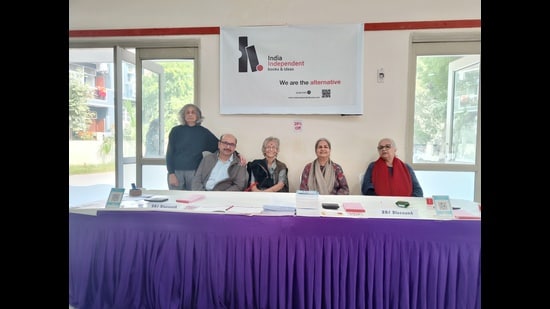
Ritu Menon, feminist publisher, writer and
A literary event held on a pleasantly chilly November afternoon in Delhi promises to change publishing in India. A newly-formed collaborative brand of independent book publishers from across the country, India Independent Books and Ideas, organised ‘The Independents @ CR Park’. Comprising publishers such as Speaking Tiger, Tulika Books, Women Unlimited and LeftWord Books, to name a few, this collective enterprise intends to co-foster a literary ecosystem that supports independent publishers and booksellers alike.
Ritu Menon, feminist publisher, writer and founder of Women Unlimited, said the idea was born out of a conversation that took place at the SSAF Kasauli Art Project in July this year. Indie publishers, who were a part of the event held in the scenic Kasauli hills, had wondered why independent publishers couldn’t come together under a single entity. And just like that the seeds were sown for the private limited company, Books and Ideas Publishing, from which sprang the brand ‘India Independent Books and Ideas’. Menon highlights that “the ‘independence’ is a very important part of what we do. Independent of corporations, of institutions, and of governments. We don’t affiliate with any of them”.
Menon, along with Indira Chandrasekhar of Tulika Books, elaborates on the collective’s larger vision, which includes events such as outreach initiatives to tier two cities that lack access to bookstores. They also intend to develop an online platform that will brings together independent booksellers from different parts of the country in a bid to counter the Amazonification of book distribution. The key word, as Menon and Chandrasekhar reiterate, is ‘bibliodiversity’: “How can we ensure that we remain bibliodiverse, that we remain plural, that we encourage critical thinking, that we are progressive, that we are secular?” These are some of the key questions driving this alliance that aims to overcome corporate monopolisation and the homogenisation of literary output in the country. The Delhi event, that took place on November 15 and 16, included talks, conversations and Q’n’A sessions with authors associated with these presses. There was an engaging session with Ruchika Sharma on mythology and a no-holds-barred conversation with writer and journalist Paranjoy Guha Thakurta, where topics ranged from the lawsuits against him to the recently concluded Bihar elections and its implications for Indian democracy.
The sessions, held at the Purbosree Mahila Samity, took place alongside a book sale where the latest literary works from the participating independent publishing houses were available along with their bestselling titles at discounted rates. Radhika Menon, publisher, Tulika Books for children, said that their catalogue included books for younger readers in nine different languages. About the collaboration she says, “when we come together, we learn from each other’s experiences, even if it’s in very different fields.” Two imprints run by Mandira Sen, Stree and Samya, were also a part of the initiative. Sen believes editorial support is one of the major reasons that authors make a conscious choice to publish with independent houses. The gender studies scholars who choose Stree or Samya for their rigorously researched works, “know how important it is for women’s voices to be projected in a certain way”. “When they go to a big multinational, maybe the marketing is very superior. But then they’re one of a crowd,” she says. The curated literary experience was a part of the collective’s larger vision and posters announcing ‘We are the Alternative’ adorned the venue.
While literary festivals in India have garnered the support of sponsors including corporate entities and government enterprises, India Independent Books and Ideas stands apart with its objective of enabling and strengthening a literary ecosystem that encourages a diversity of voices. In a late-stage capitalist world where ambient content reigns supreme, an intentional endeavour such as this one is a ray of hope for the country’s readers and authors alike.
India Independent Books and Ideas is on Instagram: india_independent_
Simar Bhasin is a literary critic and research scholar who lives in Delhi. Her essay ‘A Qissa of Resistance: Desire and Dissent in Selma Dabbagh’s Short Fiction’ was awarded ‘Highly Commended’ by the Wasafiri Essay Prize 2024.
One Subscription.
Get 360° coverage—from daily headlines
to 100 year archives.
Archives
HT App & Website