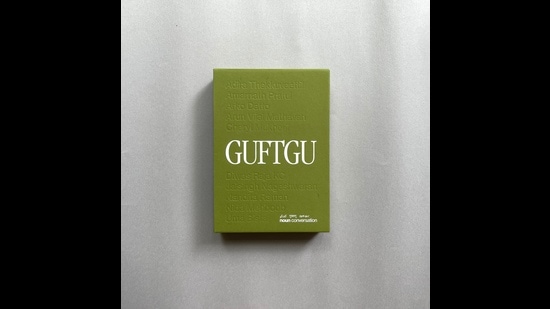
“Guftgu,” in Urdu, refers to a conversation, a free-flowing exchange of thoughts and ideas that carry each other like friends. Offset Projects’ first book, Guftgu, a first-of-its-kind deconstructed photo book is exactly that. Offset Projects’ founder Anshika Varma, also the curator and editor of the book, brought together 10 lens-based artists and photographers from South Asia to begin a conversation through their works in this volume. Comprising 10 zines that become chapters in the volume, the emphasis is on form as much as it is on the narrative of the individual works. Photography is the language in Guftgu, meant to be deconstructed, misunderstood, contextualized and reinvented as an ever-changing medium that the artists employ to talk about social and political constructs in contemporary society.
Jaisingh Nageswaran’s The Land That Is No More is a personal, public and political commentary on isolation — by way of caste discrimination, land displacement and a certain idea of modernization that leaves marginalized communities far behind in its imagination of development. Mapping a portion of the journey that indigenous people affected by the Narmada Valley Development Project have undertaken, the photographs and text mirror the challenges they face through the gaze of a person displaced by the hands of power, in this case Nageswaran himself, as a Dalit in India. In Album As Method, Diwas Raja KC examines the visual semantics of performance in the family albums of three women very important to Nepal’s feminist movement. Nandita Raman’s They Live Where They Take Seed is a nuanced visual work about roots and identity, where photographs move through the pages and folds, much like Raman coming into her own. Nida Mehboob’s Ahmadis of Pakistan brings to light the discrimination against the community, including the criminalization of their religious practices in the country.
Anshika Varma uses the accordion fold beautifully to play with the form of a book in Arko Datto’s Dinos of Hindustan, where inconspicuous pointers on the pages lead you to find and physically move to the next image on a different page, letting the visual commentary on techno-fascism and the psychosomatic stress of captive animals, among others, come at the reader like political satire. Adira Thekkuveettil and Amarnath Praful, in Acts of Looking, talk to each other using text, images and design elements, while questioning the evolution of the medium and the location of the colonial gaze. In the end, each zine is an iteration of the fluidity of the medium, and wonderfully, yet it returns to form in the physical book.
{{/usCountry}}Anshika Varma uses the accordion fold beautifully to play with the form of a book in Arko Datto’s Dinos of Hindustan, where inconspicuous pointers on the pages lead you to find and physically move to the next image on a different page, letting the visual commentary on techno-fascism and the psychosomatic stress of captive animals, among others, come at the reader like political satire. Adira Thekkuveettil and Amarnath Praful, in Acts of Looking, talk to each other using text, images and design elements, while questioning the evolution of the medium and the location of the colonial gaze. In the end, each zine is an iteration of the fluidity of the medium, and wonderfully, yet it returns to form in the physical book.
{{/usCountry}}